
Which of the following Finite Automata, recognizes the language L={a,b}* ? A. M=({q0}, {a,b}, δ, q0, {q0}) where, δ is B. M=({q0,q1}, {a,b}, δ, q0, {q0,q1}) where, δ is C. M=({q0,q1}, {a,b}, δ, q0, {q0,q1}) where, δ is D. M=({q0,q1,q2 }, {a,b}, δ, q0, {q0}) where, δ isa b q0 {q0} {q0} a b q0 {q0,q1} {q0,q1} q1 {q1} {q1} a b q0 {q0,q1} {q0} q1 - {q1} a b q0 {q0} {q0} q1 {q2} - q2 {q0} {q2}
A, B, C and D
The language \(\{a,b\}^{*}\) contains every string over a and b, including the empty string. An automaton recognizes it exactly when its start state is accepting and, from it, some run stays in accepting states on every input symbol forever.
A — One state q0, start and accepting, looping to itself on a and b. Every string ends in q0, so all strings are accepted. Recognizes L.
B — From q0 both symbols lead to {q0, q1}; q1 loops on a and b; both states are accepting. Any run is in an accepting state after every symbol, and the empty string is accepted at q0. Recognizes L.
C — q0 on a goes to {q0, q1} and on b to {q0}; so q0 is reachable after every symbol on some run. Since q0 is accepting (and q0 is the start state, so ε is accepted), every string is accepted; q1 having no a-move does not matter. Recognizes L.
D — q0 is the start and only accepting state and loops to itself on a and b. States q1 and q2 are unreachable from q0, so they never affect acceptance; every string ends in q0. Recognizes L.
All four machines therefore accept exactly \(\{a,b\}^{*}\); any choice that omits C or D wrongly rejects an automaton that does recognize the language.
A, B, C and D option is correct.
Similar Questions
There are exactly __________ different finite automata with three states x, y and z over the alphabet {a, b} where x is always the start state.
The transition function for the language \(L = \{w \mid n_{a}(w)\) and \(n_{b}(w)\) are both odd\(\}\) is given by :
\(\delta(q_{0}, a) = q_{1}\) ; \(\delta(q_{0}, b) = q_{2}\)
\(\delta(q_{1}, a) = q_{0}\) ; \(\delta(q_{1}, b) = q_{3}\)
\(\delta(q_{2}, a) = q_{3}\) ; \(\delta(q_{2}, b) = q_{0}\)
\(\delta(q_{3}, a) = q_{2}\) ; \(\delta(q_{3}, b) = q_{1}\)
The initial and final states of the automata are :
Minimal deterministic finite automaton for the language \(L = \{0^{n} \mid n \geq 0, n \neq 4\}\) will have :
For the above specified passage, which of the following is DFA for the language represented/accepeted by machine?
For the above mentioned passage which of the following is correct?
Which of the following represented the minimum state DFA for the above specified passage?
Which of the following languages can be recognized by neither Non-Deterministic Finite Automata (NFA) nor Deterministic Finite Automata (DFA) ?
(A) L1 = {w ∈ {0, 1}* | the length of w is even}
(B) L2 = {w ∈ {0, 1}* | the length of w is odd}
(C) L3 = {w ∈ {0, 1}* | all 0′s come before all 1′s in w}
(D) L4 = {w ∈ {0, 1}* | w contains an equal number of 0′s and 1′s}
(E) L5 = {w ∈ {0, 1}* | all 1′s come before all 0′s in w}
Choose the correct answer from the options given below :
What is the minimum and maximum number of initial, dead, unreachable and final states in a valid ‘n’ state finite automaton, where the language accepted is not ‘φ’?
Let L be the language generated by regular expression 0*10* and accepted by the deterministic finite automata M, whose transition table is given below (start state a; final states c, d and e).
State 0 1 a b c b a d c e f d e f e e f f f f Consider the relation RM defined by M. As all states are reachable from the start state, RM has _____ equivalence classes.
Important Questions from Finite Automata
Consider the DFA given below
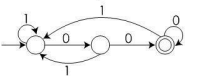
Which of the regular expressions given below represents the above DFA ?- Let $M$ be a nondeterministic finite automaton (NFA) with 6 states over a finite alphabet.
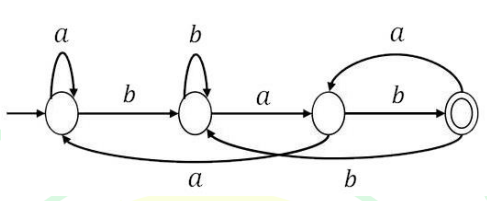
Which of the following options CANNOT be the number of states in the minimal deterministic finite automaton (DFA) that is equivalent to $M$ ? Consider the following deterministic finite automaton (DFA) defined over the alphabet, Σ = {𝑎, 𝑏}. Identify which of the following language(s) is/are accepted by the given DFA.
Consider a finite state machine (FSM) with one input 𝑋 and one output 𝑓, represented by the given state transition table. The minimum number of states required to realize this FSM is ________. (Answer in integer)
Present state Next state Output f X = 0 X = 1 X = 0 X = 1 A F B 0 0 B D C 0 0 C F E 0 0 D G A 1 0 E D C 0 0 F F B 1 1 G H 0 0 1 H G A 1 0 Consider the following DFA that generates set of strings over $\Sigma=\{a, b, c\}$
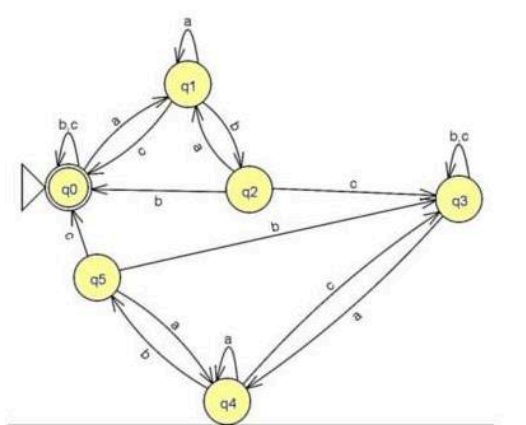
Now identify that which of the followings is the best description of the language for the above DFA



