
Which of the following options CANNOT be the number of states in the minimal deterministic finite automaton (DFA) that is equivalent to $M$ ?
NFA to Minimal DFA State Bound
The conversion from a Nondeterministic Finite Automaton (NFA) to an equivalent Deterministic Finite Automaton (DFA) is often done using the subset construction method.
For an NFA with $n$ states, the resulting DFA generated by the subset construction can have at most $2^n$ states. Each state in the DFA corresponds to a unique subset of the NFA's states.
Maximum States Calculation
Given an NFA ($M$) with $n=6$ states.
The theoretical upper limit on the number of states for the equivalent DFA, derived from the subset construction, is:
$ \text{Max DFA States} \le 2^n $
Plugging in $n=6$:
$ \text{Max DFA States} \le 2^6 = 64 $
This means the minimal DFA equivalent to the 6-state NFA cannot have more than 64 states.
Evaluating Options Against the Bound
We check which options exceed the calculated maximum of 64 states:
- Option 1 (32 states): Since $32 \le 64$, this is a possible number of states for the minimal DFA.
- Option 2 (65 states): Since $65 > 64$, this number of states is impossible for the minimal DFA.
- Option 3 (1 state): Since $1 \le 64$, this is a possible number of states (e.g., for trivial NFAs).
- Option 4 (128 states): Since $128 > 64$, this number of states is impossible for the minimal DFA.
Identifying Impossible State Counts
The options that represent a number of states greater than the maximum possible bound ($2^6 = 64$) are the ones that CANNOT be the number of states in the minimal DFA.
Therefore, the impossible numbers of states are 65 and 128.
Important Questions from Finite Automata
- Let $\Sigma = \{1,2,3,4\}$. For $x \in \Sigma^*$, let $prod(x)$ be the product of symbols in $x$ modulo 7. We take $prod(\epsilon) = 1$, where $\epsilon$ is the null string.
For example, $prod(124) = (1 \times 2 \times 4)$ mod 7 = 1.
Define $L = \{x \in \Sigma^* \mid prod(x) = 2\}$.
The number of states in a minimum state DFA for L is ____________ (Answer in integer) Consider the following two finite automata $D_1$ and $D_2$.
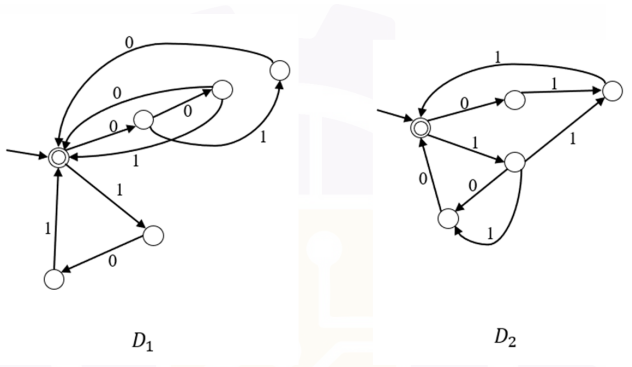
Which of the following statements is/are true?Consider the DFA given below
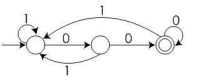
Which of the regular expressions given below represents the above DFA ?Consider the following deterministic finite automaton (DFA) defined over the alphabet, Σ = {𝑎, 𝑏}. Identify which of the following language(s) is/are accepted by the given DFA.
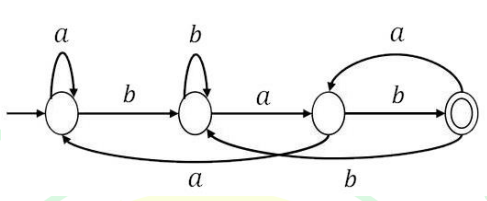
Consider a finite state machine (FSM) with one input 𝑋 and one output 𝑓, represented by the given state transition table. The minimum number of states required to realize this FSM is ________. (Answer in integer)
Present state Next state Output f X = 0 X = 1 X = 0 X = 1 A F B 0 0 B D C 0 0 C F E 0 0 D G A 1 0 E D C 0 0 F F B 1 1 G H 0 0 1 H G A 1 0


