
Consider the following two finite automata $D_1$ and $D_2$.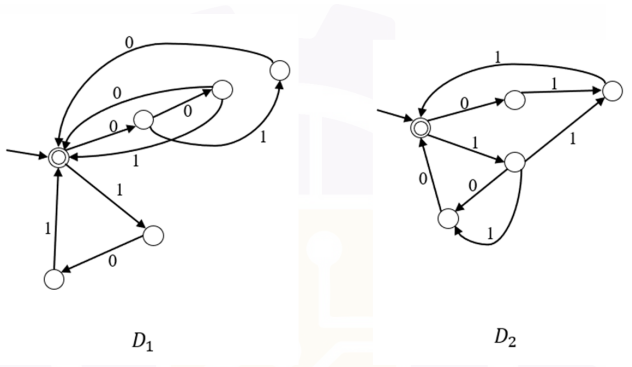
Which of the following statements is/are true?
To determine which statements are true about the finite automata \(D_1\) and \(D_2\), we first need to analyze the languages accepted by each automaton.
Step 1: Analyze \(D_1\) and \(D_2\)
Finite automata \(D_1\) and \(D_2\) are defined over the alphabet \(\{0, 1\}\). Each automaton transitions based on input characters. The task is to evaluate the operations and find out about:
- The equivalence of languages: \(L(D_1) = L(D_2)\)
- Subset relation: \(L(D_1) \subset L(D_2)\)
- Intersection: \(L(D_1) \cap L(D_2) = \{\epsilon\}\)
- Closure property: \((L(D_1) \cup L(D_2))^*\) resulting in strings whose length is divisible by 3
Step 2: Determine \(L(D_1)\) and \(L(D_2)\)
Without explicit transition details, determining the exact languages requires observation or given transition rules. Normally, this involves enumerating or deducing from patterns what each automaton accepts.
Step 3: Evaluate Statements
- \(L(D_1) = L(D_2)\): This would imply both automata accept exactly the same set of strings. The provided solution does not confirm this.
- \(L(D_1) \subset L(D_2)\): This would suggest that all strings accepted by \(D_1\) are also accepted by \(D_2\) but not vice versa. This is unconfirmed without specific analysis.
- \(L(D_1) \cap L(D_2) = \{\epsilon\}\): This states only the empty string \(\epsilon\) is in both languages, meaning they share no other common strings. This is marked as correct in the information given.
- \((L(D_1) \cup L(D_2))^*\) consists of all strings whose length is divisible by 3: This claims that the repeated union (closure) of both languages leads to strings with lengths divisible by 3. This also is marked as correct.
Conclusion:
- The correct statements are: \(L(D_1) \cap L(D_2) = \{\epsilon\}\) and \((L(D_1) \cup L(D_2))^*\) consists of all strings whose length is divisible by 3.
Important Questions from Finite Automata
- Let $\Sigma = \{1,2,3,4\}$. For $x \in \Sigma^*$, let $prod(x)$ be the product of symbols in $x$ modulo 7. We take $prod(\epsilon) = 1$, where $\epsilon$ is the null string.
For example, $prod(124) = (1 \times 2 \times 4)$ mod 7 = 1.
Define $L = \{x \in \Sigma^* \mid prod(x) = 2\}$.
The number of states in a minimum state DFA for L is ____________ (Answer in integer) Consider the DFA given below
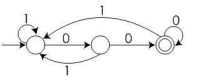
Which of the regular expressions given below represents the above DFA ?- Let $M$ be a nondeterministic finite automaton (NFA) with 6 states over a finite alphabet.
Which of the following options CANNOT be the number of states in the minimal deterministic finite automaton (DFA) that is equivalent to $M$ ? Consider the following deterministic finite automaton (DFA) defined over the alphabet, Σ = {𝑎, 𝑏}. Identify which of the following language(s) is/are accepted by the given DFA.
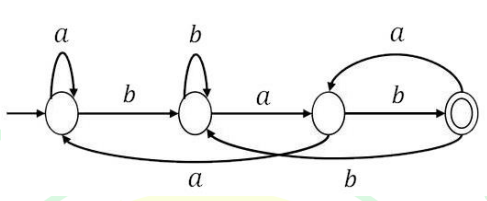
Consider a finite state machine (FSM) with one input 𝑋 and one output 𝑓, represented by the given state transition table. The minimum number of states required to realize this FSM is ________. (Answer in integer)
Present state Next state Output f X = 0 X = 1 X = 0 X = 1 A F B 0 0 B D C 0 0 C F E 0 0 D G A 1 0 E D C 0 0 F F B 1 1 G H 0 0 1 H G A 1 0


