
Consider the following deterministic finite automaton (DFA) defined over the alphabet, Σ = {𝑎, 𝑏}. Identify which of the following language(s) is/are accepted by the given DFA.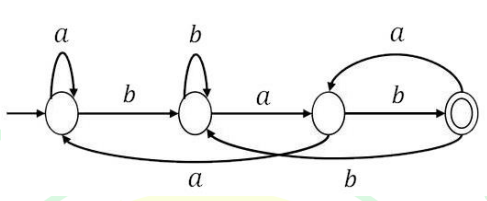
To determine which language is accepted by the given deterministic finite automaton (DFA), we need to analyze the structure of the DFA and the transitions based on the states.
The DFA is defined over the alphabet Σ = {𝑎, 𝑏}. The task is to determine the language accepted by it from the given options.
Let's break down the transitions:
- The initial state transitions on receiving 'a' or 'b'. Moving from state 1 to state 2 on 'b'.
- From state 2, it remains in state 2 on 'b' and moves to state 3 on 'a'.
- From state 3, it transitions back to state 2 on 'a' and moves to state 4 on 'b'.
- From state 4, the final state, it returns to state 3 on 'a' and stays on state 4 on 'b'.
Now, let’s examine each option:
- The set of all strings containing an even number of 𝑏’s:
This is not accepted because the DFA doesn't ensure even 𝑏's; the transitions don't reset based on the number of 𝑏's. - The set of all strings containing the pattern 𝑏𝑎𝑏:
The DFA does move through states on a 𝑏𝑎𝑏 pattern but doesn't end in a final state immediately after. - The set of all strings ending with the pattern 𝑏𝑎𝑏:
Correct Answer. The DFA reaches the final state precisely when the string ends with 𝑏𝑎𝑏. - The set of all strings not containing the pattern 𝑎𝑏𝑎:
There's no specific behavioral restriction on \( \text{ab}\text{a} \) pattern here.
Based on this analysis, the DFA accepts the set of all strings ending with the pattern 𝑏𝑎𝑏. Therefore, the correct answer is The set of all strings ending with the pattern 𝑏𝑎𝑏.
Important Questions from Finite Automata
- Let $\Sigma = \{1,2,3,4\}$. For $x \in \Sigma^*$, let $prod(x)$ be the product of symbols in $x$ modulo 7. We take $prod(\epsilon) = 1$, where $\epsilon$ is the null string.
For example, $prod(124) = (1 \times 2 \times 4)$ mod 7 = 1.
Define $L = \{x \in \Sigma^* \mid prod(x) = 2\}$.
The number of states in a minimum state DFA for L is ____________ (Answer in integer) Consider the following two finite automata $D_1$ and $D_2$.
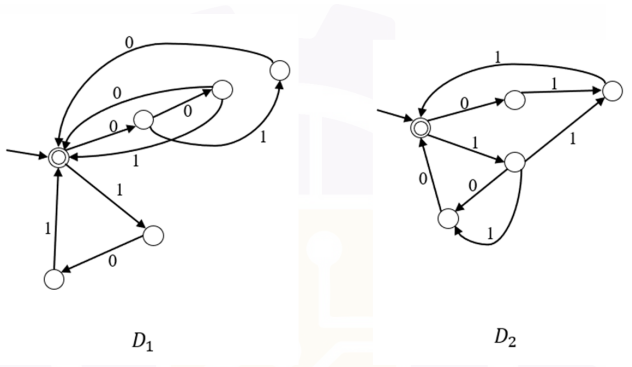
Which of the following statements is/are true?Consider the DFA given below
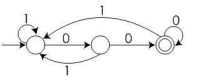
Which of the regular expressions given below represents the above DFA ?- Let $M$ be a nondeterministic finite automaton (NFA) with 6 states over a finite alphabet.
Which of the following options CANNOT be the number of states in the minimal deterministic finite automaton (DFA) that is equivalent to $M$ ? Consider a finite state machine (FSM) with one input 𝑋 and one output 𝑓, represented by the given state transition table. The minimum number of states required to realize this FSM is ________. (Answer in integer)
Present state Next state Output f X = 0 X = 1 X = 0 X = 1 A F B 0 0 B D C 0 0 C F E 0 0 D G A 1 0 E D C 0 0 F F B 1 1 G H 0 0 1 H G A 1 0


