
What is the minimum and maximum number of initial, dead, unreachable and final states in a valid ‘n’ state finite automaton, where the language accepted is not ‘φ’?
Minimum: 1,0,0,1; Maximum: 1, (n-1), (n-1), n
A finite automaton has exactly one initial state; a dead (sink) state is a non-final state from which no final state can be reached; an unreachable state cannot be reached from the initial state. The language must be non-empty, so some final state is reachable from the start.
Step 1 — Initial states: exactly one, so minimum 1 and maximum 1.
Step 2 — Dead states: a minimal DFA may need none, so the minimum is 0. The initial state can never be dead (the language is not empty), so at most the other \(n-1\) states are dead, e.g. when the initial state is final and every other state is dead.
Step 3 — Unreachable states: minimum 0. The initial state is always reachable, so at most \(n-1\) states are unreachable (initial state final, all others unreachable).
Step 4 — Final states: at least 1 is needed for a non-empty language, and all n states may be final, so minimum 1 and maximum n.
Codes with a minimum of 1 dead and 1 unreachable state, or 0 final states, contradict Steps 2–4, and a code with n dead states or n minimum final states is impossible.
Minimum: 1,0,0,1; Maximum: 1, (n-1), (n-1), n option is correct.
Similar Questions
There are exactly __________ different finite automata with three states x, y and z over the alphabet {a, b} where x is always the start state.
The transition function for the language \(L = \{w \mid n_{a}(w)\) and \(n_{b}(w)\) are both odd\(\}\) is given by :
\(\delta(q_{0}, a) = q_{1}\) ; \(\delta(q_{0}, b) = q_{2}\)
\(\delta(q_{1}, a) = q_{0}\) ; \(\delta(q_{1}, b) = q_{3}\)
\(\delta(q_{2}, a) = q_{3}\) ; \(\delta(q_{2}, b) = q_{0}\)
\(\delta(q_{3}, a) = q_{2}\) ; \(\delta(q_{3}, b) = q_{1}\)
The initial and final states of the automata are :
Minimal deterministic finite automaton for the language \(L = \{0^{n} \mid n \geq 0, n \neq 4\}\) will have :
For the above specified passage, which of the following is DFA for the language represented/accepeted by machine?
For the above mentioned passage which of the following is correct?
Which of the following represented the minimum state DFA for the above specified passage?
Which of the following languages can be recognized by neither Non-Deterministic Finite Automata (NFA) nor Deterministic Finite Automata (DFA) ?
(A) L1 = {w ∈ {0, 1}* | the length of w is even}
(B) L2 = {w ∈ {0, 1}* | the length of w is odd}
(C) L3 = {w ∈ {0, 1}* | all 0′s come before all 1′s in w}
(D) L4 = {w ∈ {0, 1}* | w contains an equal number of 0′s and 1′s}
(E) L5 = {w ∈ {0, 1}* | all 1′s come before all 0′s in w}
Choose the correct answer from the options given below :
Which of the following Finite Automata, recognizes the language L={a,b}* ?
A. M=({q0}, {a,b}, δ, q0, {q0}) where, δ is
a b q0 {q0} {q0} B. M=({q0,q1}, {a,b}, δ, q0, {q0,q1}) where, δ is
a b q0 {q0,q1} {q0,q1} q1 {q1} {q1} C. M=({q0,q1}, {a,b}, δ, q0, {q0,q1}) where, δ is
a b q0 {q0,q1} {q0} q1 - {q1} D. M=({q0,q1,q2 }, {a,b}, δ, q0, {q0}) where, δ is
a b q0 {q0} {q0} q1 {q2} - q2 {q0} {q2} Let L be the language generated by regular expression 0*10* and accepted by the deterministic finite automata M, whose transition table is given below (start state a; final states c, d and e).
State 0 1 a b c b a d c e f d e f e e f f f f Consider the relation RM defined by M. As all states are reachable from the start state, RM has _____ equivalence classes.
Important Questions from Finite Automata
Consider the DFA given below
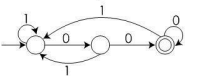
Which of the regular expressions given below represents the above DFA ?- Let $M$ be a nondeterministic finite automaton (NFA) with 6 states over a finite alphabet.
Which of the following options CANNOT be the number of states in the minimal deterministic finite automaton (DFA) that is equivalent to $M$ ? Consider the following deterministic finite automaton (DFA) defined over the alphabet, Σ = {𝑎, 𝑏}. Identify which of the following language(s) is/are accepted by the given DFA.
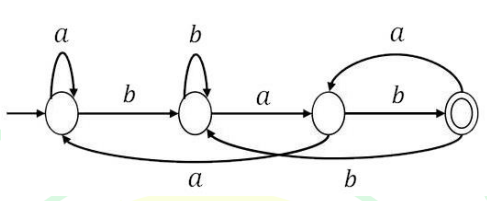
Consider a finite state machine (FSM) with one input 𝑋 and one output 𝑓, represented by the given state transition table. The minimum number of states required to realize this FSM is ________. (Answer in integer)
Present state Next state Output f X = 0 X = 1 X = 0 X = 1 A F B 0 0 B D C 0 0 C F E 0 0 D G A 1 0 E D C 0 0 F F B 1 1 G H 0 0 1 H G A 1 0 Consider the following DFA that generates set of strings over $\Sigma=\{a, b, c\}$
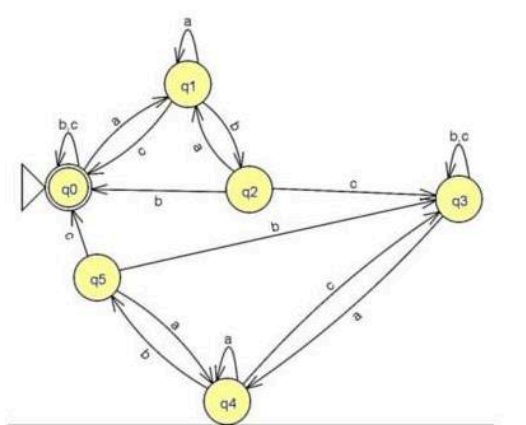
Now identify that which of the followings is the best description of the language for the above DFA



