
Which of the following circuits will have transients ? 1. Resistive Which is correct ?
2. R-L
3. R-C
4. R-L-C
2, 3, 4
A transient requires an element that stores energy, and a purely resistive circuit has none — so the answer is 2, 3 and 4, option 4.
Why a resistive circuit cannot have a transient. Ohm's law is algebraic:
\(i=\dfrac{v}{R}\)
The current at any instant depends only on the voltage at that instant. There is no derivative, so there is no differential equation to solve, no time constant, and no memory of what came before. Apply a step and the current steps with it — the new state is reached immediately.
Why the other three do have transients. Each contains at least one storage element whose defining relation involves a derivative:
| Element | Relation | Cannot change instantly |
|---|---|---|
| Inductor | \(v=L\dfrac{di}{dt}\) | Its current |
| Capacitor | \(i=C\dfrac{dv}{dt}\) | Its voltage |
A discontinuous change would demand infinite voltage or infinite current. Energy stored as \(\frac{1}{2}Li^{2}\) or \(\frac{1}{2}Cv^{2}\) must be moved at a finite rate, and the interval during which it is redistributed is the transient.
The order of the circuit sets the character of the response.
First order — R-L or R-C, one storage element — gives a simple exponential with a single time constant, \(\tau=L/R\) or \(RC\). It approaches the final value monotonically and can never overshoot.
Second order — R-L-C, two storage elements — allows energy to be exchanged between L and C, so the response can oscillate. Its character depends on the damping:
\(\zeta=\dfrac{R}{2}\sqrt{\dfrac{C}{L}}\qquad\text{(series R-L-C)}\)
giving an overdamped, critically damped or underdamped approach — the last with ringing at
\(\omega_{d}=\omega_{n}\sqrt{1-\zeta^{2}}\)
Where this matters practically : stray inductance and capacitance are unavoidable, so every real "resistive" circuit shows a small transient at high enough speed — which is why fast digital edges ring on long traces.
Hence, the circuits with transients are 2, 3 and 4.
Similar Questions
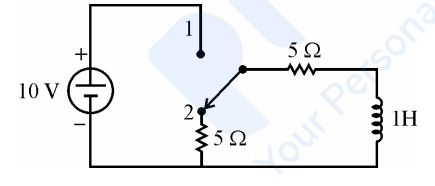
The switch is thrown to position 1. What will be the current in the circuit in the steady state condition ?
Arrange the time constant in descending order, for the circuit given below (having different combinations of Vsupply and Capacitor (C))
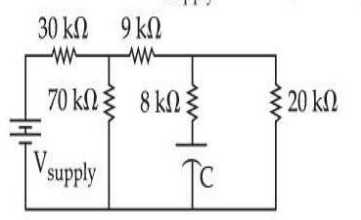
(A) Vsupply = 250 V ; C = 3 µF
(B) Vsupply = 150 V ; C = 1 µF
(C) Vsupply = 100 V ; C = 2 µF
(D) Vsupply = 250 V ; C = 6 µF
(E) Vsupply = 80 V ; C = 0.5 µFChoose the most appropriate answer from the options given below :
For series RLC circuit given below in figure, choose the correct answer based on Kirchoff's voltage law from following:
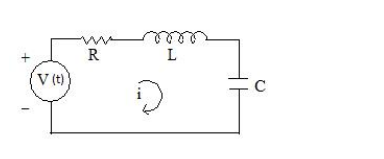
The RLC circuit given in figure below can be solved
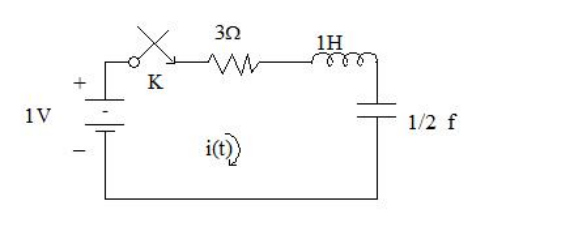
A. Current i(t) can be solved using KVL
B. Current i(t) can be solved using KCL
C. Current i(t) can be solved using fourier transform
D. Current i(t) can be solved using laplace transform
E. Current i(t) can be solved using Fourier series
Choose the correct answer from the options given below:
Match the following lists :
List – I List – II a) 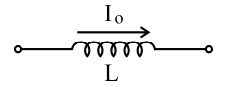
i) 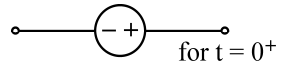
b) 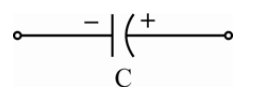
ii) 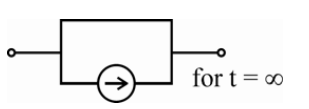
c) 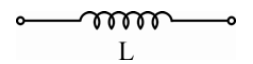
iii) 
d) 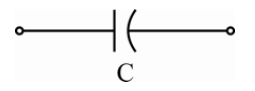
iv) 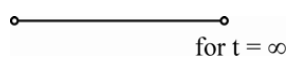
Choose the correct answer from the codes given below:
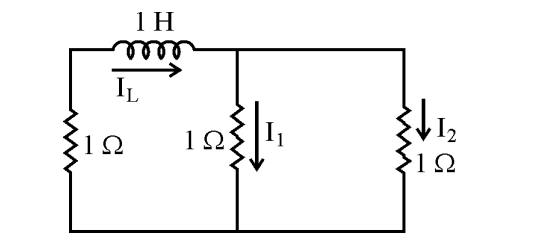
The time constant for the network shown below will be :
Match the following in the context of RLC series circuit :
List - I List - II (a) Under damped (i) \(\xi=1\) (b) Critically damped (ii) \(\xi \gt 1\) (c) Quality factor (iii) \(\dfrac{1}{2\xi}\) (d) Over damped (iv) \(\xi \lt 1\) Codes :
Important Questions from Transient Analysis
During discharging of a capacitor of C = 100 µF through a resistance of 1 KΩ applied with 50 V, the voltage at the time of the it's time constant is
In which of the following circuits, The transient currents may not occur?
There are no transients in pure resistance circuit because they
Zero initial conditions mean that the system is
In a series RL circuit the value of inductance is 1 Henry and resistance is 10 ohms. If 100 V DC is applied to the circuit at t = 0, what is the value of current at 0.1 sec?



