
Match the following in the context of RLC series circuit : Codes :List - I List - II (a) Under damped (i) \(\xi=1\) (b) Critically damped (ii) \(\xi \gt 1\) (c) Quality factor (iii) \(\dfrac{1}{2\xi}\) (d) Over damped (iv) \(\xi \lt 1\)
(a)-(iv), (b)-(i), (c)-(iii), (d)-(ii)
Everything follows from the standard second-order form. A series RLC circuit obeys
\(\dfrac{d^{2}i}{dt^{2}}+\dfrac{R}{L}\dfrac{di}{dt}+\dfrac{i}{LC}=0\)
which is written canonically as \(s^{2}+2\xi\omega_{n}s+\omega_{n}^{2}=0\) with
\(\omega_{n}=\dfrac{1}{\sqrt{LC}}\qquad \xi=\dfrac{R}{2}\sqrt{\dfrac{C}{L}}\)
The damping ratio alone decides the character of the roots \(s=-\xi\omega_{n}\pm\omega_{n}\sqrt{\xi^{2}-1}\):
| Condition | Roots | Response |
|---|---|---|
| \(\xi \lt 1\) | Complex conjugate | Under damped — decaying oscillation with overshoot |
| \(\xi=1\) | Real and equal | Critically damped — fastest approach without overshoot |
| \(\xi \gt 1\) | Real and distinct | Over damped — sluggish, no oscillation |
So (a)-(iv), (b)-(i) and (d)-(ii).
The quality factor is the reciprocal link. For a series RLC circuit
\(Q=\dfrac{\omega_{n}L}{R}=\dfrac{1}{R}\sqrt{\dfrac{L}{C}}\)
and substituting \(\xi=\dfrac{R}{2}\sqrt{\dfrac{C}{L}}\) gives directly
\(Q=\dfrac{1}{2\xi}\)
so (c)-(iii). High Q therefore means low damping: a sharply resonant, lightly damped circuit that rings for many cycles. The two quantities are simply two languages — the filter designer's Q and the control engineer's \(\xi\) — for the same physical fact.
A useful landmark. \(\xi=0.707\) gives \(Q=0.707\), the maximally flat Butterworth response — the usual compromise between speed and overshoot in practical designs.
Reading off the codes, the required order is (iv), (i), (iii), (ii), which is option 3.
Hence, the correct match is (a)-(iv), (b)-(i), (c)-(iii), (d)-(ii).
Similar Questions
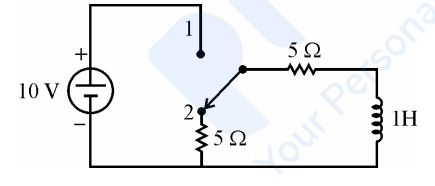
The switch is thrown to position 1. What will be the current in the circuit in the steady state condition ?
Which of the following circuits will have transients ?
1. Resistive
2. R-L
3. R-C
4. R-L-CWhich is correct ?
Arrange the time constant in descending order, for the circuit given below (having different combinations of Vsupply and Capacitor (C))
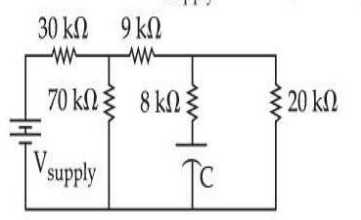
(A) Vsupply = 250 V ; C = 3 µF
(B) Vsupply = 150 V ; C = 1 µF
(C) Vsupply = 100 V ; C = 2 µF
(D) Vsupply = 250 V ; C = 6 µF
(E) Vsupply = 80 V ; C = 0.5 µFChoose the most appropriate answer from the options given below :
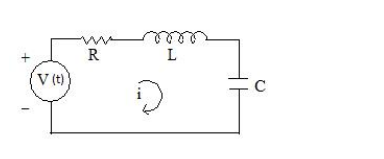
For series RLC circuit given below in figure, choose the correct answer based on Kirchoff's voltage law from following:
The RLC circuit given in figure below can be solved
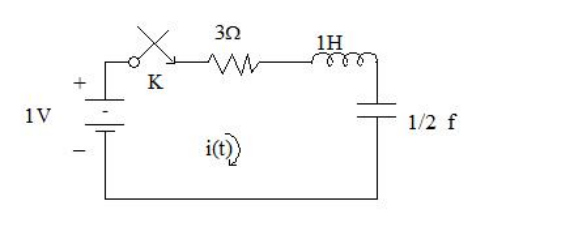
A. Current i(t) can be solved using KVL
B. Current i(t) can be solved using KCL
C. Current i(t) can be solved using fourier transform
D. Current i(t) can be solved using laplace transform
E. Current i(t) can be solved using Fourier series
Choose the correct answer from the options given below:
Match the following lists :
List – I List – II a) 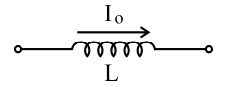
i) 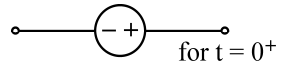
b) 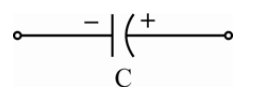
ii) 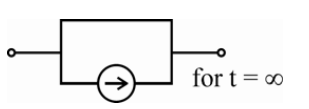
c) 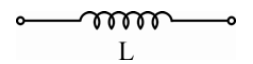
iii) 
d) 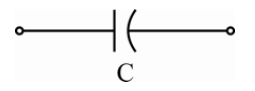
iv) 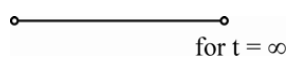
Choose the correct answer from the codes given below:
The time constant for the network shown below will be :
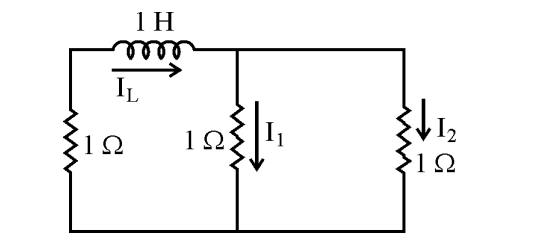
Important Questions from Transient Analysis
During discharging of a capacitor of C = 100 µF through a resistance of 1 KΩ applied with 50 V, the voltage at the time of the it's time constant is
In which of the following circuits, The transient currents may not occur?
There are no transients in pure resistance circuit because they
Zero initial conditions mean that the system is
In a series RL circuit the value of inductance is 1 Henry and resistance is 10 ohms. If 100 V DC is applied to the circuit at t = 0, what is the value of current at 0.1 sec?



