
The RLC circuit given in figure below can be solved A. Current i(t) can be solved using KVL B. Current i(t) can be solved using KCL C. Current i(t) can be solved using fourier transform D. Current i(t) can be solved using laplace transform E. Current i(t) can be solved using Fourier series Choose the correct answer from the options given below: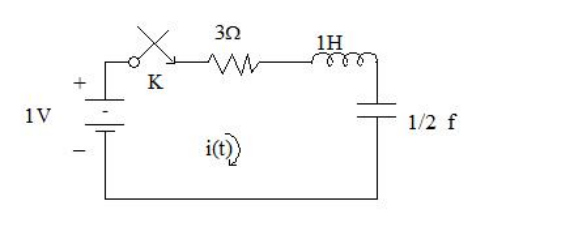
A & D only
The RLC circuit question involves determining the methods by which the current \( i(t) \) can be solved. Let's examine each of the given options:
- Using Kirchhoff's Voltage Law (KVL):
- KVL is applicable to this circuit. By applying KVL, the sum of the potential differences around the loop can be set equal to zero, thereby allowing us to write a differential equation involving the current \( i(t) \).
- This method will be effective, particularly because the circuit is linear and can be analyzed using classical methods.
- Using Kirchhoff's Current Law (KCL):
- KCL is generally used to analyze nodal points, not loops. In this single-loop circuit, KVL is more directly applicable than KCL.
- Hence, KCL is not suitable for solving for \( i(t) \) here.
- Using Fourier Transform:
- The Fourier Transform is used to analyze the frequency components of a signal, generally in steady-state AC analysis. It is less suitable for time-domain transient analysis directly applicable here.
- Using Laplace Transform:
- The Laplace Transform is a powerful tool for solving linear differential equations by transforming them into algebraic equations. It is highly applicable for analyzing RLC circuits as it simplifies circuit equations in the frequency domain.
- Thus, it can be used effectively to solve for \( i(t) \).
- Using Fourier Series:
- The Fourier Series is useful for periodic signals and doesn't directly solve time-dependent transient behavior in circuits like the RLC under analysis.
- Therefore, it is not suitable for solving \( i(t) \).
Based on the analysis, the correct methods to solve for the current \( i(t) \) are using KVL and Laplace Transform. Therefore, the correct answer is A & D only.
Similar Questions
The switch is thrown to position 1. What will be the current in the circuit in the steady state condition ?
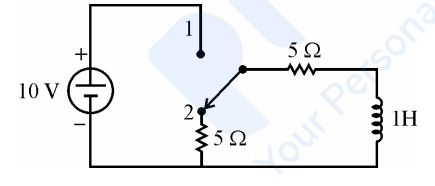
Which of the following circuits will have transients ?
1. Resistive
2. R-L
3. R-C
4. R-L-CWhich is correct ?
Arrange the time constant in descending order, for the circuit given below (having different combinations of Vsupply and Capacitor (C))
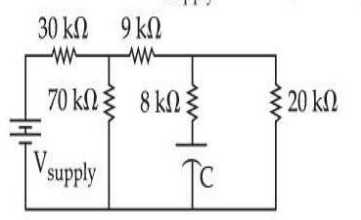
(A) Vsupply = 250 V ; C = 3 µF
(B) Vsupply = 150 V ; C = 1 µF
(C) Vsupply = 100 V ; C = 2 µF
(D) Vsupply = 250 V ; C = 6 µF
(E) Vsupply = 80 V ; C = 0.5 µFChoose the most appropriate answer from the options given below :
For series RLC circuit given below in figure, choose the correct answer based on Kirchoff's voltage law from following:
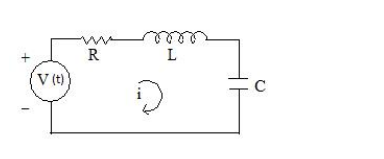
Match the following lists :
List – I List – II a) 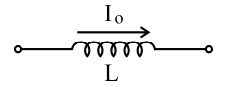
i) 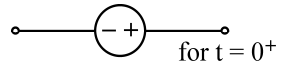
b) 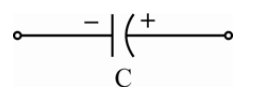
ii) 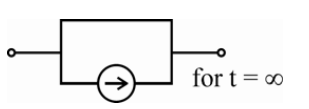
c) 
iii) 
d) 
iv) 
Choose the correct answer from the codes given below:
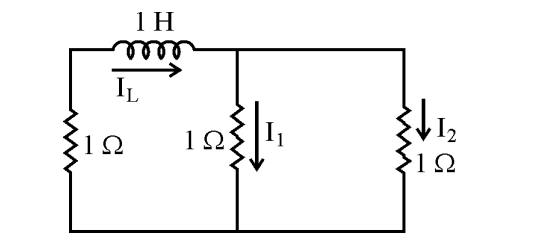
The time constant for the network shown below will be :
Match the following in the context of RLC series circuit :
List - I List - II (a) Under damped (i) \(\xi=1\) (b) Critically damped (ii) \(\xi \gt 1\) (c) Quality factor (iii) \(\dfrac{1}{2\xi}\) (d) Over damped (iv) \(\xi \lt 1\) Codes :
Important Questions from Transient Analysis
During discharging of a capacitor of C = 100 µF through a resistance of 1 KΩ applied with 50 V, the voltage at the time of the it's time constant is
In which of the following circuits, The transient currents may not occur?
There are no transients in pure resistance circuit because they
Zero initial conditions mean that the system is
In a series RL circuit the value of inductance is 1 Henry and resistance is 10 ohms. If 100 V DC is applied to the circuit at t = 0, what is the value of current at 0.1 sec?



