
Arrange the time constant in descending order, for the circuit given below (having different combinations of Vsupply and Capacitor (C)) (A) Vsupply = 250 V ; C = 3 µF Choose the most appropriate answer from the options given below :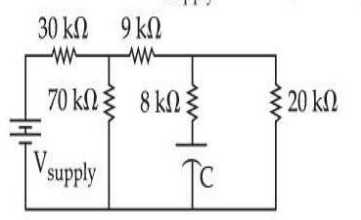
(B) Vsupply = 150 V ; C = 1 µF
(C) Vsupply = 100 V ; C = 2 µF
(D) Vsupply = 250 V ; C = 6 µF
(E) Vsupply = 80 V ; C = 0.5 µF
(D), (A), (C), (B), (E)
The whole question turns on one observation: the time constant does not depend on the supply voltage at all.
\(\tau=R_{th}C\)
where \(R_{th}\) is the resistance seen by the capacitor with the source deactivated. Since \(R_{th}\) is the same in all five cases, the ordering is decided by C alone — and the various supply voltages are there purely as a distraction.
Step 1 — find the resistance seen by C. Short the voltage source. Then:
The 30 kΩ now runs from the first node to the return rail, in parallel with the 70 kΩ:
\(30\parallel70=\dfrac{30\times70}{100}=21\ \text{k}\Omega\)
Adding the 9 kΩ in series gives 30 kΩ presented to the second node, which is in parallel with the 20 kΩ there:
\(30\parallel20=\dfrac{30\times20}{50}=12\ \text{k}\Omega\)
And the 8 kΩ sits in series with the capacitor itself:
\(R_{th}=8+12=20\ \text{k}\Omega\)
Step 2 — compute the five time constants.
| Case | C | τ = 20 kΩ × C | Rank |
|---|---|---|---|
| (D) | 6 µF | 120 ms | 1st |
| (A) | 3 µF | 60 ms | 2nd |
| (C) | 2 µF | 40 ms | 3rd |
| (B) | 1 µF | 20 ms | 4th |
| (E) | 0.5 µF | 10 ms | 5th |
Descending order is therefore (D), (A), (C), (B), (E) — option 4, which is simply the capacitances in descending order.
Why the supply voltage cannot matter. The time constant describes how fast the exponential approaches its final value, not what that value is. Doubling the supply doubles the final voltage and doubles the initial charging current in the same proportion, so the shape of
\(v(t)=V_{f}\left(1-e^{-t/\tau}\right)\)
is unchanged — only its vertical scale. Case (A) and case (D) share the same 250 V supply yet differ by a factor of two in \(\tau\), which makes the point directly.
A shortcut worth noting : once it is seen that \(R_{th}\) is common to all five, the network need not be reduced at all — ranking the capacitances is enough.
Hence, the descending order is (D), (A), (C), (B), (E).
Similar Questions
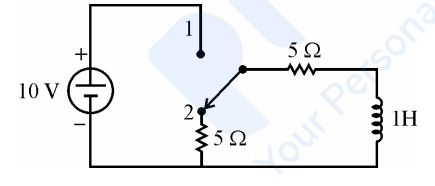
The switch is thrown to position 1. What will be the current in the circuit in the steady state condition ?
Which of the following circuits will have transients ?
1. Resistive
2. R-L
3. R-C
4. R-L-CWhich is correct ?
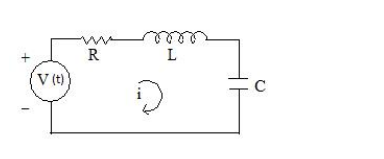
For series RLC circuit given below in figure, choose the correct answer based on Kirchoff's voltage law from following:
The RLC circuit given in figure below can be solved
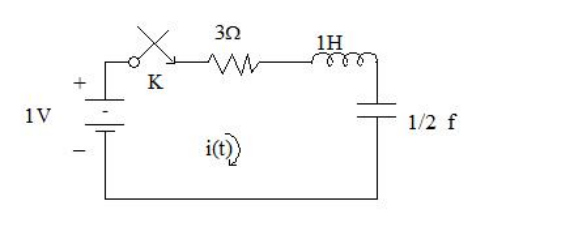
A. Current i(t) can be solved using KVL
B. Current i(t) can be solved using KCL
C. Current i(t) can be solved using fourier transform
D. Current i(t) can be solved using laplace transform
E. Current i(t) can be solved using Fourier series
Choose the correct answer from the options given below:
Match the following lists :
List – I List – II a) 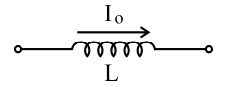
i) 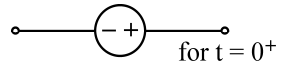
b) 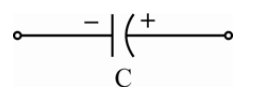
ii) 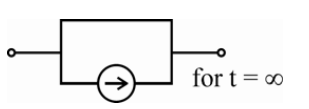
c) 
iii) 
d) 
iv) 
Choose the correct answer from the codes given below:
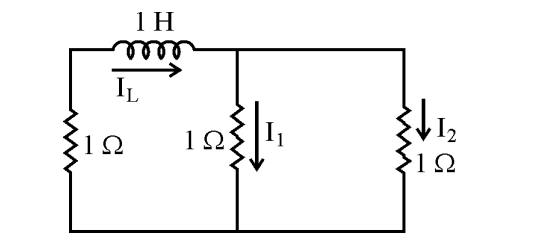
The time constant for the network shown below will be :
Match the following in the context of RLC series circuit :
List - I List - II (a) Under damped (i) \(\xi=1\) (b) Critically damped (ii) \(\xi \gt 1\) (c) Quality factor (iii) \(\dfrac{1}{2\xi}\) (d) Over damped (iv) \(\xi \lt 1\) Codes :
Important Questions from Transient Analysis
During discharging of a capacitor of C = 100 µF through a resistance of 1 KΩ applied with 50 V, the voltage at the time of the it's time constant is
In which of the following circuits, The transient currents may not occur?
There are no transients in pure resistance circuit because they
Zero initial conditions mean that the system is
In a series RL circuit the value of inductance is 1 Henry and resistance is 10 ohms. If 100 V DC is applied to the circuit at t = 0, what is the value of current at 0.1 sec?



