
Match the following lists : Choose the correct answer from the codes given below:List – I List – II a) 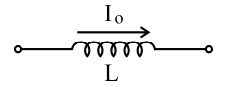
i) 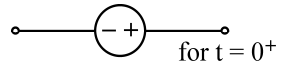
b) 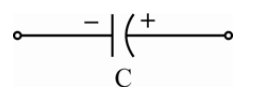
ii) 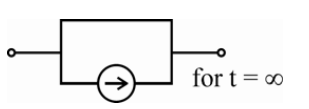
c) 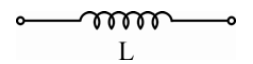
iii) 
d) 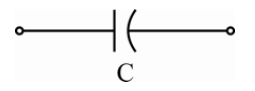
iv) 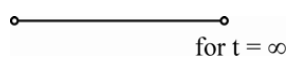
a-ii, b-i, c-iv, d-iii
Every entry follows from two rules about how L and C behave, one about stored energy and one about the steady state.
Rule 1 — continuity of the stored variable. Inductor current and capacitor voltage cannot change instantaneously, because that would need infinite voltage or infinite current:
\(i_L(0^{+})=i_L(0^{-}), \qquad v_C(0^{+})=v_C(0^{-})\)
a → ii. An inductor carrying an initial current Io must keep delivering exactly that current at the first instant, whatever the rest of the circuit does — which is the defining behaviour of a current source of value Io.
b → i. A capacitor holding an initial voltage must keep exactly that voltage across its terminals at the first instant — a voltage source of that value, which is why the polarity marks appear on the symbol.
Rule 2 — steady state under d.c. Long after switching, all derivatives vanish:
\(v_L=L\dfrac{di}{dt}=0 \Rightarrow \text{inductor becomes a SHORT circuit}\)
\(i_C=C\dfrac{dv}{dt}=0 \Rightarrow \text{capacitor becomes an OPEN circuit}\)
c → iv. The plain inductor at t = ∞ is a short circuit — a piece of wire, dropping no voltage.
d → iii. The plain capacitor at t = ∞ is an open circuit — it blocks d.c. completely.
The pattern worth memorising is that L and C always behave oppositely, and each swaps roles between the two instants:
| Element | t = 0+ (uncharged) | t = ∞ |
|---|---|---|
| Inductor | open circuit | short circuit |
| Capacitor | short circuit | open circuit |
and when energy is already stored, the element is replaced by the corresponding source instead. These four substitutions are what let you find initial and final values of any transient without solving a single differential equation.
Hence, the correct matching is a-ii, b-i, c-iv, d-iii.
Similar Questions
The switch is thrown to position 1. What will be the current in the circuit in the steady state condition ?
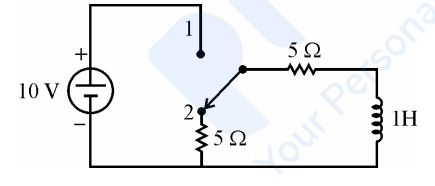
Which of the following circuits will have transients ?
1. Resistive
2. R-L
3. R-C
4. R-L-CWhich is correct ?
Arrange the time constant in descending order, for the circuit given below (having different combinations of Vsupply and Capacitor (C))
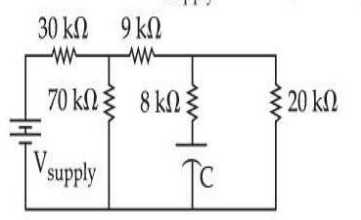
(A) Vsupply = 250 V ; C = 3 µF
(B) Vsupply = 150 V ; C = 1 µF
(C) Vsupply = 100 V ; C = 2 µF
(D) Vsupply = 250 V ; C = 6 µF
(E) Vsupply = 80 V ; C = 0.5 µFChoose the most appropriate answer from the options given below :
For series RLC circuit given below in figure, choose the correct answer based on Kirchoff's voltage law from following:
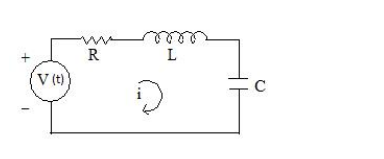
The RLC circuit given in figure below can be solved
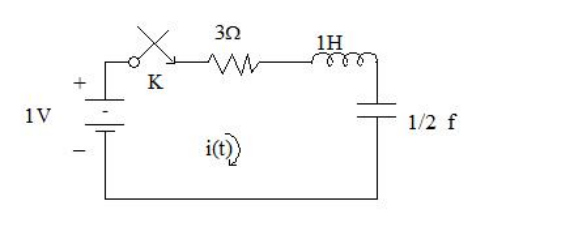
A. Current i(t) can be solved using KVL
B. Current i(t) can be solved using KCL
C. Current i(t) can be solved using fourier transform
D. Current i(t) can be solved using laplace transform
E. Current i(t) can be solved using Fourier series
Choose the correct answer from the options given below:
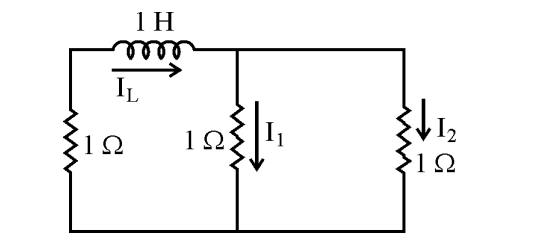
The time constant for the network shown below will be :
Match the following in the context of RLC series circuit :
List - I List - II (a) Under damped (i) \(\xi=1\) (b) Critically damped (ii) \(\xi \gt 1\) (c) Quality factor (iii) \(\dfrac{1}{2\xi}\) (d) Over damped (iv) \(\xi \lt 1\) Codes :
Important Questions from Transient Analysis
During discharging of a capacitor of C = 100 µF through a resistance of 1 KΩ applied with 50 V, the voltage at the time of the it's time constant is
In which of the following circuits, The transient currents may not occur?
There are no transients in pure resistance circuit because they
Zero initial conditions mean that the system is
In a series RL circuit the value of inductance is 1 Henry and resistance is 10 ohms. If 100 V DC is applied to the circuit at t = 0, what is the value of current at 0.1 sec?



