Which is the reagent used for the following conversion?
\(\mathrm{[Ag(NH_3)_2]^+}\)
The conversion changes only the –CHO group to –COO−; the ring ketone (C=O) is untouched, so a mild, selective oxidant of aldehydes is needed.
Tollens’ reagent, ammoniacal silver nitrate \(\mathrm{[Ag(NH_3)_2]^+}\), oxidises aldehydes to carboxylate ions in basic medium but does not attack ketones:
\(\mathrm{RCHO+2[Ag(NH_3)_2]^++3OH^-\rightarrow RCOO^-+2Ag+2H_2O+4NH_3}\)
\(\mathrm{NaBH_4}\) would reduce, \(\mathrm{NaCN/HCl}\) forms cyanohydrins, \(\mathrm{SOCl_2}\) and ozonolysis do not give this product.
Hence, \(\mathrm{[Ag(NH_3)_2]^+}\).
Similar Questions
The carbohydrates are stored in animal body as
Oxidation of gluconic acid with nitric acid gives
An aromatic compound (X) of molecular formula, \(\mathrm{C_7H_7Cl}\), on ammonolysis gives Y (Molecular formula, \(\mathrm{C_7H_9N}\)). The compound ‘Y’ reacts with two moles of \(\mathrm{CH_3Cl}\) gives N, N-Dimethylphenylmethanamine. The compounds ‘X’ and ‘Y’ are
The order of boiling point of the following amines is
(i) Butan-1-amine (ii) N-Ethylethanamine (iii) N,N-Dimethylethanamine
The number of moles of alkyl halides required to convert primary amine into quaternary ammonium salt is
Match the following
Compound use (a) Benzaldehyde (i) food preservative (b) Methanoic acid (ii) nylon 6,6 (c) Sodium benzoate (iii) perfumery (d) Hexanedioic acid (iv) Electroplating industry When \(\mathrm{C_6H_5CHO}\) reacts with the mixture of \(\mathrm{HNO_3}\) and \(\mathrm{H_2SO_4}\) at 273-283K gives
When benzene is treated with carbon monoxide and hydrogen chloride in the presence of anhydrous aluminium chloride, benzaldehyde is formed. The reaction is known as
The order of acidity of the following compounds is
(i) \(o\)-Nitrophenol (ii) Phenol (iii) \(o\)-Cresol (iv) Ethanol
The reagent used for the conversion of carboxylic acids to primary alcohols is
Important Questions from Organic Chemistry
- In Dumas method for estimation of nitrogen, 0.50 g of an organic compound gave 70 mL of nitrogen collected at 300 K and 715 mm pressure. The percentage of nitrogen in the organic compound is ______ %.
(Aqueous tension at 300 K is 15 mm). - $0.25 \text{ g}$ of an organic compound "A" containing carbon, hydrogen and oxygen was analysed using the combustion method. There was an increase in mass of $\text{CaCl}_2$ tube and potash tube at the end of the experiment. The amount was found to be $0.15 \text{ g}$ and $0.1837 \text{ g}$, respectively. The percentage of oxygen in compound A is ______ %. (Nearest integer)
(Given: molar mass in $\text{g mol}^{-1}$ $\text{H} : 1, \text{C} : 12, \text{O} : 16$) - Grignard reagent $\text{RMgBr (P)}$ reacts with water and forms a gas $\text{(Q)}$. One gram of Q occupies $1.4 \text{ dm}^3$ at STP. (P) on reaction with dry ice in dry ether followed by $\text{H}_3\text{O}^+$ forms a compound $\text{(Z)}$. 0.1 mole of $\text{(Z)}$ will weigh _________ g. (Nearest integer)
- Consider all the structural isomers with molecular formula $\text{C}_5\text{H}_{11}\text{Br}$ are separately treated with $\text{KOH(aq)}$ to give respective substitution products, without any rearrangement. The number of products which can exhibit optical isomerism from these is ___________.
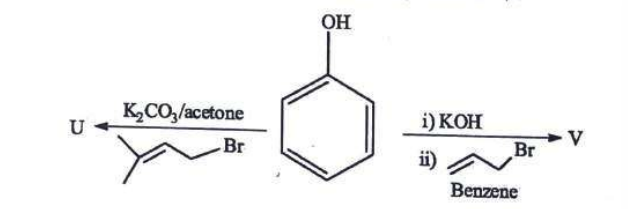
The major products U and V in the following reaction are