
Three statements are given, followed by three conclusions numbered I, II and III. Assuming the statements to be true, even if they seem to be at variance with commonly known facts, decide which of the conclusions logically follow(s) from the statements. Statements: All reds are pinks. All whites are pinks. All pinks are oranges. Conclusions: I. All whites are oranges. II. All oranges are reds. III. Some oranges are whites.
Only conclusions I and III follow
Statements:
All reds are pinks.
All whites are pinks.
All pinks are oranges.
Venn diagram:
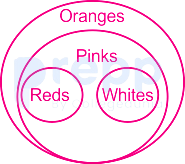
Conclusions:
I. All whites are oranges → Follow → Since 'all whites are pinks' & 'all pinks are oranges' thus the conclusion follows.
II. All oranges are reds → Does not follow → From the diagram we can see that all reds are oranges but all oranges are not red therefore the conclusion does not follow.
III. Some oranges are whites → Follow → We have 'all whites are pink' and 'all pinks are oranges' so some oranges will be definitely whites.
So, only conclusions I and III follow.
Hence, the correct answer is "Option 1".
Similar Questions
Read the given statements and conclusions carefully. Assuming that the information given in the statements is true, even if it appears to be at variance with commonly known facts, decide which of the given conclusions logically follow(s) from the statements.
Statements:
All Tim are Jack.
No Jack is Ben.
Some Ben is Ruth.
Conclusions:
I. No Ruth is Jack.
II. Some Ben are Jack.
III. No Ben is Tim.
Read the given statements and conclusions carefully. Assuming that the information given in the statements is true, even if it appears to be at variance with commonly known facts, decide which of the given conclusions logically follow(s) from the statements.
Statements:
1. All rugs are blankets.
2. All blankets are pillows.
3. Some blankets are frames.
Conclusions:
I. All pillows are rugs.
II. Some pillows are rugs.
III. All rugs are frames
In the following question below are given some statements followed by some conclusions based on those statements. Taking the given statements to be true even if they seem to be at variance from commonly known facts. Read all the conclusions and then decide which of the given conclusion logically follows the given statements.
Statements:
I. All T are G.
II. All G are H.
Conclusions:
I. All T are H.
II. No G is T.
III. All H are G.
In the following question below are given some statements followed by some conclusions based on those statements. Taking the given statements to be true even if they seem to be at variance from commonly known facts. Read all the conclusions and then decide which of the given conclusion logically follows the given statements.
Statements:
I. All R are M.
II. All L are M.
Conclusions:
I. Some M are not R.
II. Some L are R.
III. Some M are L.
In the following question below are given some statements followed by some conclusions based on those statements. Taking the given statements to be true even if they seem to be at variance from commonly known facts. Read all the conclusions and then decide which of the given conclusion logically follows the given statements.
Statements:
I. All M are A.
II. No A is R.
Conclusion:
I. No M is R.
II. Some A are M.
III. Some R are A.
Three statements are given, followed by two conclusions numbered I and II. Assuming the statements to be true, even if they seem to be at variance with commonly known facts, decide which of the conclusions logically follow(s) from the statements.
Statements:
All c are f.
No f is t.
All p are c.
Conclusions:
I. Some t are c.
II. No p is t.
Read the given statements and conclusions carefully. Assuming that the information given in the statements is true, even if it appears to be at variance with commonly known facts, decide which of the given conclusions logically follow(s) from the statements.
Statements:
Some laptops are phones.
Some phones are capsules.
Some capsules are pens.
Conclusions:
I. Some laptops are capsules.
II. Some phones are pens.
III. Some pens are capsules.
IV. Some pens are phones.
Three statements are given followed by three conclusions numbered I, II and III. Assuming the statements to be true, even if they seem to be at variance with commonly known facts, decide which of the conclusions logically follow from the statements.
Statements:
All blocks are toys.
All toys are books.
All books are stories.
Conclusions:
I. Some toys are blocks.
II. Some blocks are books.
III. Some stories are toys.
Three Statements are given followed by Three conclusions numbered I, II and III. Assuming the statements to be true, even if they seem to be at variance with commonly known facts, decide which of the conclusions logically follow(s) from the statements.
Statements:
All plates are bowls.
No bowl is a glass.
Some glasses are vessels.
Conclusions:
I. Some glasses are plates.
II. Some bowls are plates.
III. Some vessels are bowls.
Read the given statements and conclusions carefully. Assuming that the information given in the statements is true, even if it appears to be at variance with commonly known facts, decide which of the given conclusions logically follow(s) from the statements.
Statements:
All polygons are angles.
All angles are diagonals.
All cones are cubes.
All cubes are decagons.
No diagonal is a cube.
Conclusions:
I. Some diagonals are polygons.
II. All diagonals are decagons.
III. No polygon is a cone.
IV. Some cubes are angles.
Important Questions from Conventional Syllogism
In this question, three statements followed by two conclusions numbered I and II have been given. You have to take the given statements to be true even if they seem to be at variance from the commonly facts and then decide which of the given conclusions logically follows from the given statements disregarding commonly known facts.
Statements: Some flats are apartments.
No apartment is a hall.
Some halls are rooms.
Conclusions: I. At least some rooms are flats.
II. No apartment is a room.
Read the given statements and conclusions carefully. Assuming that the information given in the statements is true, even if it appears to be at variance with commonly known facts, decide which of the given conclusions logically follow(s) from the statements.
Statements:
I. Some blue are red.
II. Some green are red.
Conclusions:
I. No blue is green.
II. No red is green.
Given below are two statements, Consider these statements to be true even if they seem factuality absurd, Read the conclusions and then decide which of the given conclusions logically follow(s) from the given statements?
Statements :
1. All vases are flowers.
2. No flowers is a plant.
Conclusions :
1. No vases is a plant.
2. Some plant are vases
In the question two statements are given, followed by three conclusions, I, II and III. You have to consider the statements to be true even if it seems to be at variance from commonly known facts. You have to decide which of the given conclusions, if any, follows from the given statements.
Statement 1 : Some cars are scooters.
Statement 2 : All scooters are buses.
Conclusion I : Some scooters are cars.
Conclusion II : Some buses are cars.
Conclusion III : All cars are buses.
Read the given statements and conclusions carefully. Assuming that the information in the statement is true even if they appear to be at variance with commonly known facts, choose the conclusion that logically follows from the statement beyond reasonable doubt.
Statement:-
1. Some dogs are cats.
2. All cats are birds.
Conclusion:-
1. Some dogs are birds.
2. No cat is dog.



