The type of fracture marked with arrow heads in the following figure is 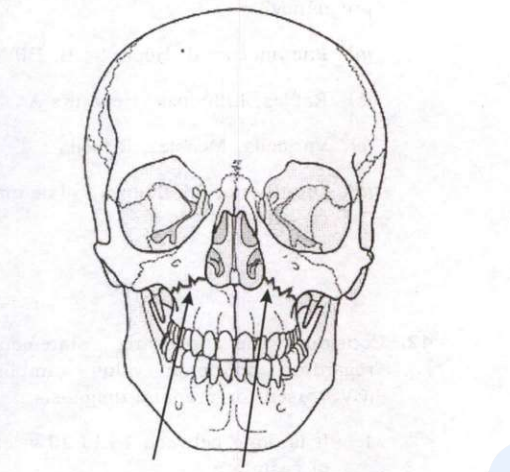
Le Fort I
The correct answer is Le Fort I. A Le Fort I (Guerin or floating palate) fracture is a horizontal fracture above the tooth apices, crossing the lower nasal septum, lateral nasal walls, anterior and lateral maxillary sinus walls and lower pterygoid plates. It detaches the entire tooth-bearing alveolar segment and hard palate from the midface, which is exactly the region the arrows indicate. Clinically the maxilla moves independently on grasping the upper alveolus while the nasal bridge and orbital rims stay fixed, with malocclusion and mobile dentition.
Le Fort II is pyramidal, running through the nasal bridge, medial orbital wall, orbital floor and infraorbital rim, so the nose moves with the maxilla. Le Fort III is complete craniofacial dysjunction through the nasofrontal suture, orbital walls and zygomatic arches, often with CSF rhinorrhoea. Le Fort IV is not part of the original classification and is not an accepted level.
Key point: Le Fort I = floating palate, II = floating maxilla (pyramidal), III = floating face. All three involve the pterygoid plates.
Similar Questions
A patient is undergoing a surgery for removal of a benign tumour from the parotid gland. Which one of the following structures should be preserved during this surgery?
A 52-year-old carpenter presents with the history of a persistent non-healing ulcer on his lower alveolus. He is a smoker for last 30 years and also chews tobacco. What is the next most appropriate step in the management?
Important Questions from Head
- A patient operated for a parotid gland tumour developed symptoms of sweating and erytherma (flushing) over the region of surgical excision while eating. The probable diagnosis is:
- Which of the statements regarding Salivary gland neoplasms are correct?
1. 80-90% of parotid tumors are malignant
2. 90% of sublingual gland tumors are malignant
3. 60-70% of submandibular gland tumors are benign
4. Parotid gland is most common site for salivary gland tumors
Select the correct answer using the code given below: - A young boy riding a motorcycle, met with a road traffic accident. On examination he had maxillofacial trauma with paraesthesia of the lower lip. Most likely underlying he has a:
- A 40-year-old smoker presents with soreness of tongue since last 2 months. On examination, it is found that the oral hygiene is poor and there is a white plaque over the lateral border of the tongue. What is the next step in the management of this patient?
- A 6-year-old boy has recurrent history of pain and swelling below his left ear, which generally lasts for 3-7 days and improves mildly after a course of antibiotics. Sialography shows punctate sialectasis. He should be treated by