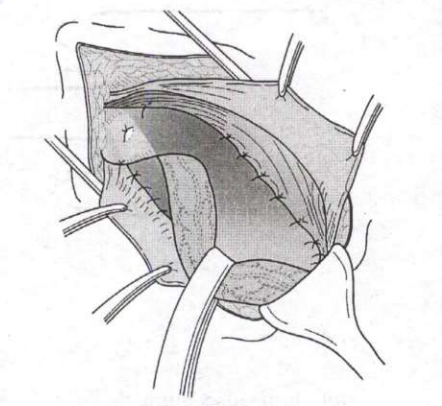
A patient is undergoing a surgery for removal of a benign tumour from the parotid gland. Which one of the following structures should be preserved during this surgery?
Facial nerve
The correct answer is the facial nerve. After leaving the stylomastoid foramen it enters the posteromedial surface of the parotid and divides at the pes anserinus into temporofacial and cervicofacial trunks, giving temporal, zygomatic, buccal, marginal mandibular and cervical branches; this plane arbitrarily separates the superficial (about 80 percent) from the deep lobe. For a benign tumour, usually a pleomorphic adenoma, the standard operation is superficial parotidectomy with facial nerve preservation. The nerve is located using the tragal pointer, tympanomastoid suture and posterior belly of digastric; sacrifice causes facial palsy with lagophthalmos and exposure keratopathy.
The facial artery does not traverse the parotid; it grooves the submandibular gland and crosses the mandible at the anterior border of masseter. The auriculotemporal nerve is routinely divided, its aberrant regeneration causing Frey syndrome (gustatory sweating), a complication rather than a structure to save. The zygomatic artery is not a significant structure at risk; the vessels within the gland are the external carotid and retromandibular vein, which may be safely ligated.
Key point: In parotid surgery the facial nerve is identified first and preserved at all costs; benign disease needs superficial parotidectomy, never enucleation.
Similar Questions
A 52-year-old carpenter presents with the history of a persistent non-healing ulcer on his lower alveolus. He is a smoker for last 30 years and also chews tobacco. What is the next most appropriate step in the management?
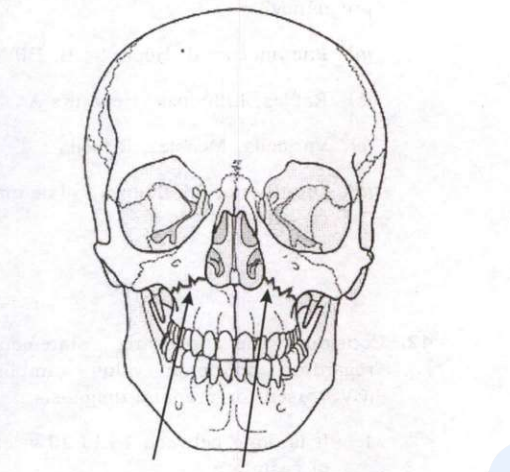
The type of fracture marked with arrow heads in the following figure is
Important Questions from Head
- A patient operated for a parotid gland tumour developed symptoms of sweating and erytherma (flushing) over the region of surgical excision while eating. The probable diagnosis is:
- Which of the statements regarding Salivary gland neoplasms are correct?
1. 80-90% of parotid tumors are malignant
2. 90% of sublingual gland tumors are malignant
3. 60-70% of submandibular gland tumors are benign
4. Parotid gland is most common site for salivary gland tumors
Select the correct answer using the code given below: - A young boy riding a motorcycle, met with a road traffic accident. On examination he had maxillofacial trauma with paraesthesia of the lower lip. Most likely underlying he has a:
- A 40-year-old smoker presents with soreness of tongue since last 2 months. On examination, it is found that the oral hygiene is poor and there is a white plaque over the lateral border of the tongue. What is the next step in the management of this patient?
- A 6-year-old boy has recurrent history of pain and swelling below his left ear, which generally lasts for 3-7 days and improves mildly after a course of antibiotics. Sialography shows punctate sialectasis. He should be treated by