$ \because $ Stress, $ \frac{F}{\Delta A}=1\%$ of $ Y=\frac{Y}{100}$
But Young's modulus, $ Y=\frac{\text{ stress }}{\text{ strain }}=\frac{\frac{F}{\Delta A}}{\frac{\Delta l}{l}}$
$ \therefore \quad \quad Y=\frac{\frac{Y}{100}}{\frac{\Delta l}{l}}$ $ \left(\right.$ putting $ \left.\frac{F}{\Delta A}=\frac{Y}{100}\right)$
$ \therefore \quad \quad \frac{\Delta l}{l}=\frac{1}{100}$
Poisson's ratio, $ \sigma =\frac{-\frac{\Delta r}{r}}{\frac{\Delta l}{l}}$
$ \therefore \quad \quad \frac{\Delta r}{r}=-\sigma .\frac{\Delta l}{l}=\frac{-0.3}{100}$
$ \frac{\Delta r}{r}=\frac{-0.3}{100}$
$ \therefore $ Change in volume, $ \frac{\Delta V}{V}=\frac{2\Delta r}{r}+\frac{\Delta l}{l}$
$ =\frac{2\times (-0.3)}{100}+\frac{1}{100}$
$ =\frac{1-0.6}{100}=\frac{0.4}{100}$
$ \therefore \quad \quad \Delta V\%=0.4\%$
Similar Questions
Which one of the following graphs represents the velocity-time ($v-t$) graph of a small spherical body falling in a viscous liquid?
- Two spherical soap bubbles of radii $r_1$ and $r_2$ in vaccum coalesce under isothermal condition. The newly formed bubble has a radius ($r$) given by
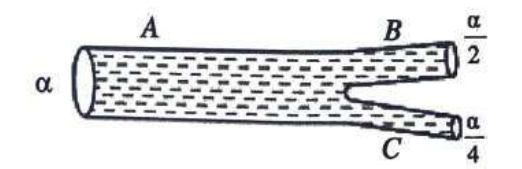
A pipe $A$ is connected with other pipes $B$ and $C$ as shown in the figure. The areas of cross-section of $A, B$ and $C$ are respectively $\alpha, \frac{\alpha}{2}$ and $\frac{\alpha}{4}$. If the velocities of flow of water through $A$ and $B$ are $10\text{ m/sec}$ and $6\text{ m/sec}$, respectively, then velocity of flow, $V_{c}$ along $C$ is
Important Questions from Mechanical Properties of Matter
- The terminal velocity of a metallic ball of radius $6\text{ mm}$ in a viscous fluid is $20\text{ cm/s}$. The terminal velocity of another ball of same material and having radius $3\text{ mm}$ in the same fluid will be __________ $\text{cm/s}$.
- Sixty four rain drops of radius 1 mm each falling down with a terminal velocity of 10 cm/s coalesce to form a bigger drop. The terminal velocity of bigger drop is ______ cm/s.
- A small metallic sphere of diameter 2 mm and density $10.5 \text{ g/cm}^3$ is dropped in glycerine having viscosity 10 Poise and density $1.5 \text{ g/cm}^3$ respectively. The terminal velocity attained by the sphere is ____ cm/s. ($\pi = \frac{22}{7}$ and $g = 10 \text{ m/s}^2$)
- A cubical block of density $\rho_b = 600 \text{ kg/m}^3$ floats in a liquid of density $\rho_l = 900 \text{ kg/m}^3$. If the height of block is $H = 8.0 \text{ cm}$ then height of the submerged part is _______ cm.
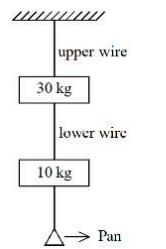
Two wires as shown in the figure below, made of steel and have breaking stress of $12 \times 10^8\text{ N/m}^2$. Area of cross-section of upper wire is $0.008\text{ cm}^2$ and of lower wire is $0.004\text{ cm}^2$. The maximum mass that can be added to pan without breaking any wire is _______ kg.
(take $g = 10\text{ m/s}^2$)