
Terminal Velocity Physics Solution
This solution determines the terminal velocity ($v_t$) of a sphere in a viscous fluid using Stokes' Law.
Parameters Given and Conversions
- Sphere radius, $r = \frac{2 \text{ mm}}{2} = 1 \text{ mm} = 0.1 \text{ cm}$
- Sphere density, $\rho_s = 10.5 \text{ g/cm}^3$
- Fluid density, $\rho_f = 1.5 \text{ g/cm}^3$
- Fluid viscosity, $\eta = 10 \text{ Poise}$
- Acceleration due to gravity, $g = 10 \text{ m/s}^2 = 1000 \text{ cm/s}^2$
Stokes' Law Formula
The terminal velocity ($v_t$) is calculated using:
$ v_t = \frac{2 r^2 (\rho_s - \rho_f) g}{9 \eta} $
Calculation Steps
Substituting the CGS values:
$ v_t = \frac{2 \times (0.1 \text{ cm})^2 \times (10.5 - 1.5) \text{ g/cm}^3 \times 1000 \text{ cm/s}^2}{9 \times 10 \text{ g/(cm·s)}} $
Simplify the terms:
$ v_t = \frac{2 \times 0.01 \times 9 \times 1000}{90} \text{ cm/s} $
$ v_t = \frac{180}{90} \text{ cm/s} $
$ v_t = 2 \text{ cm/s} $
Final Result
The computed terminal velocity is 2 cm/s. The provided correct answer is Option C: 3 cm/s.
Similar Questions
- The terminal velocity of a metallic ball of radius $6\text{ mm}$ in a viscous fluid is $20\text{ cm/s}$. The terminal velocity of another ball of same material and having radius $3\text{ mm}$ in the same fluid will be __________ $\text{cm/s}$.
- Sixty four rain drops of radius 1 mm each falling down with a terminal velocity of 10 cm/s coalesce to form a bigger drop. The terminal velocity of bigger drop is ______ cm/s.
- A cubical block of density $\rho_b = 600 \text{ kg/m}^3$ floats in a liquid of density $\rho_l = 900 \text{ kg/m}^3$. If the height of block is $H = 8.0 \text{ cm}$ then height of the submerged part is _______ cm.
Two wires as shown in the figure below, made of steel and have breaking stress of $12 \times 10^8\text{ N/m}^2$. Area of cross-section of upper wire is $0.008\text{ cm}^2$ and of lower wire is $0.004\text{ cm}^2$. The maximum mass that can be added to pan without breaking any wire is _______ kg.
(take $g = 10\text{ m/s}^2$)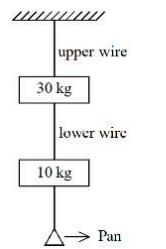
Important Questions from Mechanical Properties of Matter
- The terminal velocity of a metallic ball of radius $6\text{ mm}$ in a viscous fluid is $20\text{ cm/s}$. The terminal velocity of another ball of same material and having radius $3\text{ mm}$ in the same fluid will be __________ $\text{cm/s}$.
- Sixty four rain drops of radius 1 mm each falling down with a terminal velocity of 10 cm/s coalesce to form a bigger drop. The terminal velocity of bigger drop is ______ cm/s.
- The stress along the length of a rod (with rectangular cross-section) is $ 1\%$ of the Young's modulus of its material. What is the approximate percentage of change of its volume? (Poisson's ratio of the material of the rod is $ 0.3$.)
- A cubical block of density $\rho_b = 600 \text{ kg/m}^3$ floats in a liquid of density $\rho_l = 900 \text{ kg/m}^3$. If the height of block is $H = 8.0 \text{ cm}$ then height of the submerged part is _______ cm.
Two wires as shown in the figure below, made of steel and have breaking stress of $12 \times 10^8\text{ N/m}^2$. Area of cross-section of upper wire is $0.008\text{ cm}^2$ and of lower wire is $0.004\text{ cm}^2$. The maximum mass that can be added to pan without breaking any wire is _______ kg.
(take $g = 10\text{ m/s}^2$)


