
Terminal Velocity Physics Problem Explained
This question asks for the terminal velocity of a smaller metallic ball in a viscous fluid, given the terminal velocity of a larger ball of the same material and radius.
Physics Principle: Stokes' Law and Terminal Velocity
Terminal velocity ($v_t$) is reached when the drag force on a falling object equals its effective weight. For a sphere moving slowly in a viscous fluid, Stokes' Law gives the drag force. The resulting terminal velocity is proportional to the square of the radius ($r^2$) and inversely proportional to the fluid's viscosity ($\eta$). Assuming the fluid and material are constant:
$ v_t \propto r^2 $
Therefore, the ratio of terminal velocities for two spheres of the same material in the same fluid is equal to the ratio of the squares of their radii:
$ \frac{v_{t2}}{v_{t1}} = \left(\frac{r_2}{r_1}\right)^2 $
Calculation Steps
- Identify Given Information:
- Radius of the first ball ($r_1$) = $6 \text{ mm}$
- Terminal velocity of the first ball ($v_{t1}$) = $20 \text{ cm/s}$
- Radius of the second ball ($r_2$) = $3 \text{ mm}$
- Apply the Ratio Formula: We need to find the terminal velocity of the second ball ($v_{t2}$). Rearranging the formula:
$ v_{t2} = v_{t1} \times \left(\frac{r_2}{r_1}\right)^2 $
- Substitute Values: Insert the known values into the equation. Note that the units for radius (mm) cancel out.
$ v_{t2} = 20 \text{ cm/s} \times \left(\frac{3 \text{ mm}}{6 \text{ mm}}\right)^2 $
- Calculate the Result: Simplify the expression.
$ v_{t2} = 20 \times \left(\frac{1}{2}\right)^2 $
$ v_{t2} = 20 \times \frac{1}{4} $
$ v_{t2} = 5 \text{ cm/s} $
Conclusion
The terminal velocity of the second metallic ball is calculated to be 5 cm/s.
Similar Questions
- Sixty four rain drops of radius 1 mm each falling down with a terminal velocity of 10 cm/s coalesce to form a bigger drop. The terminal velocity of bigger drop is ______ cm/s.
- A small metallic sphere of diameter 2 mm and density $10.5 \text{ g/cm}^3$ is dropped in glycerine having viscosity 10 Poise and density $1.5 \text{ g/cm}^3$ respectively. The terminal velocity attained by the sphere is ____ cm/s. ($\pi = \frac{22}{7}$ and $g = 10 \text{ m/s}^2$)
- A cubical block of density $\rho_b = 600 \text{ kg/m}^3$ floats in a liquid of density $\rho_l = 900 \text{ kg/m}^3$. If the height of block is $H = 8.0 \text{ cm}$ then height of the submerged part is _______ cm.
Two wires as shown in the figure below, made of steel and have breaking stress of $12 \times 10^8\text{ N/m}^2$. Area of cross-section of upper wire is $0.008\text{ cm}^2$ and of lower wire is $0.004\text{ cm}^2$. The maximum mass that can be added to pan without breaking any wire is _______ kg.
(take $g = 10\text{ m/s}^2$)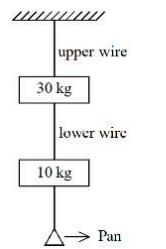
Important Questions from Mechanical Properties of Matter
Which one of the following graphs represents the velocity-time ($v-t$) graph of a small spherical body falling in a viscous liquid?
- Sixty four rain drops of radius 1 mm each falling down with a terminal velocity of 10 cm/s coalesce to form a bigger drop. The terminal velocity of bigger drop is ______ cm/s.
- Two spherical soap bubbles of radii $r_1$ and $r_2$ in vaccum coalesce under isothermal condition. The newly formed bubble has a radius ($r$) given by
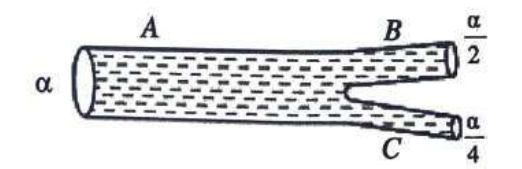
A pipe $A$ is connected with other pipes $B$ and $C$ as shown in the figure. The areas of cross-section of $A, B$ and $C$ are respectively $\alpha, \frac{\alpha}{2}$ and $\frac{\alpha}{4}$. If the velocities of flow of water through $A$ and $B$ are $10\text{ m/sec}$ and $6\text{ m/sec}$, respectively, then velocity of flow, $V_{c}$ along $C$ is
- A small metallic sphere of diameter 2 mm and density $10.5 \text{ g/cm}^3$ is dropped in glycerine having viscosity 10 Poise and density $1.5 \text{ g/cm}^3$ respectively. The terminal velocity attained by the sphere is ____ cm/s. ($\pi = \frac{22}{7}$ and $g = 10 \text{ m/s}^2$)


