
Solution
This problem involves calculating the terminal velocity of a large raindrop formed after several smaller drops coalesce. We need to use principles of volume conservation and the relationship between terminal velocity and drop size.
Volume Conservation for Coalescing Drops
When $N$ small drops of radius $r$ coalesce to form a single large drop of radius $R$, the total volume remains constant.
Volume of one small drop: $ V_{small} = \frac{4}{3} \pi r^3 $
Volume of the large drop: $ V_{large} = \frac{4}{3} \pi R^3 $
Total volume conservation implies: $ N \times V_{small} = V_{large} $
$ N \times \frac{4}{3} \pi r^3 = \frac{4}{3} \pi R^3 $
$ N r^3 = R^3 $
Taking the cube root of both sides gives the relationship between the radii:
$ R = N^{1/3} r $
Given $N = 64$ and $r = 1$ mm:
$ R = (64)^{1/3} \times (1 \text{ mm}) = 4 \times 1 \text{ mm} = 4 \text{ mm} $
The radius of the larger drop is 4 mm.
Terminal Velocity Dependence on Radius
The terminal velocity ($v_t$) of a spherical object falling through a fluid is often approximated as being proportional to the square of its radius, especially under certain conditions (like those approximated by Stokes' law for small Reynolds numbers, or simplified models):
$ v_t \propto r^2 $
Therefore, the ratio of the terminal velocities of the large drop ($v_2$) and the small drops ($v_1$) is related to the ratio of their radii squared:
$ \frac{v_2}{v_1} = \left(\frac{R}{r}\right)^2 $
Calculating the New Terminal Velocity
We have the initial velocity $v_1 = 10$ cm/s, the initial radius $r = 1$ mm, and the final radius $R = 4$ mm.
Substitute these values into the velocity ratio equation:
$ \frac{v_2}{10 \text{ cm/s}} = \left(\frac{4 \text{ mm}}{1 \text{ mm}}\right)^2 $
$ \frac{v_2}{10 \text{ cm/s}} = (4)^2 = 16 $
Now, solve for $v_2$:
$ v_2 = 16 \times 10 \text{ cm/s} $
$ v_2 = 160 \text{ cm/s} $
The terminal velocity of the larger drop is 160 cm/s.
Similar Questions
- The terminal velocity of a metallic ball of radius $6\text{ mm}$ in a viscous fluid is $20\text{ cm/s}$. The terminal velocity of another ball of same material and having radius $3\text{ mm}$ in the same fluid will be __________ $\text{cm/s}$.
- A small metallic sphere of diameter 2 mm and density $10.5 \text{ g/cm}^3$ is dropped in glycerine having viscosity 10 Poise and density $1.5 \text{ g/cm}^3$ respectively. The terminal velocity attained by the sphere is ____ cm/s. ($\pi = \frac{22}{7}$ and $g = 10 \text{ m/s}^2$)
- A cubical block of density $\rho_b = 600 \text{ kg/m}^3$ floats in a liquid of density $\rho_l = 900 \text{ kg/m}^3$. If the height of block is $H = 8.0 \text{ cm}$ then height of the submerged part is _______ cm.
Two wires as shown in the figure below, made of steel and have breaking stress of $12 \times 10^8\text{ N/m}^2$. Area of cross-section of upper wire is $0.008\text{ cm}^2$ and of lower wire is $0.004\text{ cm}^2$. The maximum mass that can be added to pan without breaking any wire is _______ kg.
(take $g = 10\text{ m/s}^2$)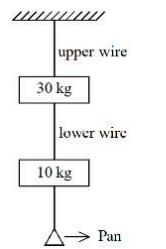
Important Questions from Mechanical Properties of Matter
- The terminal velocity of a metallic ball of radius $6\text{ mm}$ in a viscous fluid is $20\text{ cm/s}$. The terminal velocity of another ball of same material and having radius $3\text{ mm}$ in the same fluid will be __________ $\text{cm/s}$.
Which one of the following graphs represents the velocity-time ($v-t$) graph of a small spherical body falling in a viscous liquid?
- Two spherical soap bubbles of radii $r_1$ and $r_2$ in vaccum coalesce under isothermal condition. The newly formed bubble has a radius ($r$) given by
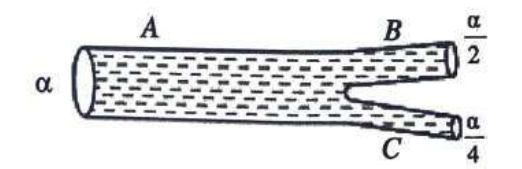
A pipe $A$ is connected with other pipes $B$ and $C$ as shown in the figure. The areas of cross-section of $A, B$ and $C$ are respectively $\alpha, \frac{\alpha}{2}$ and $\frac{\alpha}{4}$. If the velocities of flow of water through $A$ and $B$ are $10\text{ m/sec}$ and $6\text{ m/sec}$, respectively, then velocity of flow, $V_{c}$ along $C$ is
- A small metallic sphere of diameter 2 mm and density $10.5 \text{ g/cm}^3$ is dropped in glycerine having viscosity 10 Poise and density $1.5 \text{ g/cm}^3$ respectively. The terminal velocity attained by the sphere is ____ cm/s. ($\pi = \frac{22}{7}$ and $g = 10 \text{ m/s}^2$)


