Two wires as shown in the figure below, made of steel and have breaking stress of $12 \times 10^8\text{ N/m}^2$. Area of cross-section of upper wire is $0.008\text{ cm}^2$ and of lower wire is $0.004\text{ cm}^2$. The maximum mass that can be added to pan without breaking any wire is _______ kg.
(take $g = 10\text{ m/s}^2$)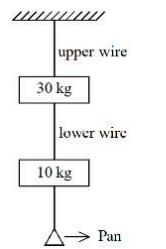
Given
Breaking stress:
$\sigma = 12\times10^8\ \text{N/m}^2$
Area of upper wire:
$A_1=0.008\ \text{cm}^2$
Area of lower wire:
$A_2=0.004\ \text{cm}^2$
Masses attached:
- Upper block $=30\ \text{kg}$
- Lower block $=10\ \text{kg}$
Let maximum additional mass in pan be $m$ kg.
Take
$g=10\ \text{m/s}^2$
Step 1 : Maximum tension in each wire
Using
$F=\sigma A$
Convert areas into $\text{m}^2$:
$A_1=0.008\times10^{-4}=8\times10^{-7}\ \text{m}^2$
$A_2=0.004\times10^{-4}=4\times10^{-7}\ \text{m}^2$
Upper wire
$T_1=(12\times10^8)(8\times10^{-7})$
$T_1=960\ \text{N}$
Equivalent supported mass:
$\dfrac{960}{10}=96\ \text{kg}$
Lower wire
$T_2=(12\times10^8)(4\times10^{-7})$
$T_2=480\ \text{N}$
Equivalent supported mass:
$\dfrac{480}{10}=48\ \text{kg}$
Step 2 : Condition for lower wire
Lower wire supports:
$(10+m)\ \text{kg}$
So,
$10+m\leq 48$
$m\leq 38$
Step 3 : Condition for upper wire
Upper wire supports:
$(30+10+m)\ \text{kg}$
So,
$40+m\leq 96$
$m\leq 56$
Step 4 : Maximum possible mass
Smaller value is allowed.
Hence,
$m_{\max}=38\ \text{kg}$
Final Answer
$\boxed{38\ \text{kg}}$
Similar Questions
- The terminal velocity of a metallic ball of radius $6\text{ mm}$ in a viscous fluid is $20\text{ cm/s}$. The terminal velocity of another ball of same material and having radius $3\text{ mm}$ in the same fluid will be __________ $\text{cm/s}$.
- Sixty four rain drops of radius 1 mm each falling down with a terminal velocity of 10 cm/s coalesce to form a bigger drop. The terminal velocity of bigger drop is ______ cm/s.
- A small metallic sphere of diameter 2 mm and density $10.5 \text{ g/cm}^3$ is dropped in glycerine having viscosity 10 Poise and density $1.5 \text{ g/cm}^3$ respectively. The terminal velocity attained by the sphere is ____ cm/s. ($\pi = \frac{22}{7}$ and $g = 10 \text{ m/s}^2$)
- A cubical block of density $\rho_b = 600 \text{ kg/m}^3$ floats in a liquid of density $\rho_l = 900 \text{ kg/m}^3$. If the height of block is $H = 8.0 \text{ cm}$ then height of the submerged part is _______ cm.
Important Questions from Mechanical Properties of Matter
- The terminal velocity of a metallic ball of radius $6\text{ mm}$ in a viscous fluid is $20\text{ cm/s}$. The terminal velocity of another ball of same material and having radius $3\text{ mm}$ in the same fluid will be __________ $\text{cm/s}$.
Which one of the following graphs represents the velocity-time ($v-t$) graph of a small spherical body falling in a viscous liquid?
- Sixty four rain drops of radius 1 mm each falling down with a terminal velocity of 10 cm/s coalesce to form a bigger drop. The terminal velocity of bigger drop is ______ cm/s.
- Two spherical soap bubbles of radii $r_1$ and $r_2$ in vaccum coalesce under isothermal condition. The newly formed bubble has a radius ($r$) given by
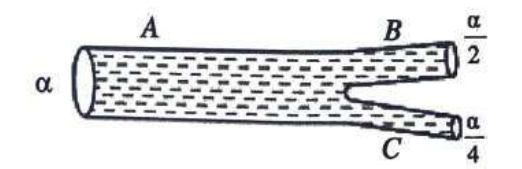
A pipe $A$ is connected with other pipes $B$ and $C$ as shown in the figure. The areas of cross-section of $A, B$ and $C$ are respectively $\alpha, \frac{\alpha}{2}$ and $\frac{\alpha}{4}$. If the velocities of flow of water through $A$ and $B$ are $10\text{ m/sec}$ and $6\text{ m/sec}$, respectively, then velocity of flow, $V_{c}$ along $C$ is