Soap Bubble Coalescence Radius
This problem concerns the radius ($r$) of a new soap bubble formed when two bubbles with radii $r_1$ and $r_2$ merge (coalesce) in a vacuum under isothermal conditions. The resulting formula depends on the physical principle governing the coalescence.
Surface Area Conservation Principle
The provided answer suggests a specific relationship ($r = \sqrt{r_1^2 + r_2^2}$). This relationship arises if we assume that the total surface area of the bubbles remains constant during coalescence. The surface area ($A$) of a sphere with radius $R$ is given by the formula $A = 4\pi R^2$.
- The initial surface area of the first bubble is $A_1 = 4\pi r_1^2$.
- The initial surface area of the second bubble is $A_2 = 4\pi r_2^2$.
- The total initial surface area is $A_{total\_initial} = A_1 + A_2 = 4\pi r_1^2 + 4\pi r_2^2$.
- The surface area of the newly formed bubble with radius $r$ is $A_{final} = 4\pi r^2$.
Radius Calculation Steps
By applying the principle of conservation of surface area, we equate the total initial surface area to the final surface area:
$ A_{final} = A_{total\_initial} $
Substituting the area formulas:
$ 4\pi r^2 = 4\pi r_1^2 + 4\pi r_2^2 $
Divide both sides of the equation by $4\pi$:
$ r^2 = r_1^2 + r_2^2 $
Taking the square root of both sides provides the final radius:
$ r = \sqrt{r_1^2 + r_2^2} $
This result matches Option 4.
Similar Questions
Which one of the following graphs represents the velocity-time ($v-t$) graph of a small spherical body falling in a viscous liquid?
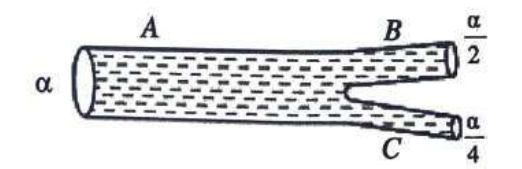
A pipe $A$ is connected with other pipes $B$ and $C$ as shown in the figure. The areas of cross-section of $A, B$ and $C$ are respectively $\alpha, \frac{\alpha}{2}$ and $\frac{\alpha}{4}$. If the velocities of flow of water through $A$ and $B$ are $10\text{ m/sec}$ and $6\text{ m/sec}$, respectively, then velocity of flow, $V_{c}$ along $C$ is
Important Questions from Mechanical Properties of Matter
- The terminal velocity of a metallic ball of radius $6\text{ mm}$ in a viscous fluid is $20\text{ cm/s}$. The terminal velocity of another ball of same material and having radius $3\text{ mm}$ in the same fluid will be __________ $\text{cm/s}$.
Which one of the following graphs represents the velocity-time ($v-t$) graph of a small spherical body falling in a viscous liquid?
- Sixty four rain drops of radius 1 mm each falling down with a terminal velocity of 10 cm/s coalesce to form a bigger drop. The terminal velocity of bigger drop is ______ cm/s.
A pipe $A$ is connected with other pipes $B$ and $C$ as shown in the figure. The areas of cross-section of $A, B$ and $C$ are respectively $\alpha, \frac{\alpha}{2}$ and $\frac{\alpha}{4}$. If the velocities of flow of water through $A$ and $B$ are $10\text{ m/sec}$ and $6\text{ m/sec}$, respectively, then velocity of flow, $V_{c}$ along $C$ is
- A small metallic sphere of diameter 2 mm and density $10.5 \text{ g/cm}^3$ is dropped in glycerine having viscosity 10 Poise and density $1.5 \text{ g/cm}^3$ respectively. The terminal velocity attained by the sphere is ____ cm/s. ($\pi = \frac{22}{7}$ and $g = 10 \text{ m/s}^2$)