A pipe $A$ is connected with other pipes $B$ and $C$ as shown in the figure. The areas of cross-section of $A, B$ and $C$ are respectively $\alpha, \frac{\alpha}{2}$ and $\frac{\alpha}{4}$. If the velocities of flow of water through $A$ and $B$ are $10\text{ m/sec}$ and $6\text{ m/sec}$, respectively, then velocity of flow, $V_{c}$ along $C$ is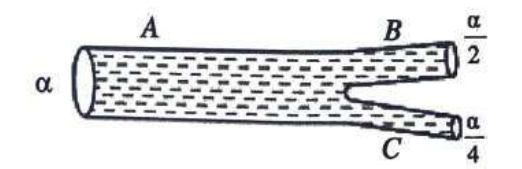
$28\text{ m/sec}$
To find the velocity of flow along pipe \( C \), we can use the principle of conservation of mass or continuity equation for incompressible flow. According to this principle, the mass flow rate must remain constant throughout the connected pipes.
The continuity equation is given by:
\(A_{1}V_{1} = A_{2}V_{2} + A_{3}V_{3}\)
Where:
- \(A_{1}, A_{2}, A_{3}\) are the cross-sectional areas of pipes \( A, B, C \) respectively.
- \(V_{1}, V_{2}, V_{3}\) are the velocities of flow through pipes \( A, B, C \) respectively.
Given:
- \(A_{1} = \alpha\)
- \(A_{2} = \frac{\alpha}{2}\)
- \(A_{3} = \frac{\alpha}{4}\)
- \(V_{1} = 10\, \text{m/sec}\)
- \(V_{2} = 6\, \text{m/sec}\)
Substitute these values into the continuity equation:
\(\alpha \times 10 = \frac{\alpha}{2} \times 6 + \frac{\alpha}{4} \times V_{3}\)
Solving for \(V_{3}\):
\(10\alpha = 3\alpha + \frac{\alpha}{4}V_{3}\)
\(7\alpha = \frac{\alpha}{4}V_{3}\)
Dividing both sides by \(\frac{\alpha}{4}\):
\(V_{3} = \frac{7\alpha \times 4}{\alpha}\)
\(V_{3} = 28\, \text{m/sec}\)
Thus, the velocity of flow along pipe \( C \) is 28 m/sec.
Similar Questions
Which one of the following graphs represents the velocity-time ($v-t$) graph of a small spherical body falling in a viscous liquid?
- Two spherical soap bubbles of radii $r_1$ and $r_2$ in vaccum coalesce under isothermal condition. The newly formed bubble has a radius ($r$) given by
Important Questions from Mechanical Properties of Matter
- The terminal velocity of a metallic ball of radius $6\text{ mm}$ in a viscous fluid is $20\text{ cm/s}$. The terminal velocity of another ball of same material and having radius $3\text{ mm}$ in the same fluid will be __________ $\text{cm/s}$.
Which one of the following graphs represents the velocity-time ($v-t$) graph of a small spherical body falling in a viscous liquid?
- Sixty four rain drops of radius 1 mm each falling down with a terminal velocity of 10 cm/s coalesce to form a bigger drop. The terminal velocity of bigger drop is ______ cm/s.
- Two spherical soap bubbles of radii $r_1$ and $r_2$ in vaccum coalesce under isothermal condition. The newly formed bubble has a radius ($r$) given by
- A small metallic sphere of diameter 2 mm and density $10.5 \text{ g/cm}^3$ is dropped in glycerine having viscosity 10 Poise and density $1.5 \text{ g/cm}^3$ respectively. The terminal velocity attained by the sphere is ____ cm/s. ($\pi = \frac{22}{7}$ and $g = 10 \text{ m/s}^2$)