
The correct set(s) of reactions to synthesize benzoic acid starting from benzene is/are
Benzoic acid can be built from benzene by first introducing a substituent through electrophilic substitution and then converting that substituent into a –COOH group; each route must use reactions that actually occur under the stated conditions.
Step 1 — Bromination, Grignard formation and carboxylation work: \(\text{C}_6\text{H}_6 \rightarrow \text{C}_6\text{H}_5\text{Br} \rightarrow \text{C}_6\text{H}_5\text{MgBr} \xrightarrow{\text{CO}_2} \text{C}_6\text{H}_5\text{COOMgBr} \xrightarrow{\text{H}_3\text{O}^+} \text{C}_6\text{H}_5\text{COOH}\). This route holds.
Step 2 — Friedel–Crafts methylation gives toluene, and hot alkaline permanganate oxidises the side chain: \(\text{C}_6\text{H}_6 \rightarrow \text{C}_6\text{H}_5\text{CH}_3 \xrightarrow{\text{KMnO}_4/\text{OH}^-,\ \Delta} \text{C}_6\text{H}_5\text{COO}^- \xrightarrow{\text{H}_3\text{O}^+} \text{C}_6\text{H}_5\text{COOH}\). This route holds.
Step 3 — Friedel–Crafts acylation gives acetophenone, and the haloform reaction with Br2/NaOH cleaves the methyl ketone: \(\text{C}_6\text{H}_5\text{COCH}_3 + 3\text{Br}_2 + 4\text{NaOH} \rightarrow \text{C}_6\text{H}_5\text{COONa} + \text{CHBr}_3 + 3\text{NaBr} + 3\text{H}_2\text{O}\); acidification gives benzoic acid. This route holds.
Step 4 — In the route through Br2/Fe and NH3 at 25°C, bromobenzene does not undergo nucleophilic substitution with ammonia under such mild conditions, because the C–Br bond of an aryl halide has partial double-bond character and the ring is not activated. Aniline is not formed, so the diazotisation, Sandmeyer cyanation and nitrile hydrolysis steps cannot follow. This route fails.
(i) Br2 / Fe (ii) Mg / dry ether (iii) CO2 (iv) H3O⊕, (i) CH3Cl, Anhydrous AlCl3 (ii) KMnO4 | \(\overset{\ominus}{\text{O}}\text{H}\), Δ (iii) H3O⊕ and (i) CH3COCl, Anhydrous AlCl3 (ii) Br2, NaOH (iii) H3O⊕ options are correct.
Similar Questions
The conversion(s) that can be carried out by bromine in carbon tetrachloride solvent is/are

‘L’ in the above sequence of reaction is/are (where L ≠ M ≠ N)
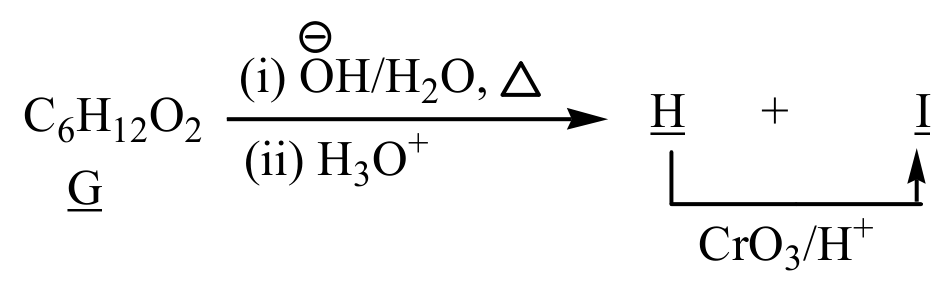
‘G’ in the above sequence of reactions is
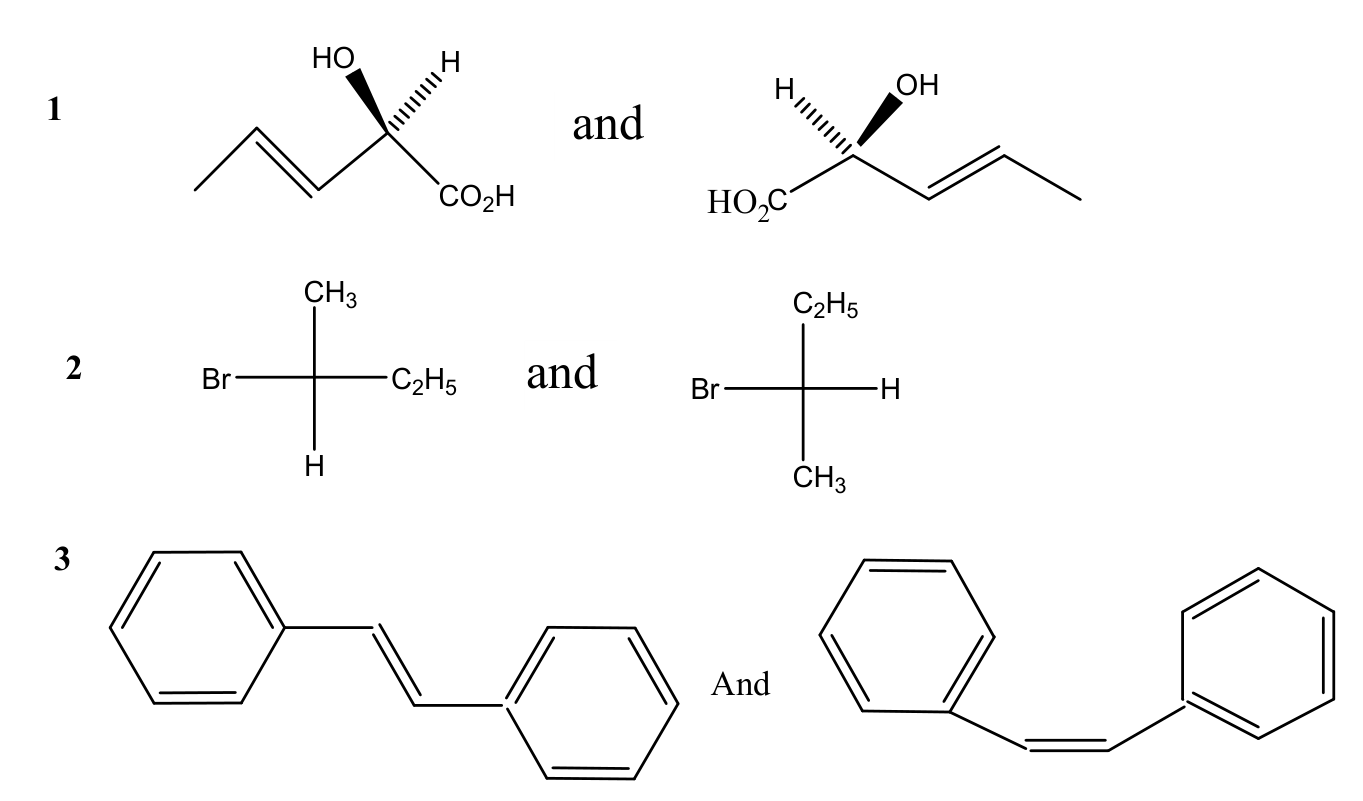
The relationship between the pair of compounds shown above are respectively,
The correct stability order of the following carbocations is
H2\(\overset{\oplus}{\text{C}}\) – CH = CH – CH3 \(\overset{\oplus}{\text{C}}\)H2 – CH = CH – BMe2 I II H2\(\overset{\oplus}{\text{C}}\) – CH = CH – NMe2 H2\(\overset{\oplus}{\text{C}}\) – CH = CH – OMe III IV The IUPAC name of
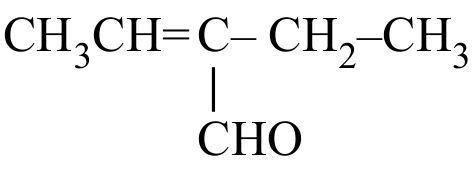
is :
Select the molecule in which all the atoms may lie on a single plane is
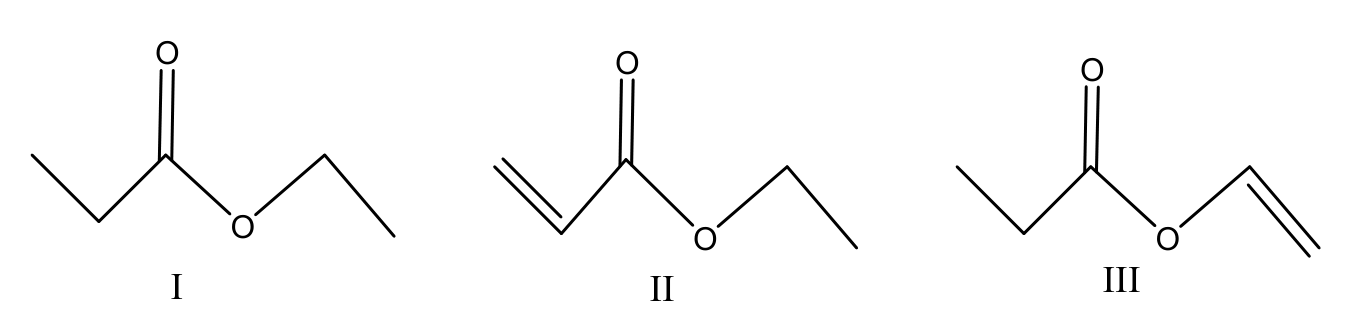
The correct order of C=O bond length in ethyl propanoate (I), ethyl propenoate (II) and ethenyl propanoate (III) is

If all the nucleophilic substitution reactions at saturated carbon atoms in the above sequence of reactions follow SN2 mechanism, then E and F will be respectively,

The correct option for the above reaction is
Important Questions from Organic Chemistry
- In Dumas method for estimation of nitrogen, 0.50 g of an organic compound gave 70 mL of nitrogen collected at 300 K and 715 mm pressure. The percentage of nitrogen in the organic compound is ______ %.
(Aqueous tension at 300 K is 15 mm). - $0.25 \text{ g}$ of an organic compound "A" containing carbon, hydrogen and oxygen was analysed using the combustion method. There was an increase in mass of $\text{CaCl}_2$ tube and potash tube at the end of the experiment. The amount was found to be $0.15 \text{ g}$ and $0.1837 \text{ g}$, respectively. The percentage of oxygen in compound A is ______ %. (Nearest integer)
(Given: molar mass in $\text{g mol}^{-1}$ $\text{H} : 1, \text{C} : 12, \text{O} : 16$) - Grignard reagent $\text{RMgBr (P)}$ reacts with water and forms a gas $\text{(Q)}$. One gram of Q occupies $1.4 \text{ dm}^3$ at STP. (P) on reaction with dry ice in dry ether followed by $\text{H}_3\text{O}^+$ forms a compound $\text{(Z)}$. 0.1 mole of $\text{(Z)}$ will weigh _________ g. (Nearest integer)
- Consider all the structural isomers with molecular formula $\text{C}_5\text{H}_{11}\text{Br}$ are separately treated with $\text{KOH(aq)}$ to give respective substitution products, without any rearrangement. The number of products which can exhibit optical isomerism from these is ___________.
Consider the following reactions sequence
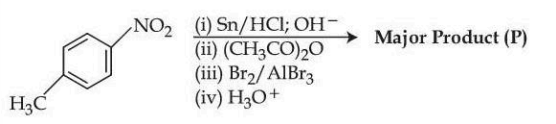
When the product (P) is subjected to Carius analysis using $\text{AgNO}_3$, $1.0\text{ g}$ of the product (P) will produce __________ g of the precipitate of AgBr. (Nearest Integer)
(Given : molar mass in $\text{g mol}^{-1}$ C : 12, H : 1, O : 16, N : 14, Br : 80, Ag : 108)


