
The correct order of C=O bond length in ethyl propanoate (I), ethyl propenoate (II) and ethenyl propanoate (III) is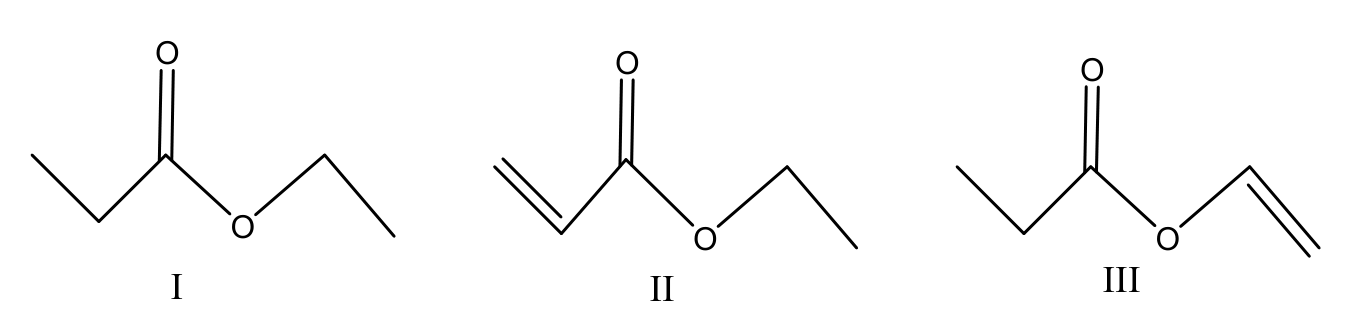
II > I > III
In an ester the lone pair on the alkoxy oxygen is delocalised into the carbonyl group (O=C–O ↔ −O–C=O+). Anything that adds single-bond character to C=O lengthens it; anything that reduces the donation shortens it.
Step 1 — Ethyl propanoate (I) shows only this normal ester resonance, so it is the reference.
Step 2 — In ethyl propenoate (II) the C=C double bond is conjugated with C=O. An extra resonance form CH2+–CH=C–O− places more single-bond character on the carbonyl, so its C=O is longer than in I.
Step 3 — In ethenyl propanoate (III) the ester oxygen lone pair is shared with the vinyl group (O+=CH–CH2−), so it donates less into C=O. The carbonyl keeps more double-bond character and is the shortest.
Step 4 — So the length order is II longest, then I, then III. The order I, II, III ignores the lengthening by conjugation in II; the order III, II, I puts the vinyl ester longest, the reverse of its behaviour; the order I, III, II puts II shortest although it is the most delocalised.
II > I > III option is correct.
Similar Questions
The conversion(s) that can be carried out by bromine in carbon tetrachloride solvent is/are
The correct set(s) of reactions to synthesize benzoic acid starting from benzene is/are

‘L’ in the above sequence of reaction is/are (where L ≠ M ≠ N)
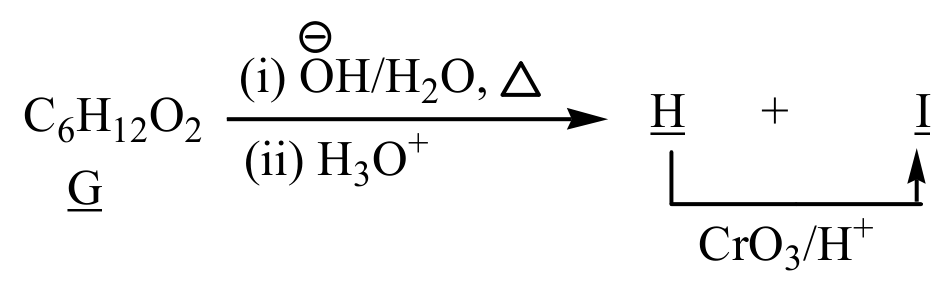
‘G’ in the above sequence of reactions is
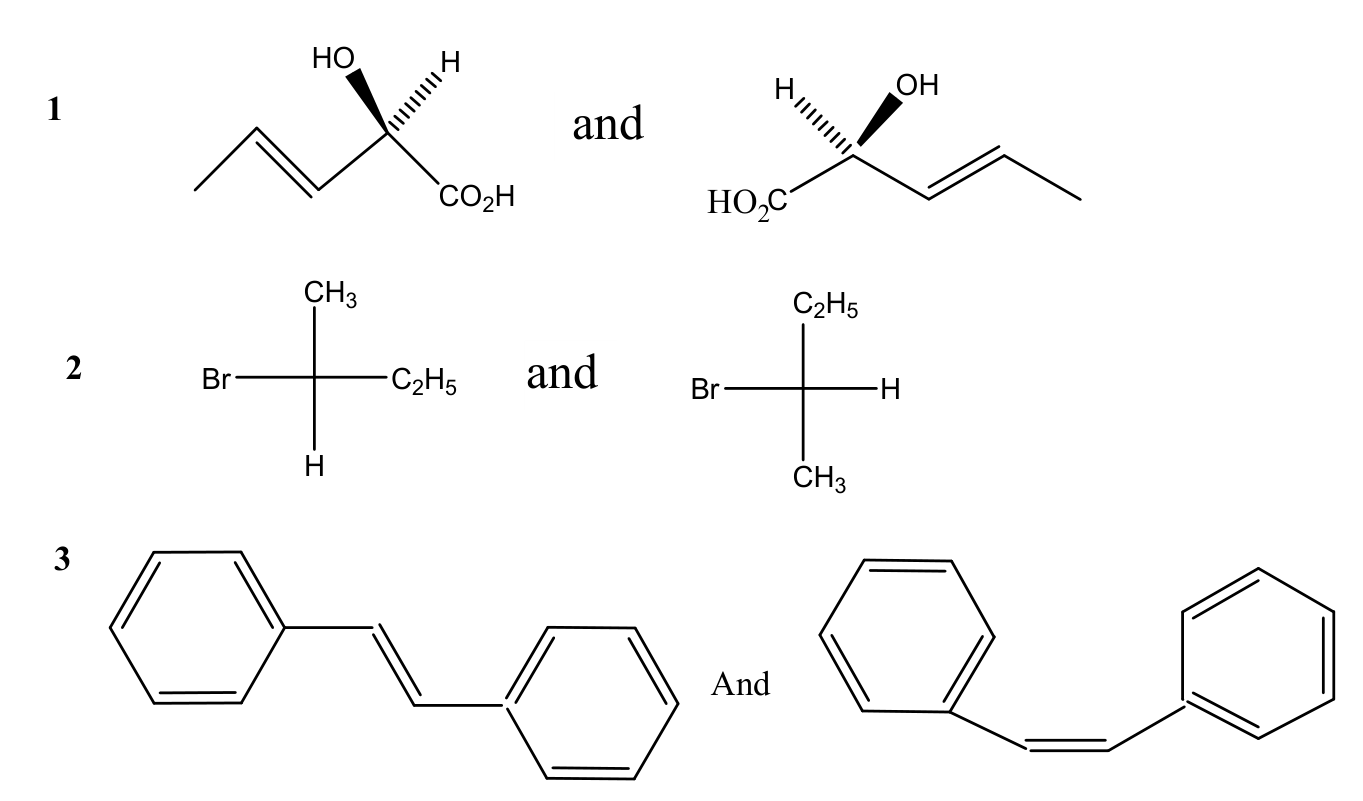
The relationship between the pair of compounds shown above are respectively,
The correct stability order of the following carbocations is
H2\(\overset{\oplus}{\text{C}}\) – CH = CH – CH3 \(\overset{\oplus}{\text{C}}\)H2 – CH = CH – BMe2 I II H2\(\overset{\oplus}{\text{C}}\) – CH = CH – NMe2 H2\(\overset{\oplus}{\text{C}}\) – CH = CH – OMe III IV The IUPAC name of
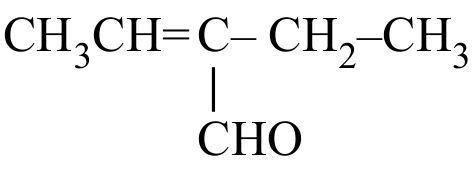
is :
Select the molecule in which all the atoms may lie on a single plane is

If all the nucleophilic substitution reactions at saturated carbon atoms in the above sequence of reactions follow SN2 mechanism, then E and F will be respectively,

The correct option for the above reaction is
Important Questions from Organic Chemistry
- In Dumas method for estimation of nitrogen, 0.50 g of an organic compound gave 70 mL of nitrogen collected at 300 K and 715 mm pressure. The percentage of nitrogen in the organic compound is ______ %.
(Aqueous tension at 300 K is 15 mm). - $0.25 \text{ g}$ of an organic compound "A" containing carbon, hydrogen and oxygen was analysed using the combustion method. There was an increase in mass of $\text{CaCl}_2$ tube and potash tube at the end of the experiment. The amount was found to be $0.15 \text{ g}$ and $0.1837 \text{ g}$, respectively. The percentage of oxygen in compound A is ______ %. (Nearest integer)
(Given: molar mass in $\text{g mol}^{-1}$ $\text{H} : 1, \text{C} : 12, \text{O} : 16$) - Grignard reagent $\text{RMgBr (P)}$ reacts with water and forms a gas $\text{(Q)}$. One gram of Q occupies $1.4 \text{ dm}^3$ at STP. (P) on reaction with dry ice in dry ether followed by $\text{H}_3\text{O}^+$ forms a compound $\text{(Z)}$. 0.1 mole of $\text{(Z)}$ will weigh _________ g. (Nearest integer)
- Consider all the structural isomers with molecular formula $\text{C}_5\text{H}_{11}\text{Br}$ are separately treated with $\text{KOH(aq)}$ to give respective substitution products, without any rearrangement. The number of products which can exhibit optical isomerism from these is ___________.
Consider the following reactions sequence
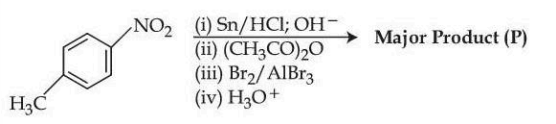
When the product (P) is subjected to Carius analysis using $\text{AgNO}_3$, $1.0\text{ g}$ of the product (P) will produce __________ g of the precipitate of AgBr. (Nearest Integer)
(Given : molar mass in $\text{g mol}^{-1}$ C : 12, H : 1, O : 16, N : 14, Br : 80, Ag : 108)


