
The correct stability order of the following carbocations isH2\(\overset{\oplus}{\text{C}}\) – CH = CH – CH3 \(\overset{\oplus}{\text{C}}\)H2 – CH = CH – BMe2 I II H2\(\overset{\oplus}{\text{C}}\) – CH = CH – NMe2 H2\(\overset{\oplus}{\text{C}}\) – CH = CH – OMe III IV
III > IV > I > II
All four ions are allyl cations of the type CH2+–CH=CH–X. Allylic resonance moves the positive charge to the carbon that carries X (CH2=CH–CH+–X), so the stability depends on how well X can donate electrons to that carbon.
Step 1 — III, X = NMe2: nitrogen donates its lone pair (+M), giving the iminium form CH2=CH–CH=N+Me2. Nitrogen is the best π-donor here, so III is the most stable.
Step 2 — IV, X = OMe: oxygen also donates a lone pair (oxocarbenium form), but being more electronegative than nitrogen it donates less, so IV comes after III.
Step 3 — I, X = CH3: the methyl group stabilises only by hyperconjugation and the +I effect, weaker than lone-pair donation, so I comes after IV.
Step 4 — II, X = BMe2: boron has an empty p orbital and no lone pair; it withdraws π-electron density and destabilises the positive charge, so II is the least stable. The order is therefore III, IV, I, II; orders that place II first, or put OMe below CH3 or BMe2, or put OMe above NMe2, contradict these donor strengths.
III > IV > I > II option is correct.
Similar Questions
The conversion(s) that can be carried out by bromine in carbon tetrachloride solvent is/are
The correct set(s) of reactions to synthesize benzoic acid starting from benzene is/are

‘L’ in the above sequence of reaction is/are (where L ≠ M ≠ N)
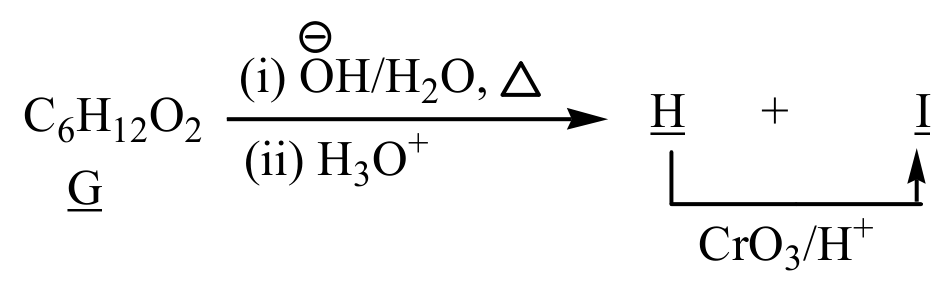
‘G’ in the above sequence of reactions is
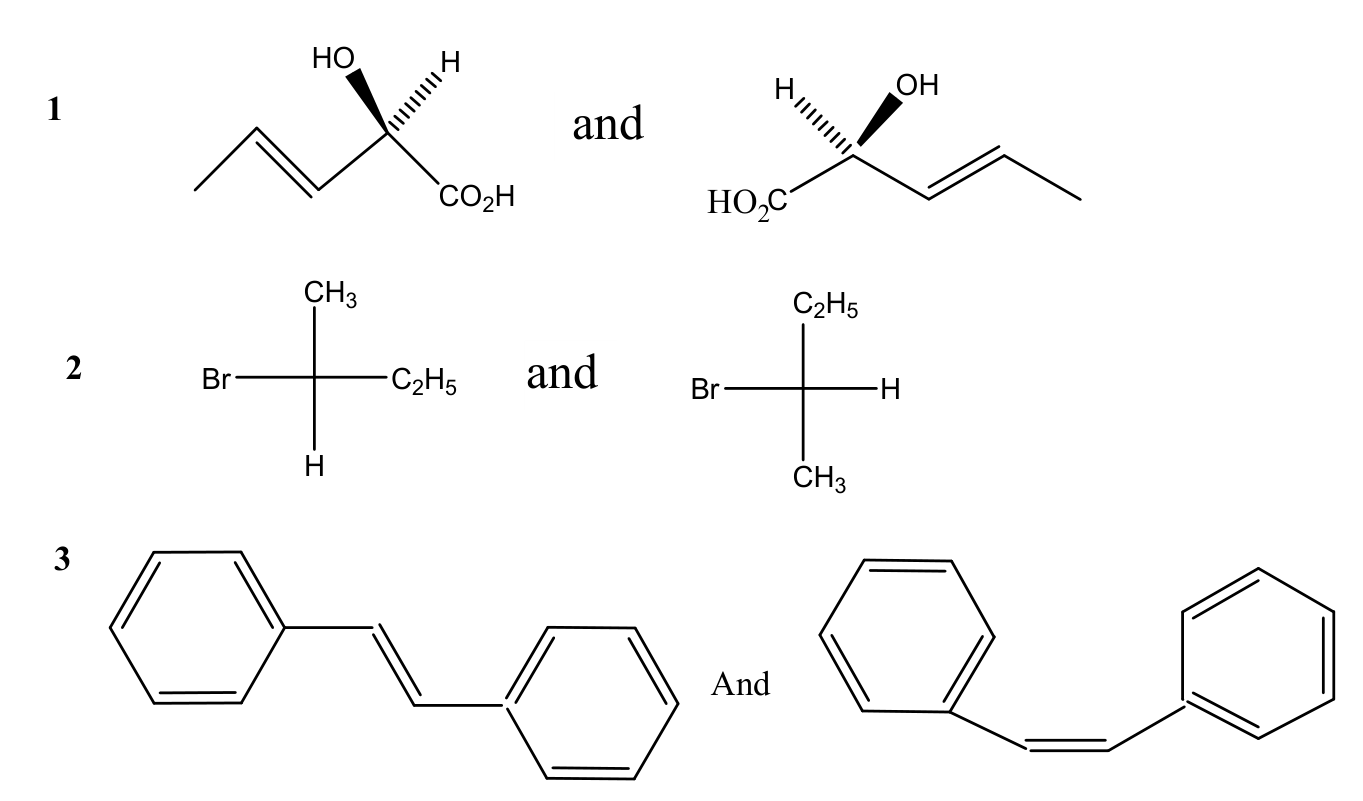
The relationship between the pair of compounds shown above are respectively,
The IUPAC name of
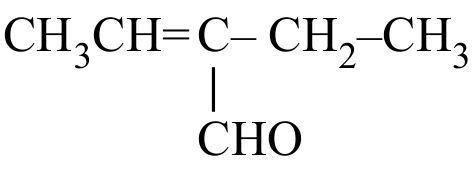
is :
Select the molecule in which all the atoms may lie on a single plane is
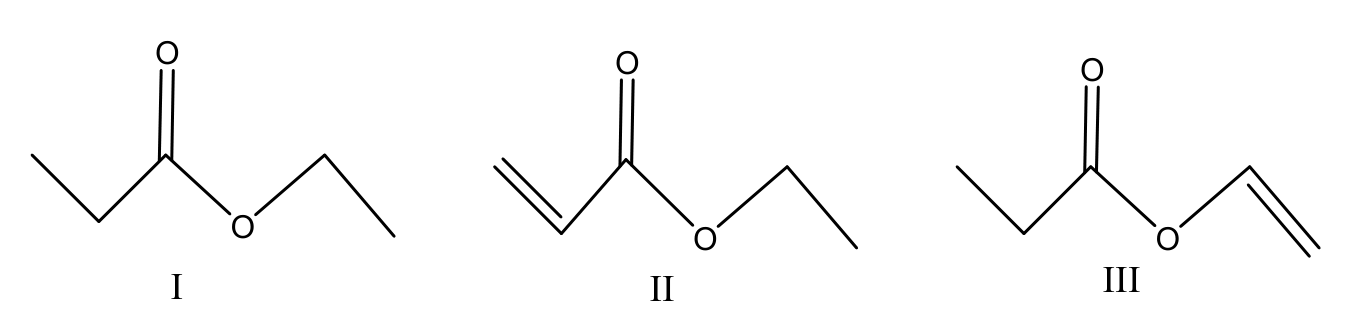
The correct order of C=O bond length in ethyl propanoate (I), ethyl propenoate (II) and ethenyl propanoate (III) is

If all the nucleophilic substitution reactions at saturated carbon atoms in the above sequence of reactions follow SN2 mechanism, then E and F will be respectively,

The correct option for the above reaction is
Important Questions from Organic Chemistry
- In Dumas method for estimation of nitrogen, 0.50 g of an organic compound gave 70 mL of nitrogen collected at 300 K and 715 mm pressure. The percentage of nitrogen in the organic compound is ______ %.
(Aqueous tension at 300 K is 15 mm). - $0.25 \text{ g}$ of an organic compound "A" containing carbon, hydrogen and oxygen was analysed using the combustion method. There was an increase in mass of $\text{CaCl}_2$ tube and potash tube at the end of the experiment. The amount was found to be $0.15 \text{ g}$ and $0.1837 \text{ g}$, respectively. The percentage of oxygen in compound A is ______ %. (Nearest integer)
(Given: molar mass in $\text{g mol}^{-1}$ $\text{H} : 1, \text{C} : 12, \text{O} : 16$) - Grignard reagent $\text{RMgBr (P)}$ reacts with water and forms a gas $\text{(Q)}$. One gram of Q occupies $1.4 \text{ dm}^3$ at STP. (P) on reaction with dry ice in dry ether followed by $\text{H}_3\text{O}^+$ forms a compound $\text{(Z)}$. 0.1 mole of $\text{(Z)}$ will weigh _________ g. (Nearest integer)
- Consider all the structural isomers with molecular formula $\text{C}_5\text{H}_{11}\text{Br}$ are separately treated with $\text{KOH(aq)}$ to give respective substitution products, without any rearrangement. The number of products which can exhibit optical isomerism from these is ___________.
Consider the following reactions sequence
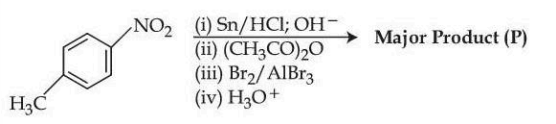
When the product (P) is subjected to Carius analysis using $\text{AgNO}_3$, $1.0\text{ g}$ of the product (P) will produce __________ g of the precipitate of AgBr. (Nearest Integer)
(Given : molar mass in $\text{g mol}^{-1}$ C : 12, H : 1, O : 16, N : 14, Br : 80, Ag : 108)


