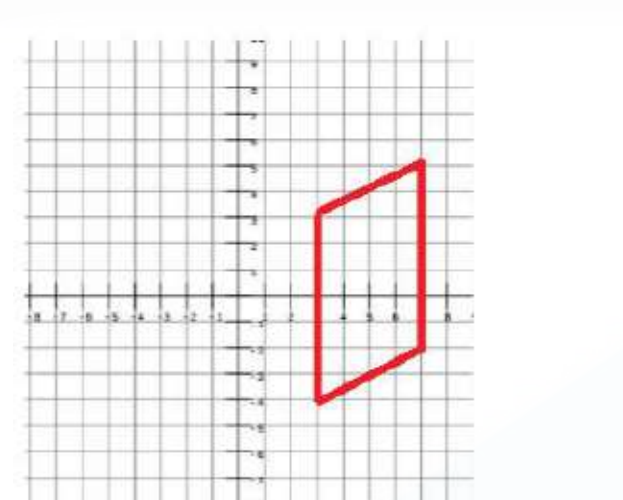
The base of a triangle is half the base of a parallelogram having the same area as that of the triangle. The ratio of the heights of the triangle to the parallelogram will be:
4 : 1
Let the base of parallelogram = b
⇒ Base of triangle = b/2
Let the height of parallelogram be h 1and height of triangle be h 2
Given that the area of parallelogram is equal to area of triangle
⇒ 1/2 × b/2 × h 2= b × h 1
∴ h 2∶ h 1= 4 ∶ 1Similar Questions
The sum of the lengths of the edges of a cube is equal to twice the perimeter of a square. If a quarter of the numerical value of the volume of the cube is equal to the numerical value of the area of the square, then the length of one side of the square is:
The base of a triangle is five-sixth of the base of a parallelogram having the same area as that of the triangle. The ratio of the corresponding heights of the triangle to the parallelogram will be:
The sum of the lengths of the edges of a cube is equal to four times the perimeter of a square. If a quarter of the numerical value of the volume of the cube is equal to the numerical value of the area of the square, then the length of one side of the square is:
The ratio of the areas of a square and a regular hexagon, both inscribed in a circle is -
A right-angled triangle ABC is right-angled at B, and tan A = 4/3. If AC = 25 cm, the length of BC is:
Three triangles are marked out of a bigger triangle at the three vertices such that each side of each of the smaller triangles is one-fourth as long as each corresponding side of the bigger triangle. The ratio of the area of the three small triangles taken together to that of the rest of the bigger triangle is:
From each corner of a square with an edge of 4 cm, a 1 cm segment was chopped off from each side containing a vertex. What is the perimeter and the area of the octagon thus created?
A square park having a side 20 m has two roads each 2 m wide running in the middle of it and parallel to its length and breath. What will be cost of gravelling the path at the rate of Rs. 100/m 2?
The area of a rhombus is 24 m 2and the length of one of its diagonals is 8 m. The length of each side of the rhombus will be:
Find the length of one side of a rhombus whose area is 24 cm 2and the sum of the lengths of its diagonals is 14 cm.
Important Questions from Plane Figures
- A rectangular grassy plot is 38 m long and 32 m wide. It has a gravel path of uniform width on the inside having an area of $600 \text{ m}^2$. The width of the path is:
- A river, 2 m deep and 45 m wide is flowing at the speed of 3 km per hour. The quantity of water that runs into the sea per minute is:
A regular hexagonal garden with each side measuring 14 metres is surrounded by a circular jogging track that has a radius of 21 metres from the centre of the hexagon. Find the sum of the perimeters of both shapes.
(Use $\pi = \frac{22}{7}$)- If a circle and a square have the same perimeter, then
What is the area of this parallelogram in sq.cm.? The measurements are in cms.