
Select the set in which the numbers are related in the same way as are the numbers of the following sets. (NOTE : Operations should be performed on the whole numbers, without breaking down the numbers into its constituent digits. E.g. 13 - Operations on 13 such as adding / subtracting / multiplying etc. to 13 can be performed. Breaking down 13 into 1 and 3 and then performing mathematical operations on 1 and 3 is not allowed) (144, 9, 3) (225, 7, 8)
(64, 5, 3)
Solving Number Analogy Questions
This question asks us to identify the relationship between the numbers in the given sets and then find an option set that follows the same relationship. The sets provided are (144, 9, 3) and (225, 7, 8).
We are instructed to perform operations only on the whole numbers provided, not on their individual digits.
Analyzing the Given Number Sets
Let's examine the first set: (144, 9, 3).
- The first number is 144.
- The second number is 9.
- The third number is 3.
We need to find a connection between 144, 9, and 3. Let's try combining the second and third numbers using basic arithmetic operations (addition, subtraction, multiplication, division) and see if we can relate the result to the first number, 144.
- Sum of the second and third numbers: $9 + 3 = 12$. Notice that $12^2 = 144$.
- Difference of the second and third numbers: $9 - 3 = 6$. $6^2 = 36$, $6 \times 12 = 72$, etc., none directly relate to 144.
- Product of the second and third numbers: $9 \times 3 = 27$. $27 \times \text{something} = 144$? No simple integer multiplication.
- Division of the second and third numbers: $9 \div 3 = 3$. $3^2 = 9$, $3 \times \text{something} = 144$? No simple integer multiplication.
The sum relationship seems promising: The first number is the square of the sum of the second and third numbers.
Let's verify this pattern with the second set: (225, 7, 8).
- The first number is 225.
- The second number is 7.
- The third number is 8.
Using the identified pattern: Sum of the second and third numbers is $7 + 8 = 15$. The square of this sum is $15^2 = 225$. This matches the first number in the set.
So, the established relationship is: First Number = (Second Number + Third Number)$^2$
Testing the Options for the Number Relation
Now we will apply this relation to the given options to find the set that follows the same pattern.
Option 1: (168, 5, 8)
- Second number = 5
- Third number = 8
- Sum = $5 + 8 = 13$
- Square of sum = $13^2 = 169$
The first number in the option is 168. Since $169 \neq 168$, this option does not follow the pattern.
Option 2: (64, 5, 3)
- Second number = 5
- Third number = 3
- Sum = $5 + 3 = 8$
- Square of sum = $8^2 = 64$
The first number in the option is 64. Since $64 = 64$, this option follows the pattern.
Option 3: (81, 6, 2)
- Second number = 6
- Third number = 2
- Sum = $6 + 2 = 8$
- Square of sum = $8^2 = 64$
The first number in the option is 81. Since $64 \neq 81$, this option does not follow the pattern.
Option 4: (120, 7, 4)
- Second number = 7
- Third number = 4
- Sum = $7 + 4 = 11$
- Square of sum = $11^2 = 121$
The first number in the option is 120. Since $121 \neq 120$, this option does not follow the pattern.
Only Option 2 matches the number relation found in the original sets (144, 9, 3) and (225, 7, 8).
Summary of Number Relation Analysis
| Set | Second Number | Third Number | Sum (Second + Third) | Square of Sum | First Number | Pattern Followed? |
|---|---|---|---|---|---|---|
| (144, 9, 3) | 9 | 3 | 12 | $12^2 = 144$ | 144 | Yes (Base Set) |
| (225, 7, 8) | 7 | 8 | 15 | $15^2 = 225$ | 225 | Yes (Base Set) |
| (168, 5, 8) | 5 | 8 | 13 | $13^2 = 169$ | 168 | No ($169 \neq 168$) |
| (64, 5, 3) | 5 | 3 | 8 | $8^2 = 64$ | 64 | Yes ($64 = 64$) |
| (81, 6, 2) | 6 | 2 | 8 | $8^2 = 64$ | 81 | No ($64 \neq 81$) |
| (120, 7, 4) | 7 | 4 | 11 | $11^2 = 121$ | 120 | No ($121 \neq 120$) |
Based on the analysis, the set (64, 5, 3) is related in the same way as the numbers of the given sets.
Revision Table: Number Analogy Basics
| Concept | Description | How it applies here |
|---|---|---|
| Number Analogy | Identifying a pattern or relationship between numbers in a given set or pair. | Finding the rule connecting the three numbers in (144, 9, 3) and (225, 7, 8). |
| Set Relation | The specific mathematical or logical rule that connects the numbers within a set. | The rule is: First Number = (Second Number + Third Number)$^2$. |
| Pattern Identification | The process of discovering the underlying rule by observing the numbers. | Testing operations like addition, subtraction, multiplication, squaring, etc., on the numbers. |
| Applying the Pattern | Using the identified rule to test other sets or options. | Checking which option set (168, 5, 8), (64, 5, 3), (81, 6, 2), or (120, 7, 4) follows the same rule. |
Additional Information: Solving Number Relations
Number relation and analogy questions are common in logical reasoning and quantitative aptitude tests. To solve these effectively, consider the following strategies:
- Look for basic operations: Start with simple arithmetic like addition, subtraction, multiplication, and division between the numbers.
- Consider squares and cubes: Often, numbers in these sets are perfect squares or cubes, or related to squares/cubes of combinations of other numbers in the set.
- Check for ratios or proportions: Sometimes numbers might be related by a constant ratio or a simple proportion.
- Look for sequences: In sets with more numbers, there might be an arithmetic or geometric progression, or another type of sequence.
- Combine numbers: Try operations on two numbers to see if they produce the third, or if a combination of two relates to the third. For example, (A, B, C), check relations like A = B+C, A = B*C, A = B$+$C$^2$, etc.
- Factorization: For larger numbers, prime factorization might reveal a hidden relationship.
- Be mindful of constraints: Pay close attention to rules given, such as the constraint in this problem about not breaking down digits.
- Test all options: Once a potential pattern is found, rigorously test it against all the given options to ensure only one fits the relationship.
Practicing different types of number relation problems helps in quickly recognizing common patterns.
Similar Questions
Which two numbers and two signs should be interchanged to make the given equation correct?
5 + 44 - 8 × 25 = 203
Select the set in which the numbers are related in the same way as are the numbers of the following set.
(NOTE: Operations should be performed on the whole numbers, without breaking down the numbers into its constituent digits.)
(60, 5, 6)
(48, 8, 3)
A & B means ‘A is the son of B’
A # B means ‘A is the sister of B’
A @ B means ‘A is the brother of B’
A % B means ‘A is the father of B’
A - B means ‘A is the daughter of B’
A * B means ‘A is the wife of B’
If C # D @ E % Z & L # M - N * P, then how is Z related to N?
Select the figure that will come next in the following figure series.

Select the figure from among the given options that can replace the question mark (?) in the following series.

Read the given statements and conclusions carefully. Assuming that the information given in the statements is true, even if it appears to be at variance with commonly known facts, decide which of the given conclusions logically follow(s) from the statements.
Statements:
All pens are plates.
All plates are trays.
Some trays are boxes.
Conclusions:
I. Some boxes are plates.
II. Some trays are pens.
III. Some boxes are pens.
IV. No tray is a plate.
In the following question, select the missing number from the given series.
69, 70, 73, 78, 85, ?
If A × B means that A is the father of B, A + B means that A is the mother of B, A ÷ B means that A is the brother of B then which of the following expression shows that A is the paternal uncle of C?
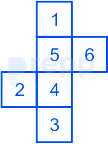
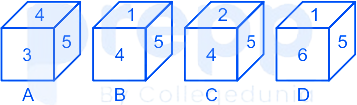
Select the cube that can be formed by folding the given sheet along the lines.
Three of the following letter-clusters are alike in some manner and hence form a group. Which letter-cluster does not belong to that group?
Important Questions from Miscellaneous
Which gas shields the surface of the earth from ultraviolet radiation from the sun?
Which event is marked as an Intangible Cultural Heritage of Humanity by UNESCO?
Who has been conferred with the rank of the Commander of the Order of the British Empire in 2018?
Who directead the film ‘Bhuvan Shome’?
The book “In my mother’s house” is written by _______



