
A & B means ‘A is the son of B’ A # B means ‘A is the sister of B’ A @ B means ‘A is the brother of B’ A % B means ‘A is the father of B’ A - B means ‘A is the daughter of B’ A * B means ‘A is the wife of B’ If C # D @ E % Z & L # M - N * P, then how is Z related to N?
Grandson
Understanding Blood Relations with Coded Language
This question asks us to determine the relationship between two individuals, Z and N, based on a complex expression involving coded relationships. We need to decode each part of the expression step-by-step and build a family tree or relationship chart.
Decoding the Relationships
Let's first understand the meaning of each symbol given:
- A & B means ‘A is the son of B’
- A # B means ‘A is the sister of B’
- A @ B means ‘A is the brother of B’
- A % B means ‘A is the father of B’
- A - B means ‘A is the daughter of B’
- A * B means ‘A is the wife of B’
Analyzing the Expression: C # D @ E % Z & L # M - N * P
Now, let's break down the given expression part by part:
- C # D: C is the sister of D. (C is female)
- D @ E: D is the brother of E. (D is male)
Combining the first two, C, D, and E are siblings. C is female, D is male. E could be male or female based on these two statements alone, but the next statement clarifies E's gender.
- E % Z: E is the father of Z. (E is male)
This confirms E is male and establishes the relationship between E and Z. Z is E's child.
- Z & L: Z is the son of L. (Z is male)
If Z is the son of E (from step 3) and also the son of L, then E and L must be the parents of Z. Since E is the father, L must be the mother. This also confirms Z is male.
- L # M: L is the sister of M. (L is female)
L and M are siblings, and L is female. M's gender is not yet determined by this statement.
- M - N: M is the daughter of N. (M is female)
This tells us M is female and N is M's parent.
- N * P: N is the wife of P. (N is female, P is male)
This establishes N and P as a married couple, with N being female. Since M is N's daughter (from step 6) and N is female, N must be M's mother.
Connecting the Relationships to Find Z's Relation to N
Let's consolidate the relationships we've found:
- C, D, E are siblings. E is male. C is female.
- E and L are parents of Z. E is father, L is mother. Z is male.
- L and M are siblings. L is female. M is female.
- N and P are married. N is wife (female), P is husband (male).
- M is the daughter of N. Since N is female, N is M's mother.
- Since L is M's sister, and M is N's daughter, L is also N's daughter.
- L is Z's mother (from step 4).
So, L is Z's mother, and L is N's daughter. This means N is the mother of Z's mother. Therefore, N is Z's maternal grandmother.
Determining How Z is Related to N
The question asks for the relationship of Z to N. We found that N is Z's grandmother. The inverse relationship is that Z is the grandson of N.
Let's summarize the relevant chain:
- Z is the son of L.
- L is the sister of M.
- M is the daughter of N.
- This implies L is also the daughter of N.
- So, Z is the son of N's daughter.
- This makes Z the grandson of N.
Here is a simplified view of the key relationships:
| Relationship | Individuals | Gender |
|---|---|---|
| Parents of Z | E (Father), L (Mother) | E: Male, L: Female |
| Children of N | M (Daughter), L (Daughter) | M: Female, L: Female |
| Relationship L to N | L is daughter of N | L: Female |
| Relationship Z to L | Z is son of L | Z: Male |
| Relationship Z to N | Z is son of N's daughter (L) | Z: Male |
Based on this analysis, Z is the grandson of N.
Revision Table: Key Relationship Codes
| Code | Meaning |
|---|---|
| & | Son of |
| # | Sister of |
| @ | Brother of |
| % | Father of |
| - | Daughter of |
| * | Wife of |
Additional Information: Solving Blood Relation Problems
Solving blood relation problems effectively requires a systematic approach. Here are some tips:
- Identify Gender: As you decode, note the gender of each person involved whenever possible.
- Build a Diagram: Drawing a simple family tree diagram can be very helpful. Use symbols like a circle for female, square for male, double line for marriage, and single line for sibling or parent-child relationships.
- Break Down Complex Expressions: Analyze the expression piece by piece, from left to right, establishing relationships incrementally.
- Focus on the Question: Once the relationships are clear, specifically focus on the two individuals mentioned in the question (Z and N in this case) and trace the path between them in your diagram or notes.
- Double-Check: Review your steps and the final relationship to ensure accuracy.
Practice with different types of blood relation questions, including those with codes, dialogues, or direct relationships, to improve speed and accuracy for competitive exams.
Similar Questions
Which two numbers and two signs should be interchanged to make the given equation correct?
5 + 44 - 8 × 25 = 203
Select the set in which the numbers are related in the same way as are the numbers of the following set.
(NOTE: Operations should be performed on the whole numbers, without breaking down the numbers into its constituent digits.)
(60, 5, 6)
(48, 8, 3)
Select the set in which the numbers are related in the same way as are the numbers of the following sets.
(NOTE : Operations should be performed on the whole numbers, without breaking down the numbers into its constituent digits. E.g. 13 - Operations on 13 such as adding / subtracting / multiplying etc. to 13 can be performed. Breaking down 13 into 1 and 3 and then performing mathematical operations on 1 and 3 is not allowed)
(144, 9, 3)
(225, 7, 8)
Select the figure that will come next in the following figure series.

Select the figure from among the given options that can replace the question mark (?) in the following series.

Read the given statements and conclusions carefully. Assuming that the information given in the statements is true, even if it appears to be at variance with commonly known facts, decide which of the given conclusions logically follow(s) from the statements.
Statements:
All pens are plates.
All plates are trays.
Some trays are boxes.
Conclusions:
I. Some boxes are plates.
II. Some trays are pens.
III. Some boxes are pens.
IV. No tray is a plate.
In the following question, select the missing number from the given series.
69, 70, 73, 78, 85, ?
If A × B means that A is the father of B, A + B means that A is the mother of B, A ÷ B means that A is the brother of B then which of the following expression shows that A is the paternal uncle of C?
Select the cube that can be formed by folding the given sheet along the lines.
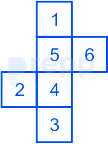
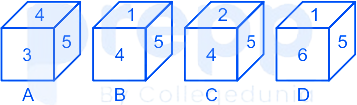
Three of the following letter-clusters are alike in some manner and hence form a group. Which letter-cluster does not belong to that group?
Important Questions from Miscellaneous
The magazine in which Mahatma Gandhi mentioned what he wanted the Constitution to do is:
Which gas shields the surface of the earth from ultraviolet radiation from the sun?
Which event is marked as an Intangible Cultural Heritage of Humanity by UNESCO?
Who has been conferred with the rank of the Commander of the Order of the British Empire in 2018?
Who directead the film ‘Bhuvan Shome’?



