
By interchanging the given two signs which of the following equation will be not correct? + and ÷
Solving Reasoning Problems by Interchanging Signs
The problem asks us to identify which of the given equations will become incorrect after interchanging two specific mathematical signs: '+' (addition) and '÷' (division). We need to replace every '+' sign with '÷' and every '÷' sign with '+' in each equation and then evaluate the new expression to see if it still equals the value given on the right side of the equals sign. We must follow the order of operations (BODMAS/PEMDAS) during evaluation.
Understanding BODMAS/PEMDAS Rule
The BODMAS or PEMDAS rule dictates the order in which operations should be performed in a mathematical expression:
- Brackets (Parentheses)
- Orders (Exponents, Square Roots, etc.)
- Division and Multiplication (from left to right)
- Addition and Subtraction (from left to right)
We will apply this rule to evaluate each equation after interchanging the signs.
Analyzing Each Equation with Interchanged Signs
Let's examine each given equation one by one after interchanging the '+' and '÷' signs.
Equation 1: 12 ÷ 8 × 12 + 6 - 7 = 21
Original equation: $12 \div 8 \times 12 + 6 - 7 = 21$
After interchanging '+' and '÷': $12 + 8 \times 12 \div 6 - 7$
Evaluating the new expression:
- First, perform division: $12 \div 6 = 2$
- The expression becomes: $12 + 8 \times 2 - 7$
- Next, perform multiplication: $8 \times 2 = 16$
- The expression becomes: $12 + 16 - 7$
- Finally, perform addition and subtraction from left to right: $12 + 16 = 28$, then $28 - 7 = 21$
The result is 21. The equation becomes $21 = 21$, which is correct.
Equation 2: 9 - 3 + 12 × 8 ÷ 4 = 11
Original equation: $9 - 3 + 12 \times 8 \div 4 = 11$
After interchanging '+' and '÷': $9 - 3 \div 12 \times 8 + 4$
Evaluating the new expression:
- First, perform division: $3 \div 12 = \frac{3}{12} = \frac{1}{4} = 0.25$
- The expression becomes: $9 - 0.25 \times 8 + 4$
- Next, perform multiplication: $0.25 \times 8 = 2$
- The expression becomes: $9 - 2 + 4$
- Finally, perform subtraction and addition from left to right: $9 - 2 = 7$, then $7 + 4 = 11$
The result is 11. The equation becomes $11 = 11$, which is correct.
Equation 3: 46 + 23 ÷ 14 × 5 - 6 = 66
Original equation: $46 + 23 \div 14 \times 5 - 6 = 66$
After interchanging '+' and '÷': $46 \div 23 + 14 \times 5 - 6$
Evaluating the new expression:
- First, perform division: $46 \div 23 = 2$
- The expression becomes: $2 + 14 \times 5 - 6$
- Next, perform multiplication: $14 \times 5 = 70$
- The expression becomes: $2 + 70 - 6$
- Finally, perform addition and subtraction from left to right: $2 + 70 = 72$, then $72 - 6 = 66$
The result is 66. The equation becomes $66 = 66$, which is correct.
Equation 4: 6 + 20 ÷ 12 × 7 - 11 = 70
Original equation: $6 + 20 \div 12 \times 7 - 11 = 70$
After interchanging '+' and '÷': $6 \div 20 + 12 \times 7 - 11$
Evaluating the new expression:
- First, perform division: $6 \div 20 = \frac{6}{20} = \frac{3}{10} = 0.3$
- The expression becomes: $0.3 + 12 \times 7 - 11$
- Next, perform multiplication: $12 \times 7 = 84$
- The expression becomes: $0.3 + 84 - 11$
- Finally, perform addition and subtraction from left to right: $0.3 + 84 = 84.3$, then $84.3 - 11 = 73.3$
The result is 73.3. The equation becomes $73.3 = 70$, which is not correct.
Conclusion
After interchanging the '+' and '÷' signs, three of the equations result in a correct mathematical equality. However, the fourth equation ($6 + 20 \div 12 \times 7 - 11 = 70$) results in $73.3 = 70$, which is incorrect. Therefore, this is the equation that will be not correct after the sign interchange.
| Equation | Original Expression | Expression After Sign Interchange (+ ⇆ ÷) | Evaluated Result | Is Equation Correct? |
|---|---|---|---|---|
| 1 | $12 \div 8 \times 12 + 6 - 7$ | $12 + 8 \times 12 \div 6 - 7$ | 21 | Yes ($21 = 21$) |
| 2 | $9 - 3 + 12 \times 8 \div 4$ | $9 - 3 \div 12 \times 8 + 4$ | 11 | Yes ($11 = 11$) |
| 3 | $46 + 23 \div 14 \times 5 - 6$ | $46 \div 23 + 14 \times 5 - 6$ | 66 | Yes ($66 = 66$) |
| 4 | $6 + 20 \div 12 \times 7 - 11$ | $6 \div 20 + 12 \times 7 - 11$ | 73.3 | No ($73.3 \neq 70$) |
The equation that will be not correct after interchanging the given two signs (+ and ÷) is the fourth equation.
Revision Table: Key Concepts for Interchanging Signs Problems
| Concept | Description |
|---|---|
| Sign Interchange | Replacing given mathematical operators with others as specified in the problem. |
| Order of Operations | The standard rule (BODMAS/PEMDAS) that governs the sequence of calculations in an expression. |
| Equation Verification | Checking if the value of the expression on the left side of the equals sign is equal to the value on the right side after performing operations. |
| Mathematical Reasoning | Problems that test logical and arithmetic skills by manipulating mathematical expressions based on given conditions. |
Additional Information: Solving Mathematical Reasoning Questions
Mathematical reasoning questions often involve manipulating equations or expressions based on given rules, such as interchanging signs, changing numbers, or defining new operators. To solve these questions effectively, follow these steps:
- Read Carefully: Understand exactly which signs or numbers need to be interchanged.
- Apply Changes: Rewrite the equation or expression with the specified changes.
- Follow Order of Operations: Always use BODMAS/PEMDAS to evaluate the modified expression. This is crucial for arriving at the correct result.
- Verify the Condition: Check if the evaluated result satisfies the condition given in the question (e.g., does it equal the right side of the equation? Is it greater than/less than a certain value?).
- Test All Options (if needed): If the question asks which option satisfies or does not satisfy a condition, you often need to apply the changes and evaluate each option.
Practice with different types of sign interchange and operator-based problems will help improve speed and accuracy.
Similar Questions
Which two numbers and two signs should be interchanged to make the given equation correct?
5 + 44 - 8 × 25 = 203
Select the set in which the numbers are related in the same way as are the numbers of the following set.
(NOTE: Operations should be performed on the whole numbers, without breaking down the numbers into its constituent digits.)
(60, 5, 6)
(48, 8, 3)
A & B means ‘A is the son of B’
A # B means ‘A is the sister of B’
A @ B means ‘A is the brother of B’
A % B means ‘A is the father of B’
A - B means ‘A is the daughter of B’
A * B means ‘A is the wife of B’
If C # D @ E % Z & L # M - N * P, then how is Z related to N?
Select the set in which the numbers are related in the same way as are the numbers of the following sets.
(NOTE : Operations should be performed on the whole numbers, without breaking down the numbers into its constituent digits. E.g. 13 - Operations on 13 such as adding / subtracting / multiplying etc. to 13 can be performed. Breaking down 13 into 1 and 3 and then performing mathematical operations on 1 and 3 is not allowed)
(144, 9, 3)
(225, 7, 8)
Select the figure that will come next in the following figure series.

Select the figure from among the given options that can replace the question mark (?) in the following series.

Read the given statements and conclusions carefully. Assuming that the information given in the statements is true, even if it appears to be at variance with commonly known facts, decide which of the given conclusions logically follow(s) from the statements.
Statements:
All pens are plates.
All plates are trays.
Some trays are boxes.
Conclusions:
I. Some boxes are plates.
II. Some trays are pens.
III. Some boxes are pens.
IV. No tray is a plate.
In the following question, select the missing number from the given series.
69, 70, 73, 78, 85, ?
If A × B means that A is the father of B, A + B means that A is the mother of B, A ÷ B means that A is the brother of B then which of the following expression shows that A is the paternal uncle of C?
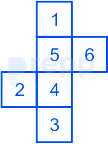
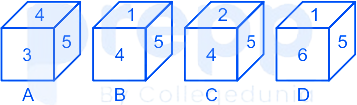
Select the cube that can be formed by folding the given sheet along the lines.
Important Questions from Miscellaneous
The magazine in which Mahatma Gandhi mentioned what he wanted the Constitution to do is:
Which gas shields the surface of the earth from ultraviolet radiation from the sun?
Which event is marked as an Intangible Cultural Heritage of Humanity by UNESCO?
Who has been conferred with the rank of the Commander of the Order of the British Empire in 2018?
Who directead the film ‘Bhuvan Shome’?



