
Which two numbers and two signs should be interchanged to make the given equation correct? 5 + 44 - 8 × 25 = 203
8, 5 and -, ×
Solving Equations by Interchanging Numbers and Signs
The problem asks us to find which specific interchange of two numbers and two signs will make the given mathematical equation correct. The original equation is:
\(5 + 44 - 8 \times 25 = 203\)
Currently, let's evaluate the left side of the original equation using the BODMAS/PEMDAS rule (Multiplication before Addition and Subtraction):
\(5 + 44 - 8 \times 25 = 5 + 44 - 200\)
\(= 49 - 200\)
\(= -151\)
Since \(-151 \neq 203\), the original equation is incorrect. We need to test the given options by swapping the numbers and signs as specified and then re-evaluate the equation.
Testing Option 1: Interchange 8 and 5, and - and +
Original equation: \(5 + 44 - 8 \times 25 = 203\)
First, swap the numbers 8 and 5:
\(8 + 44 - 5 \times 25\)
Next, swap the signs - and + where they appear in the equation. The sign + is before 44, and - is before 8 (now 5):
\(8 - 44 + 5 \times 25\)
Now, evaluate the new equation following BODMAS:
\(8 - 44 + 5 \times 25 = 8 - 44 + 125\)
\(= -36 + 125\)
\(= 89\)
The result \(89\) is not equal to \(203\). So, this interchange is incorrect.
Testing Option 2: Interchange 8 and 44, and - and +
Original equation: \(5 + 44 - 8 \times 25 = 203\)
First, swap the numbers 8 and 44:
\(5 + 8 - 44 \times 25\)
Next, swap the signs - and +:
\(5 - 8 + 44 \times 25\)
Now, evaluate the new equation:
\(5 - 8 + 44 \times 25 = 5 - 8 + 1100\)
\(= -3 + 1100\)
\(= 1097\)
The result \(1097\) is not equal to \(203\). So, this interchange is incorrect.
Testing Option 3: Interchange 8 and 5, and - and ×
Original equation: \(5 + 44 - 8 \times 25 = 203\)
First, swap the numbers 8 and 5:
\(8 + 44 - 5 \times 25\)
Next, swap the signs - and ×:
\(8 + 44 \times 5 - 25\)
Now, evaluate the new equation:
\(8 + 44 \times 5 - 25 = 8 + 220 - 25\)
\(= 228 - 25\)
\(= 203\)
The result \(203\) is equal to \(203\). So, this interchange makes the equation correct.
Testing Option 4: Interchange 8 and 44, and - and ×
Original equation: \(5 + 44 - 8 \times 25 = 203\)
First, swap the numbers 8 and 44:
\(5 + 8 - 44 \times 25\)
Next, swap the signs - and ×:
\(5 + 8 \times 44 - 25\)
Now, evaluate the new equation:
\(5 + 8 \times 44 - 25 = 5 + 352 - 25\)
\(= 357 - 25\)
\(= 332\)
The result \(332\) is not equal to \(203\). So, this interchange is incorrect.
Conclusion: Correct Interchange for Equation
After testing all the options, the interchange of the numbers 8 and 5 and the signs - and × results in the correct equation:
\(8 + 44 \times 5 - 25 = 203\)
Revision Table: Equation Interchange Results
| Interchange (Numbers, Signs) | New Equation | Evaluation | Result | Correct? |
|---|---|---|---|---|
| (8, 5), (-, +) | \(8 - 44 + 5 \times 25\) | \(8 - 44 + 125 = -36 + 125\) | \(89\) | No |
| (8, 44), (-, +) | \(5 - 8 + 44 \times 25\) | \(5 - 8 + 1100 = -3 + 1100\) | \(1097\) | No |
| (8, 5), (-, ×) | \(8 + 44 \times 5 - 25\) | \(8 + 220 - 25 = 228 - 25\) | \(203\) | Yes |
| (8, 44), (-, ×) | \(5 + 8 \times 44 - 25\) | \(5 + 352 - 25 = 357 - 25\) | \(332\) | No |
Additional Information: Order of Mathematical Operations
The order in which mathematical operations are performed significantly affects the result of an expression. Following the standard order ensures consistent and correct calculations.
- BODMAS / PEMDAS: This rule dictates the sequence:
- B/P: Brackets / Parentheses - Evaluate expressions inside brackets first.
- O/E: Orders / Exponents - Evaluate powers and roots next.
- DM: Division and Multiplication - Perform these from left to right.
- AS: Addition and Subtraction - Perform these from left to right.
- In the given problem, we only have addition, subtraction, and multiplication, so the order is Multiplication first, then Addition and Subtraction from left to right.
- Interchanging numbers or signs changes the structure of the equation, requiring re-evaluation according to these rules.
Similar Questions
Select the set in which the numbers are related in the same way as are the numbers of the following set.
(NOTE: Operations should be performed on the whole numbers, without breaking down the numbers into its constituent digits.)
(60, 5, 6)
(48, 8, 3)
A & B means ‘A is the son of B’
A # B means ‘A is the sister of B’
A @ B means ‘A is the brother of B’
A % B means ‘A is the father of B’
A - B means ‘A is the daughter of B’
A * B means ‘A is the wife of B’
If C # D @ E % Z & L # M - N * P, then how is Z related to N?
Select the figure that will come next in the following figure series.

Select the figure from among the given options that can replace the question mark (?) in the following series.

Read the given statements and conclusions carefully. Assuming that the information given in the statements is true, even if it appears to be at variance with commonly known facts, decide which of the given conclusions logically follow(s) from the statements.
Statements:
All pens are plates.
All plates are trays.
Some trays are boxes.
Conclusions:
I. Some boxes are plates.
II. Some trays are pens.
III. Some boxes are pens.
IV. No tray is a plate.
In the following question, select the missing number from the given series.
69, 70, 73, 78, 85, ?
If A × B means that A is the father of B, A + B means that A is the mother of B, A ÷ B means that A is the brother of B then which of the following expression shows that A is the paternal uncle of C?
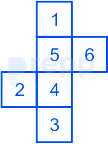
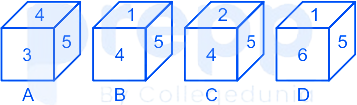
Select the cube that can be formed by folding the given sheet along the lines.
Three of the following letter-clusters are alike in some manner and hence form a group. Which letter-cluster does not belong to that group?
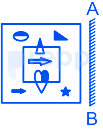
Select the correct mirror image of the given figure when the mirror is placed at AB as shown.
Important Questions from Miscellaneous
Which gas shields the surface of the earth from ultraviolet radiation from the sun?
Which event is marked as an Intangible Cultural Heritage of Humanity by UNESCO?
Who has been conferred with the rank of the Commander of the Order of the British Empire in 2018?
Who directead the film ‘Bhuvan Shome’?
The book “In my mother’s house” is written by _______



