
By Interchanging the given two numbers which of the following equation will be correct? 5 and 8
Solving Equations by Interchanging Numbers
The question asks us to find which equation becomes correct after interchanging the numbers 5 and 8 in the given expressions. We need to examine each option, swap the positions of 5 and 8, and then evaluate the resulting equation using the order of operations (BODMAS/PEMDAS).
Evaluating Option 1 after Interchanging 5 and 8
The original equation in Option 1 is 5 × 2 - 8 + 9 ÷ 1 = 20.
After interchanging 5 and 8, the equation becomes:
\(8 \times 2 - 5 + 9 \div 1 = ?\)
Let's evaluate this expression following BODMAS (Brackets, Orders/Exponents, Division and Multiplication (from left to right), Addition and Subtraction (from left to right)):
- First, perform the division: \(9 \div 1 = 9\). The equation is now \(8 \times 2 - 5 + 9 = ?\)
- Next, perform the multiplication: \(8 \times 2 = 16\). The equation is now \(16 - 5 + 9 = ?\)
- Now, perform addition and subtraction from left to right:
- \(16 - 5 = 11\). The equation is now \(11 + 9 = ?\)
- \(11 + 9 = 20\).
So, the result of the left side is 20. The equation becomes \(20 = 20\), which is a correct statement.
Thus, interchanging 5 and 8 makes the equation in Option 1 correct.
Evaluating Other Options (for completeness)
Let's also check the other options to confirm they are incorrect after interchanging 5 and 8.
Option 2 Analysis
Original equation: \(8 + 5 \times 4 - 9 \div 3 = 30\)
After interchanging 5 and 8: \(5 + 8 \times 4 - 9 \div 3 = ?\)
Evaluating:
- Division: \(9 \div 3 = 3\) → \(5 + 8 \times 4 - 3 = ?\)
- Multiplication: \(8 \times 4 = 32\) → \(5 + 32 - 3 = ?\)
- Addition/Subtraction: \(5 + 32 = 37\) → \(37 - 3 = ?\)
- \(37 - 3 = 34\)
Result: \(34 \neq 30\). Incorrect.
Option 3 Analysis
Original equation: \(5 \times 7 + 8 - 3 \div 1 = 55\)
After interchanging 5 and 8: \(8 \times 7 + 5 - 3 \div 1 = ?\)
Evaluating:
- Division: \(3 \div 1 = 3\) → \(8 \times 7 + 5 - 3 = ?\)
- Multiplication: \(8 \times 7 = 56\) → \(56 + 5 - 3 = ?\)
- Addition/Subtraction: \(56 + 5 = 61\) → \(61 - 3 = ?\)
- \(61 - 3 = 58\)
Result: \(58 \neq 55\). Incorrect.
Option 4 Analysis
Original equation: \(8 - 5 \times 2 + 6 \div 2 = -9\)
After interchanging 5 and 8: \(5 - 8 \times 2 + 6 \div 2 = ?\)
Evaluating:
- Division: \(6 \div 2 = 3\) → \(5 - 8 \times 2 + 3 = ?\)
- Multiplication: \(8 \times 2 = 16\) → \(5 - 16 + 3 = ?\)
- Addition/Subtraction: \(5 - 16 = -11\) → \(-11 + 3 = ?\)
- \(-11 + 3 = -8\)
Result: \(-8 \neq -9\). Incorrect.
Based on our evaluation, only the equation in Option 1 becomes correct after interchanging the numbers 5 and 8.
| Option | Original Equation | Equation after Interchanging 5 and 8 | Calculation Result | Correct? |
|---|---|---|---|---|
| 1 | \(5 \times 2 - 8 + 9 \div 1 = 20\) | \(8 \times 2 - 5 + 9 \div 1 = ?\) | 20 | Yes (20 = 20) |
| 2 | \(8 + 5 \times 4 - 9 \div 3 = 30\) | \(5 + 8 \times 4 - 9 \div 3 = ?\) | 34 | No (34 ≠ 30) |
| 3 | \(5 \times 7 + 8 - 3 \div 1 = 55\) | \(8 \times 7 + 5 - 3 \div 1 = ?\) | 58 | No (58 ≠ 55) |
| 4 | \(8 - 5 \times 2 + 6 \div 2 = -9\) | \(5 - 8 \times 2 + 6 \div 2 = ?\) | -8 | No (-8 ≠ -9) |
Revision Table: Checking Equation Interchanges
| Concept | Description | Application in Problem |
|---|---|---|
| Interchanging Numbers | Swapping the positions of two specific numbers within an expression or equation. | Swapping 5 and 8 in each given equation. |
| Order of Operations (BODMAS/PEMDAS) | Rules governing the sequence in which mathematical operations should be performed to ensure a unique result (Brackets, Orders, Division/Multiplication, Addition/Subtraction). | Used to evaluate the modified equations correctly after interchanging 5 and 8. |
| Equation Verification | Checking if the left side of an equation equals the right side after performing all calculations. | Comparing the calculated result of the left side to the given value on the right side for each modified equation. |
Additional Information: The Importance of BODMAS/PEMDAS
When solving mathematical expressions or equations, the order of operations is crucial. Without a standard order, the same expression could yield different results depending on which operation is performed first.
- Brackets (or Parentheses)
- Orders (or Exponents/Indices)
- Division and Multiplication (These have equal priority and are performed from left to right)
- Addition and Subtraction (These have equal priority and are performed from left to right)
In this problem, applying BODMAS correctly after interchanging the numbers is essential to determine if the resulting equation holds true.
Similar Questions
A # B means 'A is the brother of B'.
A @ B means 'A is the son of B'.
A & B means 'A is the father of B'.
A % B means 'A is the mother of B'.
If W # Q @ T & Y @ M % K % L, then how is K related to W?
By interchanging the given two signs which of the following equation will be not correct?
+ and ÷
Select the option that is related to the third term in the same way as the second term is related to the first term and the sixth term is related to the fifth term.
4 : 84 :: 11 : ? :: 13 : 2379
Which letter-cluster will replace the question mark (?) to complete the given series?
XDNC, VGOE, ?, RMQI, PPRK
Select the set in which the numbers are related in the same way as are the numbers of the given set.
(NOTE: Operations should be performed on the whole numbers, without breaking down the numbers into its constituent digits. E.g. 13 - Operations on 13 such as adding / subtracting / multiplying etc. to 13 can be performed. Breaking down 13 into 1 and 3 and then performing mathematical operations on 1 and 3 is not allowed.)
(3, 13, 18)
(29, 39, 44)
A series is given with one term missing. Select the correct alternative from the given ones that will complete the series.
NTRQ, GOIF, ZJZU, SEQJ, ?
Three different positions of the same dice are shown. Find the number on the face opposite the face showing '2'.
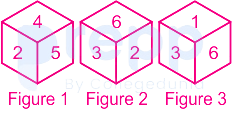
Select the correct mirror image of the given figure when the mirror is placed at AB as shown.

- In a certain code language, health is wealth' is coded as '626', 'exercise regularly' is coded as '89' and 'bring good food' is coded as '544'. How will 'balanced diet is key' be coded in that language?
In the following question below are given some statements followed by some conclusions based on those statements. Taking the given statements to be true even if they seem to be at variance from commonly known facts. Read all the conclusions and then decide which of the given conclusion logically follows the given statements.
Statements:
I. Some G are U.
II. Some S are U.
Conclusion:
I. No S is G.
II. No U is G.
Important Questions from Miscellaneous
- List-I with List-II:
List-I
(Relief Materials)List-II
(Color Code)A. Shelter I. Yellow B. Clothes II. Khaki C. Food III. Red D. Medicine IV. Brown
Choose the correct answer from the options given below: - What was a key reform introduced by the Waqf (Amendment) Act, 2025?
Which of the following is NOT a state function or state variable in a thermodynamic system?
- What is the full form for "BPL" in Socio-economic aspects?
- In October 2024, which of the following companies was awarded the contract for design, manufacturing and commissioning of two high-speed trainsets by Integral Coach Factory (ICF) to be used in India's first bullet train between Mumbai and Ahmedabad?



