
Which letter-cluster will replace the question mark (?) to complete the given series? XDNC, VGOE, ?, RMQI, PPRK
TJPG
Solving Letter-Cluster Series Puzzles
This question asks us to find the letter-cluster that completes the given series: XDNC, VGOE, ?, RMQI, PPRK.
To solve this type of letter-cluster series problem, we need to analyze the pattern for each letter position across the clusters. Let's examine the first, second, third, and fourth letters separately.
Analyzing the First Letter Pattern
The first letters of the clusters are: X, V, ?, R, P.
Let's look at their positions in the English alphabet (A=1, B=2, ..., Z=26):
- X is the 24th letter.
- V is the 22nd letter.
- R is the 18th letter.
- P is the 16th letter.
Now let's find the difference in their positions:
- V to X: \(22 - 24 = -2\)
- P to R: \(16 - 18 = -2\)
It appears there is a consistent difference of -2 between consecutive first letters. Applying this pattern:
- From X to V, the difference is -2.
- From V, the next letter should be \(22 - 2 = 20\). The 20th letter is T.
- From T, the next letter should be \(20 - 2 = 18\). The 18th letter is R, which matches the series.
- From R to P, the difference is -2, which also matches the series.
So, the first letter of the missing cluster is T.
Analyzing the Second Letter Pattern
The second letters of the clusters are: D, G, ?, M, R.
Let's look at their positions in the English alphabet:
- D is the 4th letter.
- G is the 7th letter.
- M is the 13th letter.
- R is the 18th letter.
Let's find the difference in their positions:
- G to D: \(7 - 4 = +3\)
- R to M: \(18 - 13 = +5\)
The differences are +3 and +5. Let's look at the gap between G and M, which spans the missing letter. The total difference from G to M is \(13 - 7 = +6\). If the increments are increasing, it could be +3, then an unknown step, then another unknown step that sums to +6, then +5. However, if we look closely at the options for the second letter (J, K, J, J - positions 10, 11, 10, 10), if the second letter is J (10), the pattern would be:
- D to G: \(7 - 4 = +3\)
- G to J: \(10 - 7 = +3\)
- J to M: \(13 - 10 = +3\)
- M to R: \(18 - 13 = +5\)
This pattern shows a consistent increase of +3 for the first three steps, followed by a +5 step. This is a plausible pattern for a series.
So, the second letter of the missing cluster is J.
Analyzing the Third Letter Pattern
The third letters of the clusters are: N, O, ?, Q, K.
Let's look at their positions in the English alphabet:
- N is the 14th letter.
- O is the 15th letter.
- Q is the 17th letter.
- K is the 11th letter.
Let's find the difference in their positions:
- O to N: \(15 - 14 = +1\)
- K to Q: \(11 - 17 = -6\)
The differences are +1 and -6. Let's consider the steps between O and Q, which spans the missing letter. The total difference from O to Q is \(17 - 15 = +2\). If the pattern involves small positive steps followed by a large negative step, let's see if a constant small step works between O and Q.
- From N to O, the difference is +1.
- From O, if the next step is +1, the letter is \(15 + 1 = 16\). The 16th letter is P.
- From P, if the next step is +1, the letter is \(16 + 1 = 17\). The 17th letter is Q, which matches the series.
- From Q to K, the difference is \(11 - 17 = -6\), which matches the series.
This pattern shows a +1 increase for the first three steps, followed by a -6 step. This is a consistent pattern.
So, the third letter of the missing cluster is P.
Analyzing the Fourth Letter Pattern
The fourth letters of the clusters are: C, E, ?, I, K.
Let's look at their positions in the English alphabet:
- C is the 3rd letter.
- E is the 5th letter.
- I is the 9th letter.
- K is the 11th letter.
Let's find the difference in their positions:
- E to C: \(5 - 3 = +2\)
- K to I: \(11 - 9 = +2\)
It appears there is a consistent difference of +2 between consecutive fourth letters. Applying this pattern:
- From C to E, the difference is +2.
- From E, the next letter should be \(5 + 2 = 7\). The 7th letter is G.
- From G, the next letter should be \(7 + 2 = 9\). The 9th letter is I, which matches the series.
- From I to K, the difference is +2, which also matches the series.
So, the fourth letter of the missing cluster is G.
Combining the Patterns
By analyzing each letter position independently, we found the following letters for the missing cluster:
- First letter: T
- Second letter: J
- Third letter: P
- Fourth letter: G
Combining these letters gives the cluster TJPG.
Therefore, the letter-cluster TJPG will replace the question mark (?) to complete the given series.
Revision Table: Letter Series Patterns
Let's summarize the patterns observed for each letter position:
| Position | Letters in Series | Alphabet Position | Pattern/Difference |
|---|---|---|---|
| 1st | X, V, T, R, P | 24, 22, 20, 18, 16 | Constant -2 |
| 2nd | D, G, J, M, R | 4, 7, 10, 13, 18 | +3, +3, +3, +5 |
| 3rd | N, O, P, Q, K | 14, 15, 16, 17, 11 | +1, +1, +1, -6 |
| 4th | C, E, G, I, K | 3, 5, 7, 9, 11 | Constant +2 |
Additional Information: Series Completion Reasoning
Series completion questions are common in reasoning tests. They involve identifying a pattern in a sequence of numbers, letters, or figures and predicting the next term or finding the missing term. For letter series, the patterns can be based on:
- Alphabetical position (forward or backward).
- Differences in alphabetical position (constant or varying by a rule).
- Skipping letters in the alphabet.
- A combination of these or other logical rules.
When dealing with letter clusters, it's crucial to analyze each letter position separately as the pattern for each position might be different, as seen in this example.
Similar Questions
A # B means 'A is the brother of B'.
A @ B means 'A is the son of B'.
A & B means 'A is the father of B'.
A % B means 'A is the mother of B'.
If W # Q @ T & Y @ M % K % L, then how is K related to W?
By interchanging the given two signs which of the following equation will be not correct?
+ and ÷
Select the option that is related to the third term in the same way as the second term is related to the first term and the sixth term is related to the fifth term.
4 : 84 :: 11 : ? :: 13 : 2379
Select the set in which the numbers are related in the same way as are the numbers of the given set.
(NOTE: Operations should be performed on the whole numbers, without breaking down the numbers into its constituent digits. E.g. 13 - Operations on 13 such as adding / subtracting / multiplying etc. to 13 can be performed. Breaking down 13 into 1 and 3 and then performing mathematical operations on 1 and 3 is not allowed.)
(3, 13, 18)
(29, 39, 44)
A series is given with one term missing. Select the correct alternative from the given ones that will complete the series.
NTRQ, GOIF, ZJZU, SEQJ, ?
By Interchanging the given two numbers which of the following equation will be correct?
5 and 8
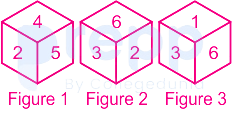
Three different positions of the same dice are shown. Find the number on the face opposite the face showing '2'.
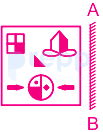
Select the correct mirror image of the given figure when the mirror is placed at AB as shown.
- In a certain code language, health is wealth' is coded as '626', 'exercise regularly' is coded as '89' and 'bring good food' is coded as '544'. How will 'balanced diet is key' be coded in that language?
In the following question below are given some statements followed by some conclusions based on those statements. Taking the given statements to be true even if they seem to be at variance from commonly known facts. Read all the conclusions and then decide which of the given conclusion logically follows the given statements.
Statements:
I. Some G are U.
II. Some S are U.
Conclusion:
I. No S is G.
II. No U is G.
Important Questions from Miscellaneous
- List-I with List-II:
List-I
(Relief Materials)List-II
(Color Code)A. Shelter I. Yellow B. Clothes II. Khaki C. Food III. Red D. Medicine IV. Brown
Choose the correct answer from the options given below: - What was a key reform introduced by the Waqf (Amendment) Act, 2025?
Which of the following is NOT a state function or state variable in a thermodynamic system?
- What is the full form for "BPL" in Socio-economic aspects?
- In October 2024, which of the following companies was awarded the contract for design, manufacturing and commissioning of two high-speed trainsets by Integral Coach Factory (ICF) to be used in India's first bullet train between Mumbai and Ahmedabad?



