
In the following question below are given some statements followed by some conclusions based on those statements. Taking the given statements to be true even if they seem to be at variance from commonly known facts. Read all the conclusions and then decide which of the given conclusion logically follows the given statements. Statements: I. Some G are U. II. Some S are U. Conclusion: I. No S is G. II. No U is G.
Neither conclusion follows
Understanding Statements and Conclusions in Logical Reasoning
This question asks us to analyze given statements and determine which of the provided conclusions logically follow. In these types of problems, we must assume the statements are absolutely true, regardless of whether they align with real-world facts.
Analyzing the Given Statements
We are given two statements:
- Statement I: Some G are U.
- Statement II: Some S are U.
Let's break down what these statements mean:
- "Some G are U" means there is an intersection between the set of Gs and the set of Us. There is at least one element that belongs to both G and U. This can be represented using set notation as \(G \cap U \neq \emptyset\).
- "Some S are U" means there is an intersection between the set of Ss and the set of Us. There is at least one element that belongs to both S and U. This can be represented using set notation as \(S \cap U \neq \emptyset\).
These statements establish a relationship between G and U, and between S and U. However, they provide no direct information about the relationship between G and S.
Analyzing the Given Conclusions
We need to evaluate each conclusion based solely on the information provided in the statements.
Conclusion I: No S is G.
This conclusion claims there is absolutely no overlap between the set of Ss and the set of Gs. In set notation, this would mean \(S \cap G = \emptyset\).
Let's consider if this conclusion must be true based on the statements. We know Some G are U (\(G \cap U \neq \emptyset\)) and Some S are U (\(S \cap U \neq \emptyset\)). It is possible to draw scenarios (like Venn diagrams) where:
- Some G are U, Some S are U, AND No S is G.
- Some G are U, Some S are U, AND Some S ARE G (for example, if the 'some U' that are G are the same as the 'some U' that are S, and these elements are also in S and G).
Since the statements allow for the possibility that "Some S are G" (e.g., if the intersection of G and U overlaps with the intersection of S and U, which in turn overlaps G and S), the conclusion "No S is G" is not necessarily true. Therefore, Conclusion I does not logically follow from the statements.
Conclusion II: No U is G.
This conclusion claims there is absolutely no overlap between the set of Us and the set of Gs. In set notation, this would mean \(U \cap G = \emptyset\).
Now, let's look at Statement I: "Some G are U". This statement explicitly tells us that there is an overlap between G and U (\(G \cap U \neq \emptyset\)). This directly contradicts the conclusion "No U is G" (\(U \cap G = \emptyset\)). If Statement I is true, then Conclusion II must be false.
Therefore, Conclusion II does not logically follow from the statements; in fact, it is contradicted by Statement I.
Determining Which Conclusion(s) Follow
Based on our analysis:
- Conclusion I ("No S is G") does not necessarily follow because the statements allow for the possibility that Some S are G.
- Conclusion II ("No U is G") does not follow because it is directly contradicted by Statement I ("Some G are U").
Since neither conclusion logically follows from the given statements, the correct answer is that neither conclusion follows.
Revision Table: Statements and Conclusions Analysis
| Statement/Conclusion | Set Notation | Analysis Based on Statements I & II | Logically Follows? |
|---|---|---|---|
| Statement I: Some G are U | \(G \cap U \neq \emptyset\) | Given as true | N/A |
| Statement II: Some S are U | \(S \cap U \neq \emptyset\) | Given as true | N/A |
| Conclusion I: No S is G | \(S \cap G = \emptyset\) | Not necessarily true. Could be Some S are G. | No |
| Conclusion II: No U is G | \(U \cap G = \emptyset\) | Directly contradicts Statement I (\(G \cap U \neq \emptyset\)) | No |
Additional Information on Syllogisms
This question is an example of a basic syllogism problem often found in logical reasoning tests. Syllogisms involve drawing conclusions from two or more premises (statements).
- Types of Statements: Common types include "All A are B", "No A is B", "Some A are B", and "Some A are not B".
- "Some" statements: In logic, "Some A are B" means at least one A is B. It does not exclude the possibility that "All A are B".
- Negative Conclusions: Conclusions using "No" or "Some...not" often require careful analysis. If the statements are all positive ("Some A are B", "Some C are B"), it is generally not possible to draw a definite negative conclusion ("No A is C" or "Some A are not C") unless other specific rules or diagrams force it.
- Mediate Inference: Conclusions drawn from two premises rely on a middle term (in this case, 'U') that connects the other two terms (G and S). However, simply having a middle term doesn't guarantee a valid conclusion about the other two terms, especially with "Some" statements.
Mastering these types of questions involves understanding the exact meaning of logical quantifiers ("All", "No", "Some") and practicing with different statement combinations, often visualized using Venn diagrams.
Similar Questions
A # B means 'A is the brother of B'.
A @ B means 'A is the son of B'.
A & B means 'A is the father of B'.
A % B means 'A is the mother of B'.
If W # Q @ T & Y @ M % K % L, then how is K related to W?
By interchanging the given two signs which of the following equation will be not correct?
+ and ÷
Select the option that is related to the third term in the same way as the second term is related to the first term and the sixth term is related to the fifth term.
4 : 84 :: 11 : ? :: 13 : 2379
Which letter-cluster will replace the question mark (?) to complete the given series?
XDNC, VGOE, ?, RMQI, PPRK
Select the set in which the numbers are related in the same way as are the numbers of the given set.
(NOTE: Operations should be performed on the whole numbers, without breaking down the numbers into its constituent digits. E.g. 13 - Operations on 13 such as adding / subtracting / multiplying etc. to 13 can be performed. Breaking down 13 into 1 and 3 and then performing mathematical operations on 1 and 3 is not allowed.)
(3, 13, 18)
(29, 39, 44)
A series is given with one term missing. Select the correct alternative from the given ones that will complete the series.
NTRQ, GOIF, ZJZU, SEQJ, ?
By Interchanging the given two numbers which of the following equation will be correct?
5 and 8
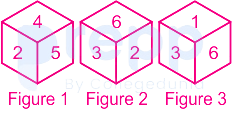
Three different positions of the same dice are shown. Find the number on the face opposite the face showing '2'.
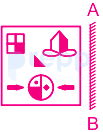
Select the correct mirror image of the given figure when the mirror is placed at AB as shown.
- In a certain code language, health is wealth' is coded as '626', 'exercise regularly' is coded as '89' and 'bring good food' is coded as '544'. How will 'balanced diet is key' be coded in that language?
Important Questions from Miscellaneous
- List-I with List-II:
List-I
(Relief Materials)List-II
(Color Code)A. Shelter I. Yellow B. Clothes II. Khaki C. Food III. Red D. Medicine IV. Brown
Choose the correct answer from the options given below: - What was a key reform introduced by the Waqf (Amendment) Act, 2025?
Which of the following is NOT a state function or state variable in a thermodynamic system?
- What is the full form for "BPL" in Socio-economic aspects?
- In October 2024, which of the following companies was awarded the contract for design, manufacturing and commissioning of two high-speed trainsets by Integral Coach Factory (ICF) to be used in India's first bullet train between Mumbai and Ahmedabad?



