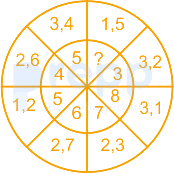
In the following question, select the number which can be placed at the sign of question mark (?) from the given alternatives. 3 4 17 5 4 2 14 6 5 2 13 ?
3
This is a missing-number (diagram) problem: within each box, three of the numbers combine to produce the fourth by one repeated rule.
Label each box by its top pair and its two lower numbers. Test the rule: (top-left × top-right) + bottom-right = bottom-left value.
Box 1: \(3 \times 4 = 12\), then \(12 + 5 = 17\), matching the given 17.
Box 2: \(4 \times 2 = 8\), then \(8 + 6 = 14\), matching the given 14.
So the rule holds: product of the top two numbers plus the bottom-right number gives the remaining number.
Box 3: \(5 \times 2 = 10\), and this must satisfy \(10 + ? = 13\), so \(? = 3\).
The key concept is confirming a single multiply-then-add relationship on the solved boxes before applying it. Hence the missing number is 3.
Similar Questions
In the following question, select the number which can be placed at the sign of question mark (?) from the given alternatives.
4 3 20 8 4 6 26 2 2 5 13 ? In the following question, select the number which can be placed at the sign of question mark (?) from the given alternatives.
2 3 5 17 4 6 7 46 2 ? 6 20
Important Questions from Missing Number in Diagram
Study the given pattern carefully and select the number that can replace the question mark (?) in it.
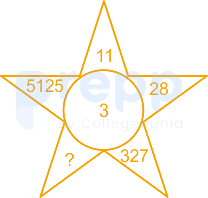
Study the given pattern carefully and select the number that can replace the question mark (?) in it:
13 108 11 26 55 9 ? 157 14 Study the given pattern carefully and select the number that can replace the question mark (?) in it :
7
4
6
927
?
349
1474
149
947
In the given square, which option will replace the question mark?
4A
6C
2E
6P
13R
7T
8N
10P
?
What is the value of the missing number?