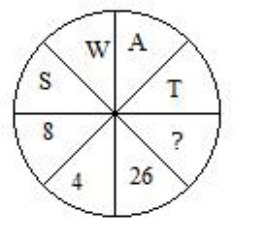
In the following question, select the number which can be placed at the sign of question mark (?) from the given alternatives.4 3 20 8 4 6 26 2 2 5 13 ?
3
Each box holds four numbers, and the aim is a single rule that links the two top numbers and the bottom-right number to the bottom-left number.
Try 'product of the two top numbers plus the bottom-right number' on Box 1: \(4\times3=12\), then \(12+8=20\), which is the bottom-left value.
Check Box 2: \(4\times6=24\), then \(24+2=26\), again the bottom-left value, so the rule holds.
Now apply it to Box 3, whose top numbers are 2 and 5 and whose bottom-left value is 13.
Compute the product first: \(2\times5=10\).
The rule requires \(10+?=13\), so \(?=13-10=3\).
Verifying the operation on two boxes before extending it to the third is what makes the answer secure.
Hence the number in place of the question mark is 3.
Similar Questions
In the following question, select the number which can be placed at the sign of question mark (?) from the given alternatives.
2 3 5 17 4 6 7 46 2 ? 6 20 In the following question, select the number which can be placed at the sign of question mark (?) from the given alternatives.
3 4 17 5 4 2 14 6 5 2 13 ?
Important Questions from Missing Number in Diagram
- The correct alternative to complete the given analogy is :
COMMENCE: FSRSLVLO:: BEGIN:? Find the missing number in the last triangle.
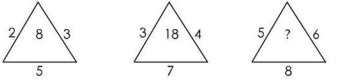
Consider the following :
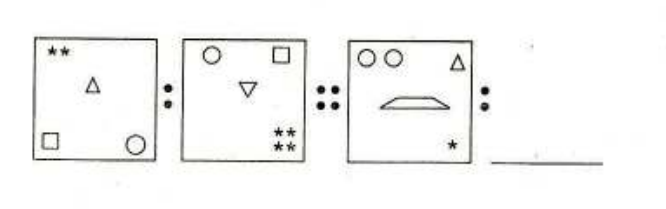
Which one of the following figures will come in the blank space ?
Consider the following diagrams:
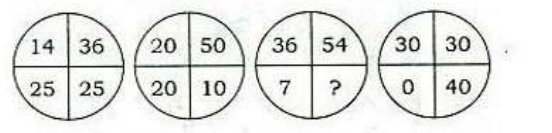
Which one of the following is the missing number in the diagrams given above?
Study the given pattern carefully and select the number from among the given options that can replace the question mark (?).