In the following question, select the number which can be placed at the sign of question mark (?) from the given alternatives.2 3 5 17 4 6 7 46 2 ? 6 20
3
Each group has four numbers, and a single rule combines three of them to produce the largest fourth value.
Reading the numbers as first, second, third and result, test the rule (second \(\times\) third) \(+\) first \(=\) result.
Group 1: \((3 \times 5) + 2 = 15 + 2 = 17\), which matches.
Group 2: \((6 \times 7) + 4 = 42 + 4 = 46\), which matches, so the rule holds.
Group 3: \((? \times 6) + 2 = 20\), so \(6 \times \; ? \; = 18\).
Dividing gives \(? = 18 \div 6 = 3\).
Verifying the rule on both full groups before applying it makes the answer reliable, so the missing number is 3.
Similar Questions
In the following question, select the number which can be placed at the sign of question mark (?) from the given alternatives.
3 4 17 5 4 2 14 6 5 2 13 ? In the following question, select the number which can be placed at the sign of question mark (?) from the given alternatives.
4 3 20 8 4 6 26 2 2 5 13 ?
Important Questions from Missing Number in Diagram
- The correct alternative to complete the given analogy is :
COMMENCE: FSRSLVLO:: BEGIN:? Find the missing number in the last triangle.
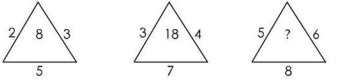
Consider the following :
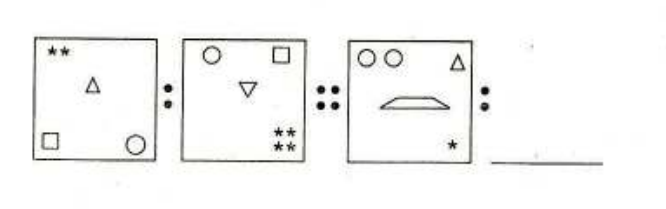
Which one of the following figures will come in the blank space ?
Consider the following diagrams:
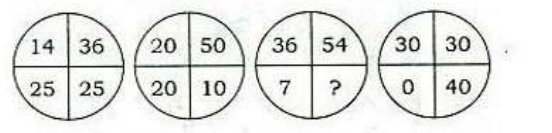
Which one of the following is the missing number in the diagrams given above?
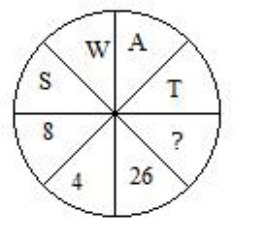
Study the given pattern carefully and select the number from among the given options that can replace the question mark (?).