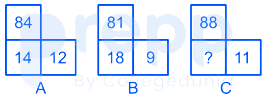
Study the given pattern carefully and select the number that can replace the question mark (?) in it:
13 108 11 26 55 9 ? 157 14
39
Solving Number Pattern Puzzles
This question asks us to identify a pattern in the given sets of numbers and use that pattern to find the missing number. We are presented with three sets, each having a top-left number, a bottom-left number, and a top-right number.
Analyzing the Given Number Sets
Let's look at the three sets:
| Set | Top-Left | Bottom-Left | Top-Right |
|---|---|---|---|
| 1 | 13 | 11 | 108 |
| 2 | 26 | 9 | 55 |
| 3 | ? | 14 | 157 |
Identifying the Pattern Logic
We need to find a relationship between the three numbers in each set that holds true for all the given sets. Let's try different mathematical operations on the first two numbers (Top-Left and Bottom-Left) to see if we can get the third number (Top-Right).
Let's denote the Top-Left number as $A$, the Bottom-Left number as $B$, and the Top-Right number as $C$.
Testing the Pattern with Set 1:
Numbers are $A=13$, $B=11$, $C=108$.
- $A + B = 13 + 11 = 24$ (Not 108)
- $A \times B = 13 \times 11 = 143$ (Not 108)
- $A^2 = 13^2 = 169$
- $B^2 = 11^2 = 121$
Let's try combining the squares:
- $A^2 + B^2 = 169 + 121 = 290$ (Not 108)
- $A^2 - B^2 = 169 - 121 = 48$ (Not 108)
- $B^2 - A^2 = 121 - 169 = -48$ (Not 108)
Let's try squaring one number and subtracting the other:
- $A^2 - B = 169 - 11 = 158$ (Not 108)
- $B^2 - A = 121 - 13 = 108$ (This matches $C$)
The pattern $B^2 - A = C$ seems promising for Set 1.
Verifying the Pattern with Set 2:
Numbers are $A=26$, $B=9$, $C=55$.
Using the potential pattern $B^2 - A = C$:
- $B^2 - A = 9^2 - 26$
- $ = 81 - 26$
- $ = 55$
This also matches $C$ in Set 2. The pattern $(Bottom-Left\;Number)^2 - (Top-Left\;Number) = (Top-Right\;Number)$ appears to be the correct logic for this pattern.
Finding the Missing Number in Set 3
Now we apply the discovered pattern to Set 3. The numbers are $A=?$, $B=14$, $C=157$.
According to the pattern:
$\qquad B^2 - A = C$
Substitute the values from Set 3:
$\qquad 14^2 - ? = 157$
Calculate $14^2$:
$\qquad 196 - ? = 157$
To find the value of ?, we rearrange the equation:
$\qquad ? = 196 - 157$
Perform the subtraction:
$\qquad ? = 39$
Conclusion
The missing number in the pattern is 39. This follows the logical rule where the square of the bottom-left number minus the top-left number equals the top-right number.
Revision Table: Key Concepts in Number Patterns
| Concept | Description | Example Type |
|---|---|---|
| Arithmetic Progression | Sequence where the difference between consecutive terms is constant. | 2, 4, 6, 8, ... (add 2) |
| Geometric Progression | Sequence where the ratio between consecutive terms is constant. | 3, 6, 12, 24, ... (multiply by 2) |
| Difference Series | Pattern found by looking at the differences between consecutive terms. | 1, 4, 9, 16, ... (Differences: 3, 5, 7, ...) |
| Mixed Operations | Pattern involving a combination of operations like addition, subtraction, multiplication, division, or powers. | The pattern in this question ($B^2 - A = C$) is an example of mixed operations involving squaring and subtraction. |
| Logical Reasoning | Using deduction and analysis to find rules or relationships in a given set of information. Essential for solving number patterns. | Analyzing the relationships between numbers in each set to find the consistent rule. |
Additional Information: Approach to Solving Reasoning Patterns
Solving logical reasoning questions involving number patterns requires a systematic approach. Here are some tips:
- Observe Carefully: Look at all the numbers in the pattern and their positions. See if there are any obvious relationships (like doubling, halving, consecutive numbers).
- Check Common Operations: Try basic arithmetic operations: addition, subtraction, multiplication, division, squares, cubes, square roots, etc.
- Look for Differences/Ratios: Sometimes the pattern is not in the numbers themselves but in the difference or ratio between them.
- Combine Operations: The pattern might involve a combination of operations, like in this question ($B^2 - A$).
- Test Your Hypothesis: Once you think you've found a pattern, test it on all the given sets to make sure it holds true for every instance.
- Isolate Variables: If the pattern involves an equation, use algebraic rearrangement to find the missing value once the pattern is confirmed.
- Practice: The more number pattern problems you solve, the better you become at recognizing common patterns and developing strategies to find new ones.
Understanding these approaches helps in tackling various types of logical reasoning and quantitative aptitude problems.
Important Questions from Missing Number in Diagram
Study the given pattern carefully and select the number that can replace the question mark (?) in it.
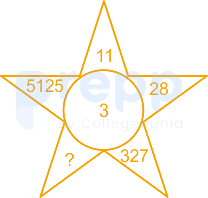
Study the given pattern carefully and select the number that can replace the question mark (?) in it :
7
4
6
927
?
349
1474
149
947
In the given square, which option will replace the question mark?
4A
6C
2E
6P
13R
7T
8N
10P
?
What is the value of the missing number?
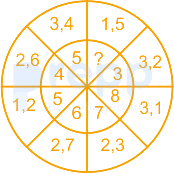
Assuming that the numbers in each of the following figures follow a similar pattern, select the option that can replace the question mark (?) in figure C.