
Scale of PMMC instrument is ______.
Understanding the Scale of a PMMC Instrument
A Permanent Magnet Moving Coil (PMMC) instrument is a type of analog measuring instrument used primarily for measuring DC current and voltage. Its operation is based on the principle that a current-carrying coil placed in a magnetic field experiences a force, which produces a deflecting torque.
Working Principle and Torque Equations
The core components of a PMMC instrument include a permanent magnet, a moving coil wound on a lightweight former, control springs, and a pointer mounted on the coil assembly.
When a current flows through the moving coil, it interacts with the magnetic field produced by the permanent magnet. This interaction generates a deflecting torque (\(T_d\)). The deflecting torque is directly proportional to the magnetic flux density (\(B\)), the number of turns in the coil (\(N\)), the area of the coil (\(A\)), and the current (\(I\)) flowing through the coil.
Mathematically, the deflecting torque is given by:
\[T_d = BINA\]
Since \(B\), \(N\), and \(A\) are constant for a given instrument, the deflecting torque is directly proportional to the current:
\[T_d \propto I\]
To control the movement of the coil and bring the pointer to rest at the correct reading, control springs are used. These springs provide a restoring or control torque (\(T_c\)) that opposes the deflecting torque. The control torque is proportional to the angle of deflection (\(\theta\)) of the coil:
\[T_c \propto \theta\]
Or, \[T_c = K\theta\] where \(K\) is the spring constant.
Equilibrium and Scale Uniformity
The coil and pointer assembly will deflect until the control torque balances the deflecting torque. At equilibrium, the net torque is zero:
\[T_d = T_c\]
Substituting the expressions for \(T_d\) and \(T_c\):
\[BINA = K\theta\]
Rearranging the equation to find the deflection angle (\(\theta\)):
\[\theta = \left(\frac{BNA}{K}\right) I\]
In this equation, \(B\), \(N\), \(A\), and \(K\) are constants for the instrument. Therefore, the deflection angle (\(\theta\)) is directly proportional to the current (\(I\)) flowing through the coil:
\[\theta \propto I\]
This linear relationship between the deflection angle and the measured current means that equal changes in current cause equal changes in deflection. Consequently, the scale markings on a PMMC instrument are spaced equally, resulting in a **uniform** scale.
Analyzing the Options
Let's look at the given options based on our understanding of the PMMC instrument's scale:
- Cubed: This would imply \(\theta \propto I^3\), which is not the case for a PMMC instrument.
- 4th power: This would imply \(\theta \propto I^4\), which is also not the case.
- Uniform: This implies \(\theta \propto I\), which matches our derivation for the PMMC instrument scale.
- Squared: This would imply \(\theta \propto I^2\), which is characteristic of instruments like dynamometer-type wattmeters or moving-iron instruments when measuring AC, but not a PMMC instrument measuring DC.
Based on the linear relationship between deflection and current (\(\theta \propto I\)), the scale of a PMMC instrument is uniform.
| Scale Type | Relationship (\(\theta\) vs \(I\)) | Example Instrument |
|---|---|---|
| Uniform (Linear) | \(\theta \propto I\) | PMMC (DC measurements) |
| Non-Uniform (Squared) | \(\theta \propto I^2\) | Moving Iron, Electrodynamometer (AC/DC measurements) |
Conclusion
The direct proportionality between the deflection angle and the current in a PMMC instrument leads to a linear spacing of scale divisions. Therefore, the scale of a PMMC instrument is uniform.
Revision Table: PMMC Instrument Scale
| Concept | Description |
|---|---|
| Working Principle | Current-carrying coil in magnetic field experiences torque. |
| Deflecting Torque (\(T_d\)) | Proportional to current (\(I\)). \(T_d \propto I\). |
| Control Torque (\(T_c\)) | Proportional to deflection angle (\(\theta\)). \(T_c \propto \theta\). |
| Equilibrium Condition | \(T_d = T_c\). |
| Relationship Derivation | \(I \propto \theta\). |
| Scale Type | Uniform (Linear). |
Additional Information on PMMC Instruments
PMMC instruments are widely used due to several advantages:
- High Sensitivity: Requires relatively small current for full-scale deflection.
- Low Power Consumption: Less power is drawn from the circuit under test.
- Uniform Scale: Easy to read accurately due to linear divisions.
- High Torque-to-Weight Ratio: Results in good damping and reduces friction errors.
- Accuracy: Generally provides high accuracy for DC measurements.
However, they also have limitations:
- DC Only: PMMC instruments measure only DC quantities. For AC measurements, a rectifier is needed, which can introduce errors.
- Susceptible to Temperature Changes: Changes in temperature can affect spring stiffness and magnetic field strength.
- Fragile Parts: The moving coil and suspension are delicate.
- Higher Cost: Generally more expensive than moving-iron instruments.
Understanding the characteristics of PMMC instruments, including their uniform scale, is fundamental in electrical measurements.
Similar Questions
Current is measured using:
Which of the following is not true with respect to the ammeter & voltmeter?
Which of the following devices is used for measuring the speed of DC machines?
How many wattmeter elements are needed at minimum to measure the power of a 3-phase circuit?
Which of the expressions is true for the balanced condition of the following wheatstone bridge?
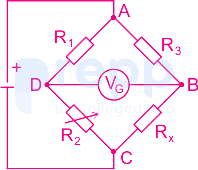
Wheatstone bridge can be used to measure ______.
Controlling Torque in megger is provided by:
High tonnage kettles are generally used in circulation lines with volumes up to _______?
A 60 microampere meter has a resistance of 100 ohms. If the meter has to measure 100 mA, then the value of current through the shunt is
Temperature control in bridge measurement is required because a difference in temperature will cause a difference in:
Important Questions from Measuring Instruments
Instrument used to measure temperature is ____________.
- The length of a sine bar is the distance between _______.
- What is the use of hermaphrodite caliper?
- The part of the universal surface gauge which helps to draw a parallel line along a datum edge is the _______.
- The number of threads per inch can be checked with a _______.



