Understanding Transport-Limited Slopes
The term "transport-limited" describes slopes where the rate at which weathered material can be moved downslope (transport) is the primary factor controlling the overall process. It means the slope's capacity to transport material is less than the rate at which material is being produced or could potentially be moved.
Process Rates on Limited Slopes
- Weathering: This is the process where rocks and minerals break down into smaller pieces or dissolve.
- Transport: This is the movement of weathered material downslope via processes like creep, slumping, or flow.
- Transport Limitation: When transport is limited, material may not be removed as quickly as it weathers.
Reasoning for Higher Weathering
On a transport-limited slope, the bottleneck is the removal of material. If weathering processes create debris faster than it can be transported away, the material effectively sits on the slope for longer periods.
- This prolonged exposure allows weathering more time to act on the material.
- Therefore, the relative rate or effectiveness of weathering increases compared to the rate of transport.
- While erosion and mass movement are related, the fundamental process driving the *availability* of material, under transport limitation, is often enhanced weathering or weathering appears higher relative to the slow removal rate.
Thus, on slopes limited by transport capacity, weathering is considered to be higher.
Similar Questions
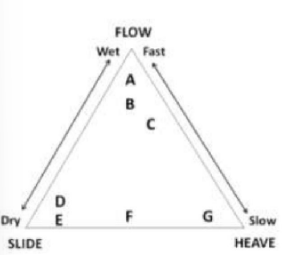
Study the diagram and identify the type of mass movement from the choice given below:
- Stream competence denotes the transport of sediment of
- Which one of the following geomorphological features is a proven crater created by meteorite impact?
- A depositional feature attached at one end to the mainland and backed by a lagoon or marshland is known as
- A relative sea level rise CANNOT result from the
Forming agent, landform and processes are given in columns A, B and C, respectively
A B C P Glacial Moraine Erosional Q Peri-glacial Horn Frost Heave R Glacio-fluvial Pingo Depositional S Glacial Kame Erosional
Identify the correct match
Important Questions from Geomorphology
- Match the following
A Evaporites O Ventifacts B Deflation P Desert varnish C Sandblasting Q Playa D Weathering R Desert pavement E Streamlined hills S Yardangs - Match List-I with List –II and select the correct answer using the codes given below the lists
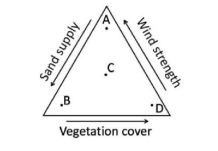
List-I List-II A Bajada P Aeolian B Dreikanter Q Desert C Karn R Glacial D Dolines S Karst Indentify the sand dune forms that are likely to develop
- If L=sediment load, $\text{D}_{50}$=median sediment size, $\bar{Q}$=mean discharge and S=slope then which one of the following relationships is correct?
- Unpaired non-cyclic river terraces are NOT associated with