Indentify the sand dune forms that are likely to develop 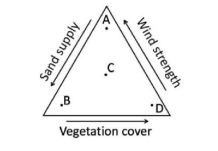
To identify the different forms of sand dunes likely to develop as indicated in the diagram, we need to consider the factors influencing their formation: sand supply, wind strength, and vegetation cover.
- Longitudinal Dunes (A):
These dunes form in areas with abundant sand supply and strong, consistent winds that blow in one direction. In the diagram, point A, where sand supply and wind strength are high, corresponds to longitudinal dunes.
- Transverse Dunes (B):
These occur in areas with a large sand supply and moderate winds, forming perpendicular to the wind direction. Point B represents regions with high sand supply and moderate wind strength.
- Parabolic Dunes (C):
These dunes typically form in areas with some vegetation cover that stabilizes parts of the sand, often found in coastal or humid regions. Point C, which shows some vegetation cover alongside sand supply, fits the profile for parabolic dunes.
- No Dunes (D):
In areas with significant vegetation cover or minimal sand supply, dunes are unlikely to form. Point D, with predominant vegetation cover, indicates a lack of dune formation.
The correct answer, therefore, corresponds to the option: A = Longitudinal, B = Transverse, C = Parabolic, D = No dunes.
Important Questions from Geomorphology
- Match the following
A Evaporites O Ventifacts B Deflation P Desert varnish C Sandblasting Q Playa D Weathering R Desert pavement E Streamlined hills S Yardangs - Match List-I with List –II and select the correct answer using the codes given below the lists
List-I List-II A Bajada P Aeolian B Dreikanter Q Desert C Karn R Glacial D Dolines S Karst - If L=sediment load, $\text{D}_{50}$=median sediment size, $\bar{Q}$=mean discharge and S=slope then which one of the following relationships is correct?
- Unpaired non-cyclic river terraces are NOT associated with
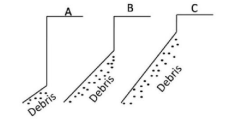
The diagrams given below show the influence of three types of cap rocks on cliffs in arid regions. Identify the correct answer.