Understanding Sediment Transport Variables
The question asks for the correct proportional relationship between four key variables in sediment transport:
- S: Represents the slope of the channel or riverbed.
- L: Represents the sediment load, which is the quantity of sediment transported.
- $\text{D}_{50}$: Represents the median sediment size, indicating the typical size of sediment particles.
- $\bar{Q}$: Represents the mean discharge, the average rate of water flow.
Deriving the Slope Relationship
The relationship between these variables can be understood by considering the factors influencing sediment movement:
- Sediment Load (L) and Size (D50): Transporting a larger amount of sediment (L) or larger sediment particles ($\text{D}_{50}$) generally requires more energy. This energy is often provided by the gravitational force component acting along the channel bed, which is directly related to the slope (S). Therefore, slope is expected to be directly proportional to both L and $\text{D}_{50}$.
- Mean Discharge ($\bar{Q}$): Discharge represents the water flow rate, which carries the energy needed to move sediment. A higher discharge ($\bar{Q}$) means more available energy for transport. For a given sediment load and size, a higher discharge can move the sediment even on a gentler slope. Conversely, a lower discharge requires a steeper slope to achieve the same sediment transport rate. Therefore, slope (S) is expected to be inversely proportional to discharge ($\bar{Q}$).
Combining these direct and inverse proportionalities, the relationship is expressed as:
Conclusion
Based on the analysis, the slope (S) increases with increasing sediment load (L) and median sediment size ($\text{D}_{50}$), while it decreases with increasing mean discharge ($\bar{Q}$). This leads to the relationship:
Important Questions from Geomorphology
- Match the following
A Evaporites O Ventifacts B Deflation P Desert varnish C Sandblasting Q Playa D Weathering R Desert pavement E Streamlined hills S Yardangs - Match List-I with List –II and select the correct answer using the codes given below the lists
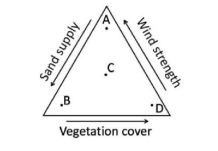
List-I List-II A Bajada P Aeolian B Dreikanter Q Desert C Karn R Glacial D Dolines S Karst Indentify the sand dune forms that are likely to develop
- Unpaired non-cyclic river terraces are NOT associated with
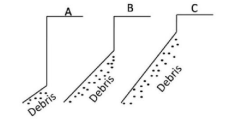
The diagrams given below show the influence of three types of cap rocks on cliffs in arid regions. Identify the correct answer.