
The diagrams given below show the influence of three types of cap rocks on cliffs in arid regions. Identify the correct answer.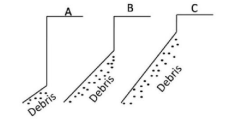
The given question involves understanding the influence of different types of cap rocks on cliffs in arid regions. Cap rocks are layers that determine the erosion rate of the structures underneath them.
Based on the diagram and options provided, let's analyze each type of cap rock:
- Resistant and thicker cap rock (A): This type of cap rock offers substantial protection to the underlying materials due to its thickness and resistance, resulting in less erosion and a steeper slope. In the diagram, this scenario aligns with the structure at A, where the steep cliff suggests minimal erosion.
- Resistant and thin cap rock (B): While resistant, the thin nature of this cap rock offers moderate protection, leading to a medium degree of erosion. In the diagram, this corresponds to B, where the slope is moderate.
- Weak cap rock (C): A weak cap rock allows for rapid erosion, resulting in a gentler slope as seen in typical arid environments. In the diagram, C represents this condition, showing a more gradual cliff.
Comparing these observations with the options provided, the correct match is:
A= resistant and thicker cap rock, B = resistant and thin cap rock, C = weak cap rock
This model accurately describes how the varying degrees of resistance and thickness in cap rocks influence cliff erosion and formation in arid regions. The resistant thick cap rock maintains a steep profile, while a thin or weak cap rock results in a more gentle slope.
Important Questions from Geomorphology
- Match the following
A Evaporites O Ventifacts B Deflation P Desert varnish C Sandblasting Q Playa D Weathering R Desert pavement E Streamlined hills S Yardangs - Match List-I with List –II and select the correct answer using the codes given below the lists
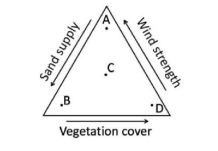
List-I List-II A Bajada P Aeolian B Dreikanter Q Desert C Karn R Glacial D Dolines S Karst Indentify the sand dune forms that are likely to develop
- If L=sediment load, $\text{D}_{50}$=median sediment size, $\bar{Q}$=mean discharge and S=slope then which one of the following relationships is correct?
- Unpaired non-cyclic river terraces are NOT associated with


