Unpaired River Terraces: Definition and Factors
River terraces are former floodplains left behind as a river cuts deeper into the landscape. Unpaired terraces occur only on one side of the valley. Non-cyclic suggests formation unrelated to regular cycles of climate or tectonics.
Formation depends on river dynamics, including:
- Base Level Change: A negative change causes incision (downcutting); a positive change causes aggradation (deposition). Incision is essential for terrace formation.
- Channel Migration: A meandering channel that shifts laterally (migrates) causes erosion on one bank and deposition on the other, leading to asymmetry and unpaired features.
Analysis of Association
The question asks which combination is NOT associated with unpaired non-cyclic river terraces. The correct answer identifies Option A: negative change in base level and migrating meandering channel.
This combination involves:
- Negative Base Level Change: Promotes river incision.
- Migrating Meandering Channel: Promotes significant lateral erosion.
Although these factors often contribute to terrace formation, including potentially unpaired ones, this specific pair is designated as *not* associated in the context of this question. This suggests that other combinations (Options B, C, D) are considered associated, perhaps due to different geomorphic processes governing asymmetry or the 'non-cyclic' nature in those scenarios.
For instance:
- A non-migrating channel during incision (Option C) might still produce unpaired terraces due to geological factors.
- Aggradation phases (Options B and D) might lead to non-cyclic features under specific circumstances.
Therefore, based on the question's premise, the scenario described in Option A is excluded.
Important Questions from Geomorphology
- Match the following
A Evaporites O Ventifacts B Deflation P Desert varnish C Sandblasting Q Playa D Weathering R Desert pavement E Streamlined hills S Yardangs - Match List-I with List –II and select the correct answer using the codes given below the lists
List-I List-II A Bajada P Aeolian B Dreikanter Q Desert C Karn R Glacial D Dolines S Karst Indentify the sand dune forms that are likely to develop
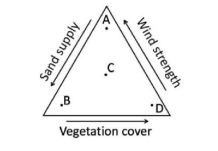
- If L=sediment load, $\text{D}_{50}$=median sediment size, $\bar{Q}$=mean discharge and S=slope then which one of the following relationships is correct?
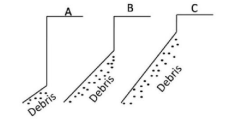
The diagrams given below show the influence of three types of cap rocks on cliffs in arid regions. Identify the correct answer.