Flux Richardson Number Definition
The Flux Richardson number (Rif) is a dimensionless number used in fluid dynamics to represent the ratio of forces acting on a fluid parcel.
Specifically, it compares the contribution of buoyancy to the contribution of mechanical forcing (like wind or stirring) in influencing fluid motion or turbulence.
Definition:
- Flux Richardson Number =
(Buoyant Production) / (Mechanical Production)
Where:
- Buoyant Production refers to the generation of kinetic energy (or turbulence) due to density differences (buoyancy).
- Mechanical Production refers to the generation of kinetic energy (or turbulence) due to mechanical stirring or shear forces.
A higher Flux Richardson number indicates that buoyancy forces are dominant, while a lower number suggests mechanical forces are more significant.
Similar Questions
- Conditional instability in the atmosphere is observed when
- In the atmospheric boundary layer
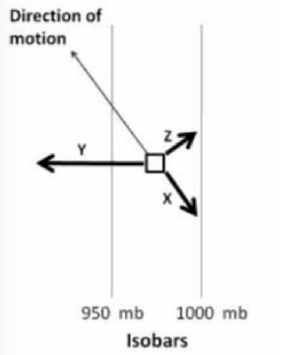
As wind in the lower atmosphere moves over the Earth's surface three forces X, Y and Z shown in the diagram operate on the air mass. If these forces are pressure gradient force (P), Frictional force (F) and Coriolis force (C), find the correct match
- What is the approximate change in pressure due to a height increase of 200 m in the atmosphere? (Assume air density = $1.0 \text{ kg/m}^3$, $g = 9.8 \text{ m/s}^2$)
- At what time of the day the near-surface air temperature will be the highest?
Important Questions from Physical Meteorology
- The maximum amount of water vapour which air can hold depends on
- Match the atmospheric optic phenomenon with the causative processes
A. Rainbows P. Refraction B. Mirage Q. Refraction and Reflection C. Corona R. Refraction, Reflection, Dispersion in ice crystals D. Halo S. Diffraction - The wavelength/colour at which solar radiation peaks is
- Which of the following is correct?
- Calculate the percentage change in the solar radiation incident on top of the Earth's atmosphere when the Earth is closest to the Sun, i.e., when the Earth - Sun distance is $147 \times 10^6 \text{ km}$. The mean distance is $149.6 \times 10^6 \text{ km}$.