Determining Highest Air Temperature Time
The near-surface air temperature is influenced by the continuous exchange of energy between the Earth's surface and the atmosphere. This exchange involves incoming solar radiation and outgoing longwave radiation.
Energy Balance and Air Temperature
The air temperature's progression throughout the day follows the net energy balance:
- Morning: After sunrise, incoming solar radiation begins to heat the surface and air. Temperature starts rising.
- Around Noon: Solar radiation is at its maximum intensity as the sun is highest. However, the ground and air are still accumulating heat.
- Mid-Afternoon: The air temperature reaches its peak. This occurs when the amount of incoming solar radiation effectively equals the amount of outgoing longwave radiation emitted by the surface. This balance point signifies that the rate of heating equals the rate of cooling, marking the maximum temperature achieved.
- Late Afternoon/Evening: As the sun lowers, incoming solar radiation decreases. Outgoing longwave radiation continues, leading to a net energy loss and falling air temperatures.
The condition described in option C, "When the incoming solar and outgoing longwave radiation balance each other," accurately represents the moment the air temperature reaches its highest point due to the cessation of net heating.
Similar Questions
- Flux Richardson number is ratio of
- Conditional instability in the atmosphere is observed when
- In the atmospheric boundary layer
As wind in the lower atmosphere moves over the Earth's surface three forces X, Y and Z shown in the diagram operate on the air mass. If these forces are pressure gradient force (P), Frictional force (F) and Coriolis force (C), find the correct match
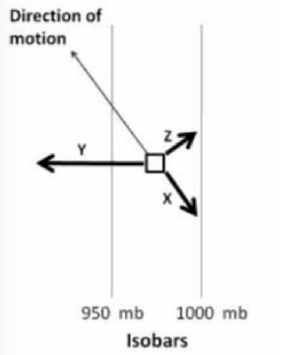
- What is the approximate change in pressure due to a height increase of 200 m in the atmosphere? (Assume air density = $1.0 \text{ kg/m}^3$, $g = 9.8 \text{ m/s}^2$)
Important Questions from Physical Meteorology
- The maximum amount of water vapour which air can hold depends on
- Match the atmospheric optic phenomenon with the causative processes
A. Rainbows P. Refraction B. Mirage Q. Refraction and Reflection C. Corona R. Refraction, Reflection, Dispersion in ice crystals D. Halo S. Diffraction - The wavelength/colour at which solar radiation peaks is
- Which of the following is correct?
- Calculate the percentage change in the solar radiation incident on top of the Earth's atmosphere when the Earth is closest to the Sun, i.e., when the Earth - Sun distance is $147 \times 10^6 \text{ km}$. The mean distance is $149.6 \times 10^6 \text{ km}$.