
Question
As wind in the lower atmosphere moves over the Earth's surface three forces X, Y and Z shown in the diagram operate on the air mass. If these forces are pressure gradient force (P), Frictional force (F) and Coriolis force (C), find the correct match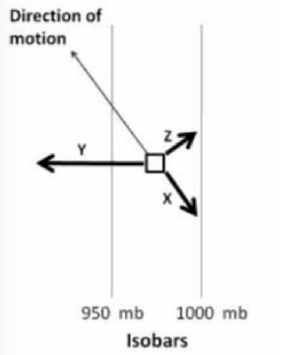
This question was previously asked in
CSIR NET 2019 Earth Science Question Paper (15-Dec-2019)
The correct answer is
X - F, Y - P, Z - C
To solve this problem, we need to correctly match the forces involved in wind movement in the lower atmosphere to the forces indicated by X, Y, and Z in the given diagram:
- In meteorology, the three main forces acting on an air mass in the lower atmosphere are the Pressure Gradient Force (P), Frictional Force (F), and Coriolis Force (C).
- The Pressure Gradient Force (PGF) is directed from high pressure to low pressure, perpendicular to isobars. In the diagram, force Y is directed from 1000 mb (higher pressure) to 950 mb (lower pressure), indicating the Pressure Gradient Force.
- The Coriolis Force is an apparent force due to the Earth's rotation, acting perpendicular to the velocity of the air. Force Z, acting to the right of the motion in the Northern Hemisphere, is consistent with the Coriolis Force.
- The Frictional Force acts opposite to the direction of motion, reducing speed. Thus, force X, opposite the direction of motion, represents the Frictional Force.
Based on this analysis, the correct match is:
- X - F (Frictional Force)
- Y - P (Pressure Gradient Force)
- Z - C (Coriolis Force)
Therefore, the correct option is: X - F, Y - P, Z - C
Was this answer helpful?
Similar Questions
- Flux Richardson number is ratio of
- Conditional instability in the atmosphere is observed when
- In the atmospheric boundary layer
- What is the approximate change in pressure due to a height increase of 200 m in the atmosphere? (Assume air density = $1.0 \text{ kg/m}^3$, $g = 9.8 \text{ m/s}^2$)
- At what time of the day the near-surface air temperature will be the highest?
Important Questions from Physical Meteorology
- The maximum amount of water vapour which air can hold depends on
- Match the atmospheric optic phenomenon with the causative processes
A. Rainbows P. Refraction B. Mirage Q. Refraction and Reflection C. Corona R. Refraction, Reflection, Dispersion in ice crystals D. Halo S. Diffraction - The wavelength/colour at which solar radiation peaks is
- Which of the following is correct?
- Calculate the percentage change in the solar radiation incident on top of the Earth's atmosphere when the Earth is closest to the Sun, i.e., when the Earth - Sun distance is $147 \times 10^6 \text{ km}$. The mean distance is $149.6 \times 10^6 \text{ km}$.
Need Expert Advice?
Test Series

Teaching
CSIR NET 2025 Mathematical Science Mock Test Series
47 Tests
523 Attempts
3.8(12)
English
More Questions from CSIR NET


