
Question
In the atmospheric boundary layer
This question was previously asked in
CSIR NET 2019 Earth Science Question Paper (15-Dec-2019)
The correct answer is
viscous force cannot be neglected
Atmospheric Boundary Layer Dynamics
The atmospheric boundary layer (ABL) is the layer of the atmosphere closest to the Earth's surface, directly affected by surface friction. Understanding the forces acting within this layer is key.
Force Considerations in the ABL
- Viscous Force: Due to friction with the Earth's surface, the air movement is slowed down. This frictional effect is represented by the viscous force. In the ABL, this force is significant and directly impacts wind speed and direction. Therefore, the viscous force cannot be neglected.
- Pressure Gradient Force: This force drives air from high pressure to low pressure areas and is fundamental to wind generation, both within and above the ABL. It is not negligible.
- Inertial Force: This includes forces like the Coriolis force, which becomes important for larger-scale motions. While its balance with other forces might change within the ABL (leading to an ageostrophic balance), it's generally not negligible in atmospheric dynamics.
- Gravitational Force: Primarily acts vertically and is typically balanced by buoyancy or vertical pressure gradients. It doesn't directly determine the horizontal wind dynamics in the same way other forces do, but it's always present.
Conclusion
Because of the direct influence of surface friction, the viscous force plays a crucial role in the dynamics of the atmospheric boundary layer and cannot be ignored when analyzing air motion within this layer.
Was this answer helpful?
Similar Questions
- Flux Richardson number is ratio of
- Conditional instability in the atmosphere is observed when
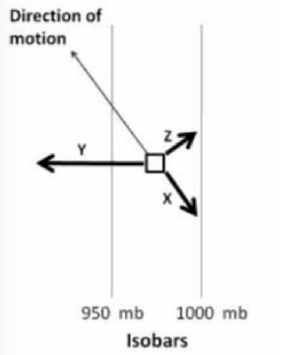
As wind in the lower atmosphere moves over the Earth's surface three forces X, Y and Z shown in the diagram operate on the air mass. If these forces are pressure gradient force (P), Frictional force (F) and Coriolis force (C), find the correct match
- What is the approximate change in pressure due to a height increase of 200 m in the atmosphere? (Assume air density = $1.0 \text{ kg/m}^3$, $g = 9.8 \text{ m/s}^2$)
- At what time of the day the near-surface air temperature will be the highest?
Important Questions from Physical Meteorology
- The maximum amount of water vapour which air can hold depends on
- Match the atmospheric optic phenomenon with the causative processes
A. Rainbows P. Refraction B. Mirage Q. Refraction and Reflection C. Corona R. Refraction, Reflection, Dispersion in ice crystals D. Halo S. Diffraction - The wavelength/colour at which solar radiation peaks is
- Which of the following is correct?
- Calculate the percentage change in the solar radiation incident on top of the Earth's atmosphere when the Earth is closest to the Sun, i.e., when the Earth - Sun distance is $147 \times 10^6 \text{ km}$. The mean distance is $149.6 \times 10^6 \text{ km}$.
Need Expert Advice?
Test Series

Teaching
CSIR NET 2025 Mathematical Science Mock Test Series
47 Tests
523 Attempts
3.8(12)
English
More Questions from CSIR NET


