An engineer is designing a feedback control system using a potentiometer transducer to measure angular position. What is the primary effect if a voltmeter with low resistance is connected to measure the potentiometer output?
It causes loading error, resulting in nonlinear output voltage relative to wiper position
A potentiometer transducer is a resistive displacement sensor. A fixed voltage is applied across the full resistance element, and a movable wiper taps off a fraction of that voltage proportional to angular position. Ideally the output voltage is a perfectly linear function of wiper position: Vout = Vs × (x/L), where x/L is the fractional travel of the wiper.
This linearity, however, assumes the measuring instrument draws zero current — i.e. it has infinite input resistance. When a voltmeter of low resistance Rm is connected across the output, this assumption breaks down:
- Rm appears in parallel with the lower portion of the potentiometer resistance (the part between the wiper and ground). Their parallel combination is smaller than the potentiometer section alone.
- The circuit is no longer a simple linear divider; the effective divider ratio now depends on wiper position in a nonlinear way. The distortion is worst near mid-travel and vanishes only at the two extreme ends.
- The measured voltage is always lower than the true tapped voltage. This deviation is called loading error, quantified by the loading factor (ratio of Rm to the potentiometer resistance Rp).
Hence the correct effect is loading error that produces a nonlinear output voltage relative to wiper position. A high-input-impedance voltmeter (or a buffer amplifier) draws negligible current and restores near-ideal linearity.
The other choices are wrong for concrete reasons. The idea that a low resistance maximizes sensitivity and accuracy is the opposite of the truth — loading degrades accuracy. Increased noise regardless of wiper position is not the primary loading phenomenon; loading is a deterministic, position-dependent error, not random noise. Reduced mechanical lifespan from excess current is a possible secondary heating concern in extreme cases, but it is not the primary measurement effect the question asks about, which is the distortion of the output characteristic.
Important Questions from Resistive Transducers
Flow can be measured by ____.
- Active strain gauges are connected in a half-bridge configuration to measure strain in a cantilever element. When powered by a voltage source of 10 V, the voltage at the output of the bridge is 1 mV. If the gauge factor is 2.5, the strain in the cantilever element is ________ microstrain.
- A wire-wound ‘resistive potentiometer type' angle sensor with 72 turns is used in an application. The first turn of the potentiometer is connected to ground while its last turn is connected to 3.6 V. The width of the wiper covers two turns ensuring make-before-break. The output (wiper) voltage when the wiper is on top of both the turns 35 and 36 is ________ V (rounded off to two decimal places).
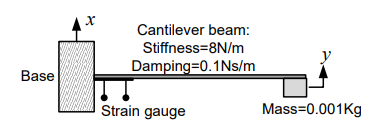
A strain gauge is attached on a cantilever beam as shown. If the base of the cantilever vibrates according to the equation \[ x(t) = \sin \omega_1 t + \sin \omega_2 t, \] where \(2~\text{rad/s} < \omega_1, \omega_2 < 3~\text{rad/s}\), then the output of the strain gauge is proportional to
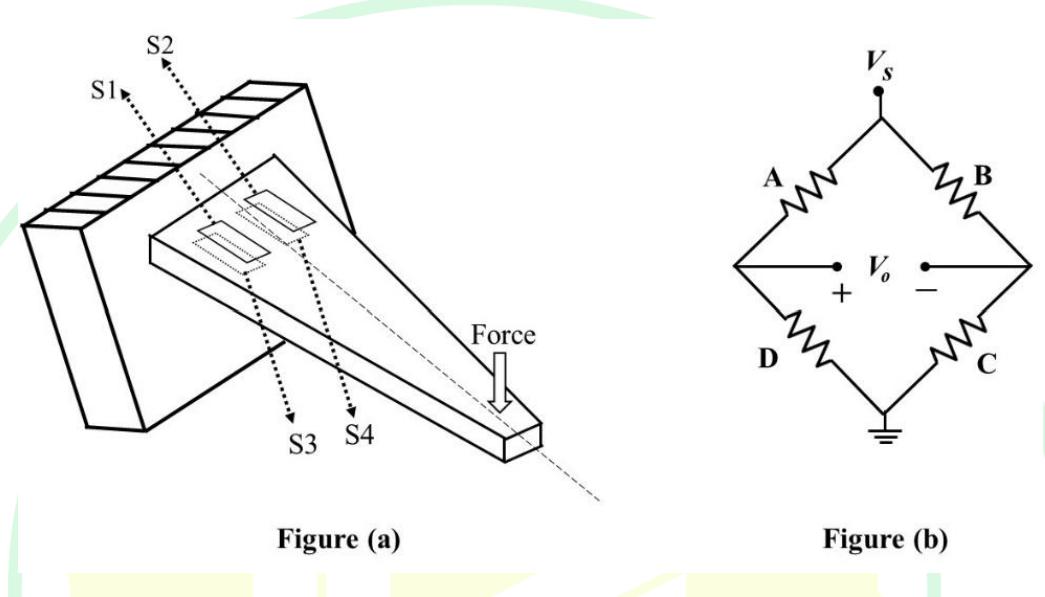
In the force transducer shown in Figure (a), four identical strain gauges S1, S2, S3, and S4 are mounted on a cantilever at equal distance from its base. S1 and S2 are mounted on the top surface and S3 and S4 are mounted on the bottom surface, as shown in the Figure (a). These strain gauges are to be connected to form a Wheatstone bridge consisting of four arms A, B, C, and D, as shown in the Figure (b). From the following options, the correct order to maximize the measurement sensitivity is