A strain gauge is attached on a cantilever beam as shown. If the base of the cantilever vibrates according to the equation \[ x(t) = \sin \omega_1 t + \sin \omega_2 t, \] where \(2~\text{rad/s} < \omega_1, \omega_2 < 3~\text{rad/s}\), then the output of the strain gauge is proportional to 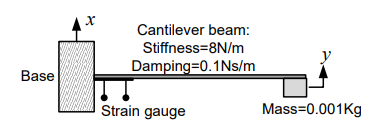
The question involves understanding the behavior of a cantilever beam with a strain gauge attached when the base vibrates. The equation given for the base vibration is:
x(t) = \sin \omega_1 t + \sin \omega_2 t
where 2~\text{rad/s} < \omega_1, \omega_2 < 3~\text{rad/s}.
The strain in the beam, detected by the strain gauge, is typically related to the bending of the beam. The strain is proportional to the second derivative of the displacement, which signifies the acceleration.
For a linear dynamic system like a cantilever beam, the relationship between strain and base motion can be understood by considering Hooke's law and beam dynamics.
- The displacement x(t) represents the motion of the base, and the response of the beam (bending) will depend on this motion.
- The strain gauge will detect changes in strain due to the bending of the beam, which is a result of the beam's acceleration.
- To find the acceleration, differentiate the displacement twice with respect to time:
The first derivative (velocity) is:
\frac{dx}{dt} = \omega_1 \cos \omega_1 t + \omega_2 \cos \omega_2 t
The second derivative (acceleration) is:
\frac{d^2x}{dt^2} = -\omega_1^2 \sin \omega_1 t - \omega_2^2 \sin \omega_2 t
- As the strain is most closely related to the acceleration of the beam, it indicates that the strain gauge output is proportional to \frac{d^2x}{dt^2}.
Thus, the correct answer is that the output of the strain gauge is proportional to the acceleration of the base, making the correct choice:
\frac{d^2x}{dt^2}
Important Questions from Resistive Transducers
Flow can be measured by ____.
- Active strain gauges are connected in a half-bridge configuration to measure strain in a cantilever element. When powered by a voltage source of 10 V, the voltage at the output of the bridge is 1 mV. If the gauge factor is 2.5, the strain in the cantilever element is ________ microstrain.
An engineer is designing a feedback control system using a potentiometer transducer to measure angular position. What is the primary effect if a voltmeter with low resistance is connected to measure the potentiometer output?
- A wire-wound ‘resistive potentiometer type' angle sensor with 72 turns is used in an application. The first turn of the potentiometer is connected to ground while its last turn is connected to 3.6 V. The width of the wiper covers two turns ensuring make-before-break. The output (wiper) voltage when the wiper is on top of both the turns 35 and 36 is ________ V (rounded off to two decimal places).
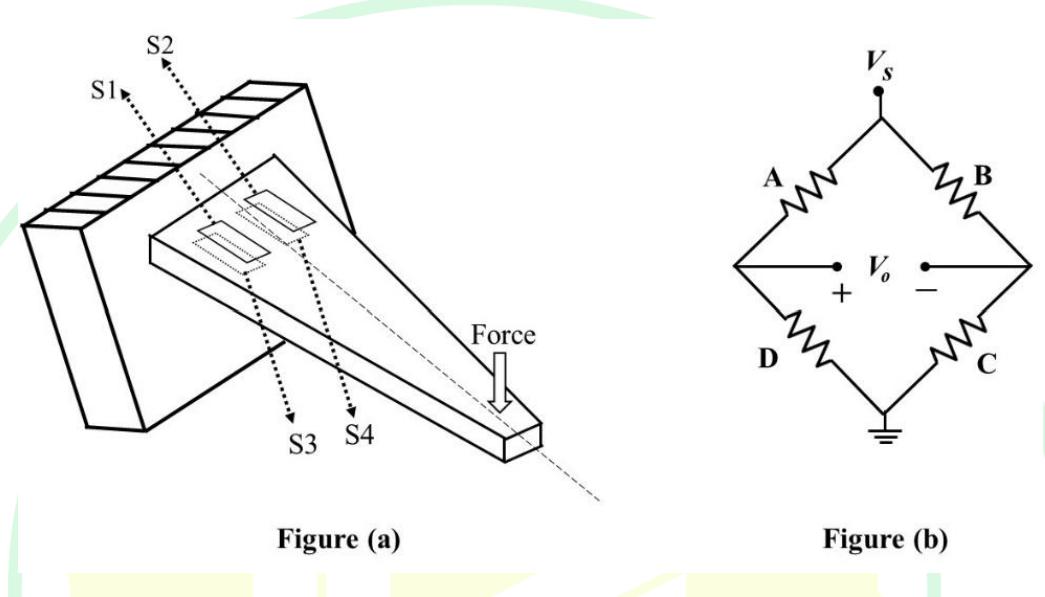
In the force transducer shown in Figure (a), four identical strain gauges S1, S2, S3, and S4 are mounted on a cantilever at equal distance from its base. S1 and S2 are mounted on the top surface and S3 and S4 are mounted on the bottom surface, as shown in the Figure (a). These strain gauges are to be connected to form a Wheatstone bridge consisting of four arms A, B, C, and D, as shown in the Figure (b). From the following options, the correct order to maximize the measurement sensitivity is