Flow can be measured by ____.
anemometer
Flow Measurement Devices Explained
Understanding how different physical quantities are measured is crucial in various fields, from engineering to meteorology. The question asks about devices used for flow measurement. Flow, in this context, typically refers to the movement of a fluid (liquid or gas). Let's explore the options provided to determine which one is used for this purpose.
Anemometer for Flow Measurement
An anemometer is a device specifically designed to measure wind speed or the velocity of gas flow. It is a common tool used in meteorology to measure wind conditions, but it also has applications in HVAC systems, aerodynamics, and environmental monitoring to measure airflow.
- Most common types include cup anemometers, vane anemometers, and hot-wire anemometers.
- Cup anemometers use rotating cups to catch the wind, and the speed of rotation is proportional to the wind speed.
- Hot-wire anemometers measure flow by detecting changes in resistance due to cooling of a heated wire by the fluid flow.
- Therefore, an anemometer is directly related to measuring flow.
Other Measurement Devices
Let's look at the other options and what they are typically used to measure:
-
Thermistor: A thermistor is a type of resistor whose resistance is strongly dependent on temperature. The word is a portmanteau of "thermal" and "resistor." They are widely used as temperature sensors or for current limiting. They do not directly measure flow.
Its resistance changes significantly with temperature, often following the relationship: $$R_T = R_0 e^{\beta \left( \frac{1}{T} - \frac{1}{T_0} \right)}$$ where \(R_T\) is resistance at temperature \(T\), \(R_0\) is resistance at reference temperature \(T_0\), and \(\beta\) is a material constant. - Strain Gauge: A strain gauge is a sensor whose resistance changes with applied force. It is used to measure strain in an object. When an object is subjected to an external force, it deforms, which is known as strain. The strain gauge converts this mechanical deformation into an electrical signal. It is not used for flow measurement.
- LVDT (Linear Variable Differential Transformer): An LVDT is an electromechanical transducer that converts the rectilinear motion of an object to which it is coupled into a corresponding electrical signal. LVDTs are primarily used for measuring displacement or position. They are highly accurate for linear motion but are not used for measuring the flow of fluids.
Conclusion on Flow Measurement
Based on the functions of each device, the anemometer is the correct instrument among the given options for measuring flow, particularly air or gas velocity. The other devices measure temperature, strain, and displacement, respectively.
Important Questions from Resistive Transducers
- Active strain gauges are connected in a half-bridge configuration to measure strain in a cantilever element. When powered by a voltage source of 10 V, the voltage at the output of the bridge is 1 mV. If the gauge factor is 2.5, the strain in the cantilever element is ________ microstrain.
An engineer is designing a feedback control system using a potentiometer transducer to measure angular position. What is the primary effect if a voltmeter with low resistance is connected to measure the potentiometer output?
- A wire-wound ‘resistive potentiometer type' angle sensor with 72 turns is used in an application. The first turn of the potentiometer is connected to ground while its last turn is connected to 3.6 V. The width of the wiper covers two turns ensuring make-before-break. The output (wiper) voltage when the wiper is on top of both the turns 35 and 36 is ________ V (rounded off to two decimal places).
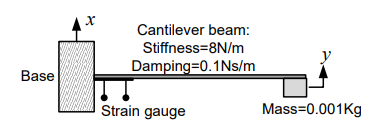
A strain gauge is attached on a cantilever beam as shown. If the base of the cantilever vibrates according to the equation \[ x(t) = \sin \omega_1 t + \sin \omega_2 t, \] where \(2~\text{rad/s} < \omega_1, \omega_2 < 3~\text{rad/s}\), then the output of the strain gauge is proportional to
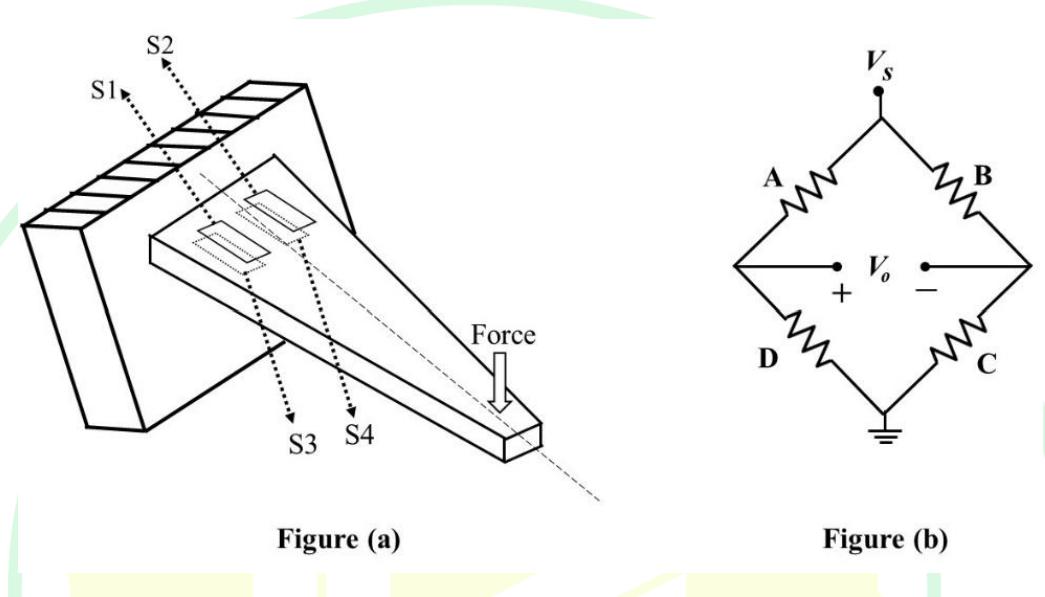
In the force transducer shown in Figure (a), four identical strain gauges S1, S2, S3, and S4 are mounted on a cantilever at equal distance from its base. S1 and S2 are mounted on the top surface and S3 and S4 are mounted on the bottom surface, as shown in the Figure (a). These strain gauges are to be connected to form a Wheatstone bridge consisting of four arms A, B, C, and D, as shown in the Figure (b). From the following options, the correct order to maximize the measurement sensitivity is