
In the following question below are given some statements followed by some conclusions based on those statements. Taking the given statements to be true even if they seem to be at variance from commonly known facts. Read all the conclusions and then decide which of the given conclusion logically follows the given statements. Statements: I. No P is Q. II. All B are Q. Conclusions: I. No P is B. II. Some Q are not P. III. Some B are not Q.
Both conclusions I and II follows
Logic Statements and Conclusions Analysis
This problem requires analyzing logical statements and determining which conclusions can be validly drawn from them. We are given two statements and three potential conclusions.
Understanding the Statements
Let's break down the given statements:
- Statement I: No P is Q.
This means that there is absolutely no overlap between the set of P and the set of Q. If something is P, it cannot be Q, and vice versa. Think of P and Q as completely separate groups. - Statement II: All B are Q.
This means that every single element belonging to the set of B is also an element of the set of Q. The set of B is entirely contained within the set of Q. Think of B as a smaller group inside the larger group of Q.
We are asked to assume these statements are true, even if they seem to contradict common knowledge.
Evaluating the Conclusions
Now let's evaluate each conclusion based on the truth of the statements.
Conclusion I: No P is B.
From Statement I, we know that P and Q have nothing in common. From Statement II, we know that all of B is part of Q. If B is entirely inside Q, and Q has no overlap with P, then B also cannot have any overlap with P. Therefore, 'No P is B' is a logical consequence of the statements.
This conclusion logically follows.
Conclusion II: Some Q are not P.
From Statement I, we know that 'No P is Q'. This is a very strong statement. It means that for every element in the set Q, that element is not in the set P. If 'all Q are not P' is true (which is what 'No P is Q' implies from the perspective of Q), then 'some Q are not P' must also be true. The word 'some' in logic means 'at least one'. If every element in Q is not P, then certainly at least one element in Q is not P.
This conclusion logically follows.
Conclusion III: Some B are not Q.
From Statement II, we are told that 'All B are Q'. This means that every single member of the group B is also a member of the group Q. If every B is a Q, it is impossible for 'some B' (meaning at least one B) to 'not be Q'. This conclusion directly contradicts Statement II.
This conclusion does not follow.
Summary of Conclusions
Based on the analysis:
- Conclusion I: No P is B - Follows
- Conclusion II: Some Q are not P - Follows
- Conclusion III: Some B are not Q - Does not follow
Therefore, both Conclusion I and Conclusion II logically follow from the given statements.
| Statement/Conclusion | Analysis | Logically Follows? |
|---|---|---|
| Statement I: No P is Q | P and Q are disjoint sets. | Given as true. |
| Statement II: All B are Q | B is a subset of Q. | Given as true. |
| Conclusion I: No P is B | Since B is in Q, and P is not in Q, P cannot be in B. | Yes |
| Conclusion II: Some Q are not P | Since no P is Q, all Q are not P. If all Q are not P, then some Q are not P. | Yes |
| Conclusion III: Some B are not Q | Statement II says All B are Q. This contradicts the conclusion. | No |
Revision Table: Key Concepts in Syllogism
| Term | Explanation | Example |
|---|---|---|
| Statement | A premise given as true for the purpose of the logic problem. | All dogs are mammals. |
| Conclusion | A sentence that is claimed to be true based on the given statements. | Therefore, my pet Spot is a mammal (if Spot is a dog). |
| Logically Follows | The conclusion is necessarily true if the statements are true. | If "All A are B" and "All B are C", then "All A are C" logically follows. |
| Categorical Proposition | A statement that relates two categories or classes. Types include All, No, Some, Some Not. | No cats are dogs. Some birds can fly. |
| Syllogism | A logical argument where a conclusion is derived from two or more statements. | The structure of the problem presented here. |
Additional Information on Logic and Syllogisms
This type of question is based on Syllogism, a form of logical reasoning. Syllogisms help test our ability to draw correct inferences from given information. Even if a statement like "All cars are birds" sounds strange in the real world, for the purpose of solving the logic puzzle, we must accept it as true and work from there.
Understanding the four basic types of categorical propositions is crucial:
- Universal Affirmative (All A are B): Every member of class A is a member of class B.
- Universal Negative (No A is B): No member of class A is a member of class B. A and B are disjoint.
- Particular Affirmative (Some A are B): At least one member of class A is a member of class B. There is some overlap.
- Particular Negative (Some A are not B): At least one member of class A is not a member of class B.
In this problem, Statement I is a Universal Negative ("No P is Q"), and Statement II is a Universal Affirmative ("All B are Q"). The conclusions are a Universal Negative ("No P is B") and two Particular statements ("Some Q are not P", "Some B are not Q").
Visualizing these relationships using Venn diagrams can often make the solution clearer, although it's not strictly required if you understand the logical implications of the statements.
Similar Questions
Select the correct mirror image of the given figure when the mirror is placed at AB as shown.
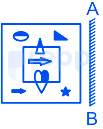
Select the correct combination of mathematical signs to sequentially replace the * signs and balance the given equation.
59 * 12 * 6 * 24 * 2 * 105
F + M means ‘F is the husband of M’
F ÷ M means ‘F is the daughter of M’
F − M means ‘F is the father of M’
F × M means ‘F is the mother of M’
If U + V × K – B, then how is U related to B?
Which of the following terms will replace the question mark (?) in the given series?
LKC KMD ? IQF HSG
In a certain code language, 'ABASE’ is coded as 'ZEZVD' and 'BANDS' is coded as 'EZQGV'. How will 'CABIN' be coded in that language?
Which number will replace the question mark (?) in the following series?
37, 39, ?, 242, 970, 4852
Select the set in which the numbers are related in the same way as are the numbers of the following set.
(NOTE: Operations should be performed on the whole numbers, without breaking down the numbers into its constituent digits.)
(2, 4, 18)
(1, 9, 50)
EGJM, GFLN, IENO, ?, MCRQ
If A ÷ B means that A is the brother of B, A × B means that A is the sister of B, A – B means that A is the father of B then which of the following expression shows that P is the father of R?
Select the set in which the numbers are related in the same way as are the numbers of the following sets.
(NOTE: Operations should be performed on the whole numbers, without breaking down the numbers into its constituent digits. E.g. 13 – Operations on 13 such as adding / subtracting / multiplying etc. to 13 can be performed. Breaking down 13 into 1 and 3 and then performing mathematical operations on 1 and 3 is not allowed)
(5, 35, 7)
(8, 32, 4)
Important Questions from Miscellaneous
Which event is marked as an Intangible Cultural Heritage of Humanity by UNESCO?
Who has been conferred with the rank of the Commander of the Order of the British Empire in 2018?
Who directead the film ‘Bhuvan Shome’?
The book “In my mother’s house” is written by _______
In which state is Vishwa Mitra Ka Tila situated?



